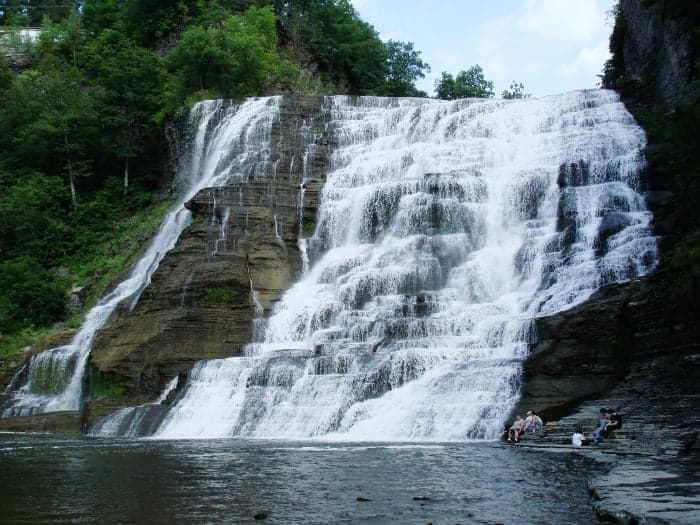
Photo: Wikipedia
Personal Sovereignty in Tompkins County
Moderate friction. Expect trade-offs in some aspect of personal liberty and independence.
What does Personal Sovereignty tell us?
Personal Sovereignty measures your capacity for self-reliance and independence with minimal government friction. Higher scores mean fewer barriers between you and the way you want to live... but it assumes you have the space you need and good neighbors.
What does this tell us?
Personal Sovereignty measures your capacity for self-reliance and independence with minimal government friction. Higher scores mean fewer barriers between you and the way you want to live... but it assumes you have the space you need and good neighbors.
State Policy
Energy independence: Importer (12% of energy produced in-state)
Personal Liberty
Homesteading

Personal Liberty Analysis
Tompkins County, anchored by Ithaca, presents a complex personal sovereignty environment where state-level mandates often override local preferences, creating a regulatory landscape that leans heavily interventionist compared to upstate rural counties. While the county offers some natural advantages for self-reliance—ample land, water resources, and a strong local food system—its tax burden, gun laws, and zoning codes are among the most restrictive in New York, making it a challenging fit for individuals and families prioritizing maximum personal autonomy. The autonomy picture varies significantly across the county: the City of Ithaca and its inner suburbs enforce the tightest controls, while outlying towns like Dryden, Caroline, and Danby offer more breathing room, though still within New York’s overarching legal framework.
Tax burden and regulatory posture in Tompkins County
New York State imposes the fourth-highest combined state and local tax burden in the nation, and Tompkins County is no exception. The county’s property tax rate averages roughly 2.3% of assessed home value, among the highest in upstate New York, with an additional county sales tax of 8% (4% state, 4% local). The Town of Ithaca and the City of Ithaca add their own layers: the city’s property tax rate is approximately 3.1% when combined with county and school levies, while outlying towns like Groton and Lansing see slightly lower effective rates near 2.0%. Regulatory posture is similarly dense: New York’s Climate Leadership and Community Protection Act (CLCPA) drives aggressive energy mandates, including a statewide ban on natural gas hookups in new construction starting in 2026, which Tompkins County has embraced through local building codes. The county’s Uniform Land Use Review (ULURP) process for subdivisions and commercial projects is lengthy and public-hearing-heavy, adding months to approvals. For a family seeking to build a home or start a small business, the permitting environment in Tompkins County is notably slower and more expensive than in neighboring counties like Schuyler or Chemung, where local governments are less staffed with environmental review boards.
Self-defense and gun law specifics in Tompkins County
New York’s Concealed Carry Improvement Act (CCIA), passed in 2022, makes Tompkins County one of the most restrictive jurisdictions for gun owners in the United States. The law requires a “proper cause” statement for a concealed carry permit—effectively a shall-issue system with a subjective “good moral character” clause—and bans firearms in a long list of “sensitive locations,” including parks, libraries, public transportation, and any place where alcohol is served. Tompkins County’s Sheriff’s Office processes permits with a typical wait time of 6–9 months, and the county’s pistol permit office is known for strict adherence to the state’s 16-hour training requirement and character reference checks. The City of Ithaca goes further: it has its own local ordinance banning firearms in city-owned buildings and parks, and the Ithaca Police Department is known for proactive enforcement of the CCIA. For a self-defense-minded individual, the practical reality is that carrying a firearm for personal protection in Tompkins County is legally burdensome and socially stigmatized, especially in Ithaca proper. Towns like Newfield and Enfield, with larger rural populations and fewer sensitive-location designations, offer slightly more practical carry options, but the state-level restrictions remain uniform. The county has no local gun show or private-sale exemption; all transfers must go through a licensed dealer with a background check.
Self-reliance and homesteading viability across Tompkins County
Homesteading and off-grid living are legally possible in Tompkins County but heavily constrained by zoning and building codes. The county’s minimum lot size for agricultural zoning is 5 acres in most rural areas, though towns like Caroline and Danby require 10 acres for new subdivisions. The City of Ithaca and the Town of Ithaca enforce a 1-acre minimum for single-family homes, effectively preventing small-scale homesteading within their borders. Off-grid systems face significant hurdles: New York’s Uniform Fire Prevention and Building Code requires all dwellings to be connected to a public sewer or an approved septic system, and solar panels must be grid-tied unless the property is more than 500 feet from a power line. Rainwater collection is legal but must be for non-potable uses only, and composting toilets are permitted only with a state-approved design. The county’s Right to Farm law protects agricultural operations from nuisance lawsuits, but it does not exempt small-scale homesteaders from zoning or health codes. For a family seeking true self-reliance—growing food, harvesting rainwater, generating off-grid power—the most viable locations are the far-flung towns of Dryden, Groton, and Lansing, where larger parcels (20+ acres) are available and enforcement of building codes is less aggressive than in Ithaca. Even there, the cost of compliance with state energy codes (e.g., required insulation R-values, air sealing) adds $10,000–$20,000 to a new home build compared to a less regulated state like Texas or Tennessee.
Personal liberties: parental rights, medical autonomy, speech, and property
Tompkins County’s personal liberties environment is shaped by New York’s progressive state laws, which often preempt local control. Parental rights are limited: New York’s Child Victims Act and Erin’s Law mandate that schools provide age-appropriate sexual health education, and parents cannot opt their children out of LGBTQ+-inclusive curriculum. The Ithaca City School District has a Gender Inclusion Policy that allows students to use preferred names and pronouns without parental notification, a policy that has drawn legal challenges from conservative groups. Medical autonomy is similarly constrained: New York’s vaccination mandates for school attendance (including COVID-19 for healthcare workers) are among the strictest nationally, and the state’s Physician-Assisted Suicide Act (2017) allows terminally ill adults to end their lives, but only with two physician approvals and a 15-day waiting period. Free speech is protected under the First Amendment, but Ithaca’s Hate Crime Enhancement ordinance allows for enhanced penalties for speech deemed to incite violence, and the city’s Public Assembly Permit requirement for gatherings of 50+ people on public property has been used to restrict political rallies. Property rights are the most constrained: New York’s rent stabilization laws apply to buildings with 6+ units built before 1974, and Tompkins County’s Agricultural District regulations limit the subdivision of farmland. For a property owner, the ability to build, renovate, or sell is heavily mediated by the county’s Environmental Review Board, which can delay projects for months over noise, traffic, or habitat concerns.
Overall, Tompkins County ranks among the least sovereignty-friendly areas in New York State for a conservative-leaning individual or family, comparable to Westchester or Albany County in regulatory density. The county’s tax burden, gun restrictions, and zoning codes create a high-compliance environment that rewards institutional knowledge and patience over self-reliance. For a reader prioritizing personal freedom, the most practical approach is to target the rural towns of Dryden, Caroline, Danby, or Groton, where enforcement is lighter and land is cheaper, while accepting that New York’s state-level mandates—on taxes, guns, education, and energy—will remain inescapable. The county’s strong local food system and abundant natural resources offer genuine self-sufficiency potential, but only for those willing to navigate a dense regulatory framework that is unlikely to loosen in the near term.

* Values derived from national, state, county, city and local statistics and may differ in a specific area. Last updated: 2026-07-16T01:02:28.000Z
Narrative content on this page is AI-generated and may contain mistakes. Verify any details that matter before acting on them.
ReloMaps may earn a commission from affiliate links at no extra cost to you.

