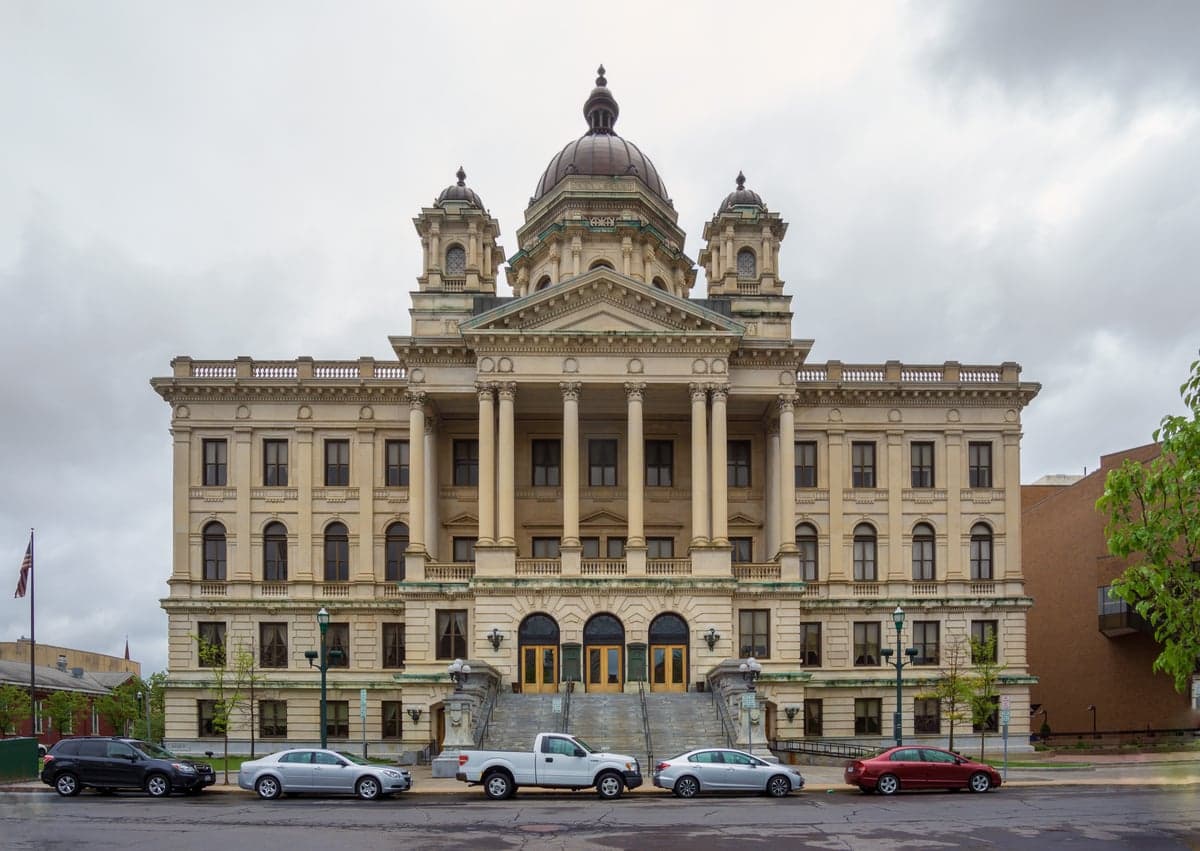
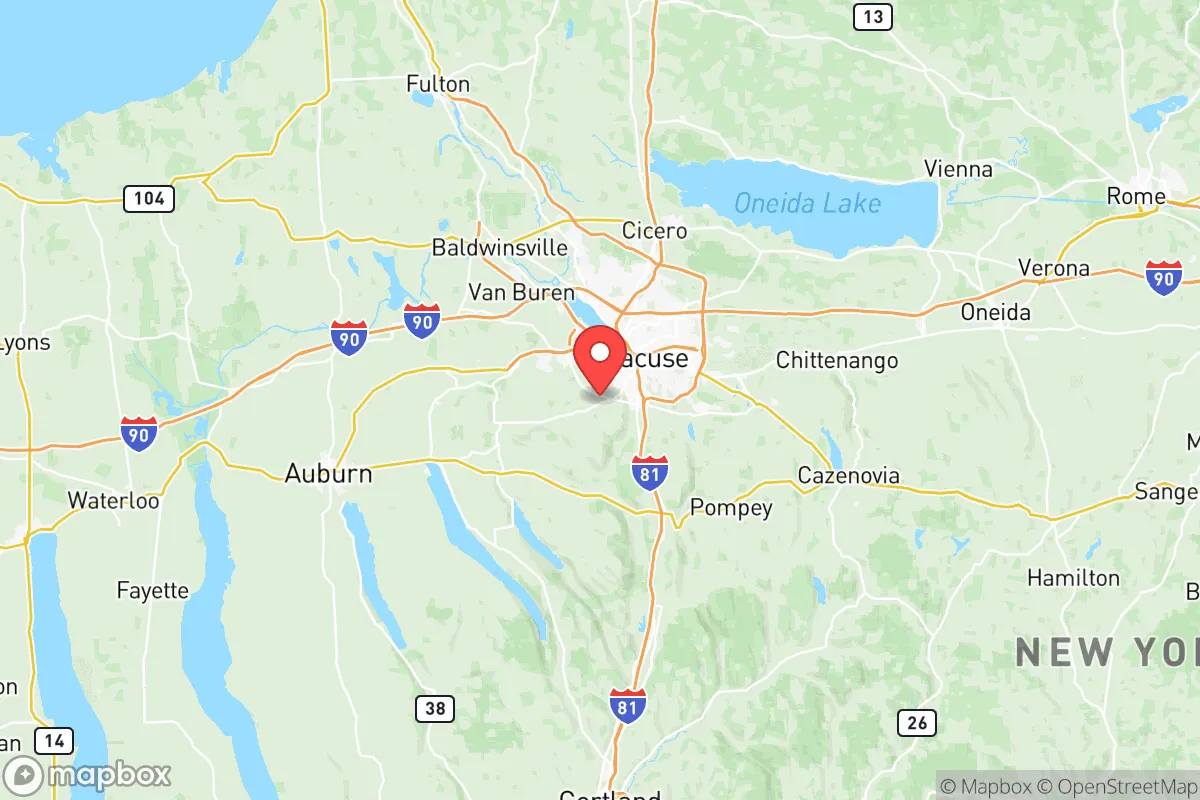
Photo: Wikipedia
Political ClimatePolitical Climate in Onondaga County
Showing district-level results — no local-only data available.
Local Political AnalysisPolitical Analysis of Onondaga County
Onondaga County, anchored by Syracuse, has a Cook PVI of D+4, meaning it leans about four points more Democratic than the nation as a whole — but that county-level number hides a deeply split landscape. The city of Syracuse itself is overwhelmingly blue, while the surrounding suburbs and rural towns shift the county's overall balance. Over the past decade, the Democratic lean has strengthened slightly in the city and inner suburbs, but the outer ring has moved right, making Onondaga a classic purple county that often decides local races by narrow margins.
How it compares
Compared to New York, NY — Manhattan and the boroughs — Onondaga County is noticeably more moderate and less uniformly liberal. In New York City, the Democratic vote share regularly exceeds 80% in many precincts, and Republican candidates rarely break 20% in general elections. Onondaga, by contrast, has real two-party competition. In the 2024 presidential race, for example, Syracuse's 15th Ward voted over 85% Democratic, while the town of Lysander in the northwestern part of the county went about 55% Republican. The town of DeWitt, just east of Syracuse, is a classic swing area: its precincts often split 50-50 or 52-48, making it a bellwether for countywide outcomes. The town of Camillus leans slightly red, while the village of Fayetteville inside DeWitt tilts blue. So unlike New York City's monolithic Democratic dominance, Onondaga offers a real mix — a conservative resident can find comfortable footing in the outer suburbs, while a liberal resident will feel at home in the city or the university neighborhoods near Syracuse University.
What this means for residents
For conservative residents, Onondaga County is not a hostile environment, but it does mean living in a place where local government — the county executive, the legislature, the city council — is usually controlled by Democrats. That translates to policies like higher property taxes in the city (around $30 per $1,000 of assessed value in Syracuse versus roughly $22 in the town of Clay) and more funding for public transit and social services. For liberal residents, the county's purple nature means that statewide progressive priorities — like the New York SAFE Act gun laws or the state's paid family leave program — are generally supported in Syracuse but often criticized in the county's more rural towns like Fabius or Tully. The practical effect is that local elections matter a lot here: the county legislature has flipped between Democratic and Republican control several times in the last 20 years, and the county executive race is always competitive.
Culturally, Onondaga County feels more like the rest of upstate New York than like New York City. The pace is slower, the cost of living is dramatically lower — median home price in Syracuse is around $150,000 versus over $1 million in Manhattan — and the political conversations are less ideological and more about potholes, school budgets, and economic development. The county is also home to the Onondaga Nation, whose sovereignty and land rights periodically become a political issue, something that has no parallel in New York City. For anyone moving from the city, the biggest adjustment isn't the politics themselves — it's that here, your vote actually has a chance to swing an election.

State Political ClimatePolitical Climate in New York
State Political AnalysisPolitical Environment in the State
New York State has been a solidly Democratic stronghold for decades, with no Republican presidential candidate winning its electoral votes since 1984. The state’s overall partisan lean is heavily blue, driven by the massive population centers of New York City and its immediate suburbs, but the political reality is far more nuanced than a simple party label. Over the last 10-20 years, the Democratic coalition has consolidated its power in Albany, while the rural and upstate regions have grown increasingly Republican, creating one of the most pronounced urban-rural divides in the nation. For a conservative-leaning relocator, the state presents a complex picture: you’ll find deep-blue policies in the capital, but also deeply red communities where those policies are resented and resisted.
Urban vs. rural divide
The political map of New York is a tale of two states. New York City’s five boroughs—Manhattan, Brooklyn, Queens, the Bronx, and Staten Island—along with the inner-ring suburbs of Westchester, Nassau, and Suffolk counties on Long Island, generate the vast majority of the state’s Democratic votes. In 2024, for example, New York City alone delivered roughly 2.2 million votes for Kamala Harris, effectively deciding the statewide outcome before the rest of the state even reported. Meanwhile, the vast expanse of upstate New York—from the Hudson Valley north to the Canadian border and west to Lake Erie—is a patchwork of red and purple counties. The "Blue Wall" of the city and its suburbs is countered by a "Red Wall" of rural counties like Wyoming, Orleans, and Allegany, which routinely vote 60-70% Republican. Some notable exceptions include the cities of Buffalo, Rochester, Syracuse, and Albany, which are Democratic-leaning islands in a sea of red, while suburbs like Erie County’s Clarence or Monroe County’s Penfield are more competitive. The divide is so stark that a resident in Manhattan and a resident in the Adirondack town of Saranac Lake effectively live under the same state laws but in entirely different political cultures.
Policy environment
New York’s policy environment is among the most progressive in the nation, reflecting the priorities of its dominant urban coalition. The state has a progressive income tax with rates up to 10.9% for top earners, and property taxes are among the highest in the country, particularly in the downstate suburbs. The regulatory posture is heavy: New York has strict rent control laws in New York City, a statewide ban on fracking, and some of the nation’s toughest environmental regulations. On education, the state funds public schools generously but also mandates a controversial "Foundation Aid" formula that critics say shortchanges upstate districts. Healthcare is dominated by the state’s Medicaid program, which covers roughly one in four New Yorkers, and the state has a robust public health infrastructure. Election laws are relatively liberal: no-excuse absentee voting was expanded during COVID and made permanent, and same-day voter registration is available. For a conservative, the policy environment can feel stifling, especially regarding taxes and business regulations, but it also provides a high level of public services and infrastructure that many residents value.
Recent policy direction
Over the past five years, New York has moved decisively left on a range of issues that matter deeply to relocators. On gun rights, the state passed the SAFE Act in 2013, which banned assault weapons and high-capacity magazines, and then the 2022 CCIA (Concealed Carry Improvement Act), which severely restricted where licensed gun owners can carry firearms, including "sensitive locations" like Times Square and public transit. This has been a flashpoint for upstate residents, who feel their Second Amendment rights are being trampled by downstate legislators. On parental and education rights, the state has moved toward a more progressive curriculum, including the adoption of "culturally responsive-sustaining education" frameworks and the expansion of gender-inclusive policies in schools, which has sparked heated debates in suburbs like Smithtown on Long Island and in the Rochester suburbs. On speech and privacy, New York has a strong shield law for journalists and a robust data privacy law, but it also has a hate crimes statute that some conservatives argue is applied unevenly. On medical and bodily autonomy, the state has enshrined abortion rights into law via the Reproductive Health Act of 2019 and has become a sanctuary for transgender individuals seeking gender-affirming care. Property rights are constrained by rent control and environmental regulations, while voting access has been expanded through early voting and automatic voter registration. The overall direction is clear: Albany is pushing a progressive agenda that is popular in the city but deeply unpopular in many upstate communities.
Civil unrest & political movements
New York has a long history of political activism, and recent years have seen both left- and right-wing movements flare up. The 2020 Black Lives Matter protests in New York City were among the largest in the nation, and the state responded with police reform legislation, including the repeal of 50-a, a law that had shielded police disciplinary records. On the right, the "Second Amendment Sanctuary" movement has gained traction in upstate counties like Chenango and Delaware, where local sheriffs have pledged not to enforce certain gun laws. Immigration politics are a major flashpoint: New York City is a sanctuary city, and the state has a "Green Light Law" that allows undocumented immigrants to obtain driver’s licenses, which has been a rallying cry for conservative activists. There have been periodic calls for upstate secession, with some rural counties floating the idea of breaking away to form a new state, though these remain largely symbolic. Election integrity controversies have simmered since 2020, with Republican-led counties demanding audits and expressing distrust in the state’s voting machines. A new resident will notice that political bumper stickers and yard signs are common, and local political meetings can be raucous affairs, especially in swing districts like the 19th Congressional District, which covers the Hudson Valley and Catskills.
Projection
Looking ahead 5-10 years, New York’s political trajectory is likely to see a continued divergence between the downstate Democratic machine and the upstate Republican resistance. Demographic trends suggest that New York City and its suburbs will continue to grow more diverse and progressive, while upstate will continue to lose population and age, deepening its conservative lean. In-migration from other states is limited, as New York has been a net loser in domestic migration for years, with many relocators heading to Florida, Texas, and the Carolinas. However, the state’s economy, anchored by finance, tech, and healthcare in the city, remains powerful, and the progressive policy environment is unlikely to be reversed without a major political realignment. For a conservative moving in now, the expectation should be that state-level policies will remain hostile to their preferences on guns, taxes, and education, but that local communities—especially in upstate counties like Livingston or Ontario—will continue to provide a cultural and political refuge. The practical reality is that you can live a conservative life in a red pocket of New York, but you will be fighting an uphill battle at the state level for the foreseeable future.
For a new resident, the bottom line is that New York offers a stark choice: live in a blue city or suburb where you’ll be in the political majority but face high taxes and progressive policies, or live in a red upstate community where you’ll share values with your neighbors but feel alienated from the state government. The state’s political climate is not monolithic, and a savvy relocator can find a community that fits their worldview, but they should be prepared for the reality that Albany’s priorities will often clash with their own. If you value low taxes, gun rights, and local control, you’ll need to look hard for a pocket of New York that works—and even then, you’ll be swimming against the current.
* Values derived from national, state, county, city and local statistics and may differ in a specific area. Last updated: 2026-06-17T14:34:23.000Z
Narrative content on this page is AI-generated and may contain mistakes. Verify any details that matter before acting on them.
ReloMaps may earn a commission from affiliate links at no extra cost to you.

