
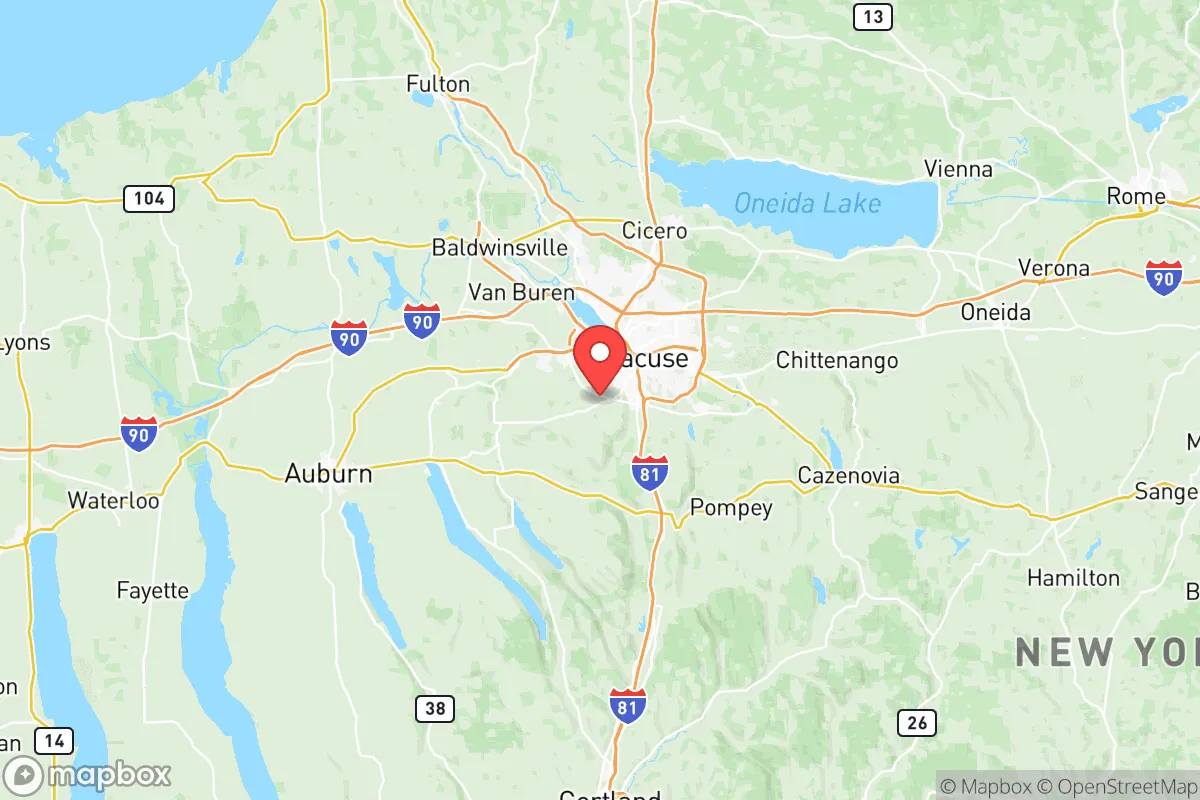
Photo: Wikipedia
Personal Sovereignty in Onondaga County
Moderate friction. Expect trade-offs in some aspect of personal liberty and independence.
What does Personal Sovereignty tell us?
Personal Sovereignty measures your capacity for self-reliance and independence with minimal government friction. Higher scores mean fewer barriers between you and the way you want to live... but it assumes you have the space you need and good neighbors.
What does this tell us?
Personal Sovereignty measures your capacity for self-reliance and independence with minimal government friction. Higher scores mean fewer barriers between you and the way you want to live... but it assumes you have the space you need and good neighbors.
State Policy
Energy independence: Importer (12% of energy produced in-state)
Personal Liberty
Homesteading

Personal Liberty Analysis
Onondaga County presents a mixed picture for those prioritizing personal sovereignty, where state-level regulatory density in New York often clashes with more localized traditions of self-reliance. While the county's urban core of Syracuse leans heavily into progressive governance, the surrounding towns and rural townships offer a noticeably different autonomy environment. For a conservative-leaning individual or family, the key is understanding that personal freedom in Onondaga County is highly zip-code dependent, with the most sovereignty-friendly conditions found in the outer ring communities like Fabius, Tully, and Lafayette, rather than within the Syracuse city limits or its immediate inner-ring suburbs.
Tax burden and regulatory posture across Onondaga County
New York State imposes one of the highest combined tax burdens in the nation, and Onondaga County residents feel this acutely. The county's property tax rate is above the national average, with the effective rate hovering around 2.5% of home value, though this varies significantly by municipality. Syracuse city residents face the highest combined city and county tax load, while towns like Camillus and Clay offer slightly lower rates due to more efficient local government structures. The regulatory posture in the county is heavily shaped by state mandates, particularly in environmental and land-use areas. The New York State Department of Environmental Conservation (DEC) maintains strict oversight on everything from septic systems to wetland buffers, which can frustrate those accustomed to lighter-touch governance found in states like Texas or Florida. However, towns such as Pompey and Otisco have more permissive local zoning boards compared to the stricter suburban codes in Dewitt and Manlius, where homeowners associations and village ordinances add another layer of regulation.
Self-defense rights and gun law specifics in Onondaga County
New York's firearm laws are among the most restrictive in the country, and Onondaga County operates fully within this framework. The county requires a pistol permit for handgun ownership, a process that involves background checks, character references, and a mandatory safety course. Since the 2022 Supreme Court decision in NYSRPA v. Bruen, the county has moved to a "shall-issue" system for concealed carry permits, but the application process remains more burdensome than in most other states. Open carry is effectively prohibited in New York, and the state's SAFE Act restricts magazine capacity to 10 rounds. Within Onondaga County, the sheriff's office in Syracuse processes permits with typical bureaucratic delays, while smaller towns like Fabius and Tully have a more streamlined, pro-Second Amendment culture among local law enforcement. The county does have a notable hunting and sport shooting tradition, with several private gun clubs and the Onondaga County Sportsmen's Federation actively advocating for firearm rights. However, anyone moving from a more permissive state should expect a significant adjustment in both legal requirements and cultural norms around self-defense.
Self-reliance and homesteading viability in Onondaga County's townships
For those seeking a self-reliant lifestyle, Onondaga County offers genuine opportunities, but they are concentrated in specific areas. The county's rural townships, particularly Lafayette, Otisco, and Pompey, feature agricultural zoning that permits keeping livestock, building barns, and maintaining substantial gardens on parcels as small as 2 to 5 acres. Minimum lot sizes in these townships typically range from 1 to 3 acres, providing enough space for a modest homestead without triggering extensive permitting. Off-grid living is legally challenging in New York due to strict building codes and health department requirements for septic systems and water wells. Completely disconnecting from the electrical grid is technically possible but requires navigating complex local permitting for solar arrays and backup generators, and the county health department mandates approved water and waste systems regardless of grid connection. Towns like Fabius and Tully have more lenient enforcement of nuisance ordinances, making them more viable for those who want to keep chickens, bees, or even a small number of goats. In contrast, suburban towns like Camillus and Clay have homeowners association restrictions and village codes that effectively prohibit most homesteading activities.
Personal liberties in Onondaga County: parental rights, medical autonomy, and property
On parental rights, Onondaga County operates under New York State's education mandates, which include comprehensive sex education requirements and vaccine mandates for school attendance. Parents in Fabius and Tully have more flexibility with homeschooling options, as the local school districts are generally more accommodating to alternative education plans compared to the larger Syracuse City School District. Medical autonomy is heavily constrained by state law, particularly regarding vaccine mandates for healthcare workers and school children, though the county's rural areas have a growing network of independent healthcare providers who offer more personalized care. Property rights are a mixed bag: while the county respects traditional property boundaries, the state's environmental regulations can restrict what owners can do with their land, especially near wetlands or waterways. Speech and assembly rights are fully protected under the First Amendment, and the county has seen active political discourse, with conservative groups meeting regularly in towns like Lafayette and Pompey. The county's more rural townships tend to have a "live and let live" culture that respects individual choices, while the urban core of Syracuse has more active code enforcement and community standards.
Overall, personal sovereignty in Onondaga County is a study in contrasts, where state-level restrictions create a baseline of regulatory density that is higher than in much of the South or Midwest, but local conditions vary dramatically. For those willing to locate in the county's outer townships like Fabius, Tully, Lafayette, or Otisco, the autonomy environment is noticeably better than in the urban core or inner suburbs. The trade-off is clear: you gain more space, lower density, and a more permissive local culture, but you still operate within New York's comprehensive state framework on taxes, firearms, and medical mandates. Compared to counties in Texas or Florida, Onondaga County will feel more regulated, but within the context of the Northeast, it offers some of the better opportunities for those seeking a self-reliant, freedom-oriented lifestyle if you choose your specific town wisely.

* Values derived from national, state, county, city and local statistics and may differ in a specific area. Last updated: 2026-06-17T14:34:23.000Z
Narrative content on this page is AI-generated and may contain mistakes. Verify any details that matter before acting on them.
ReloMaps may earn a commission from affiliate links at no extra cost to you.

