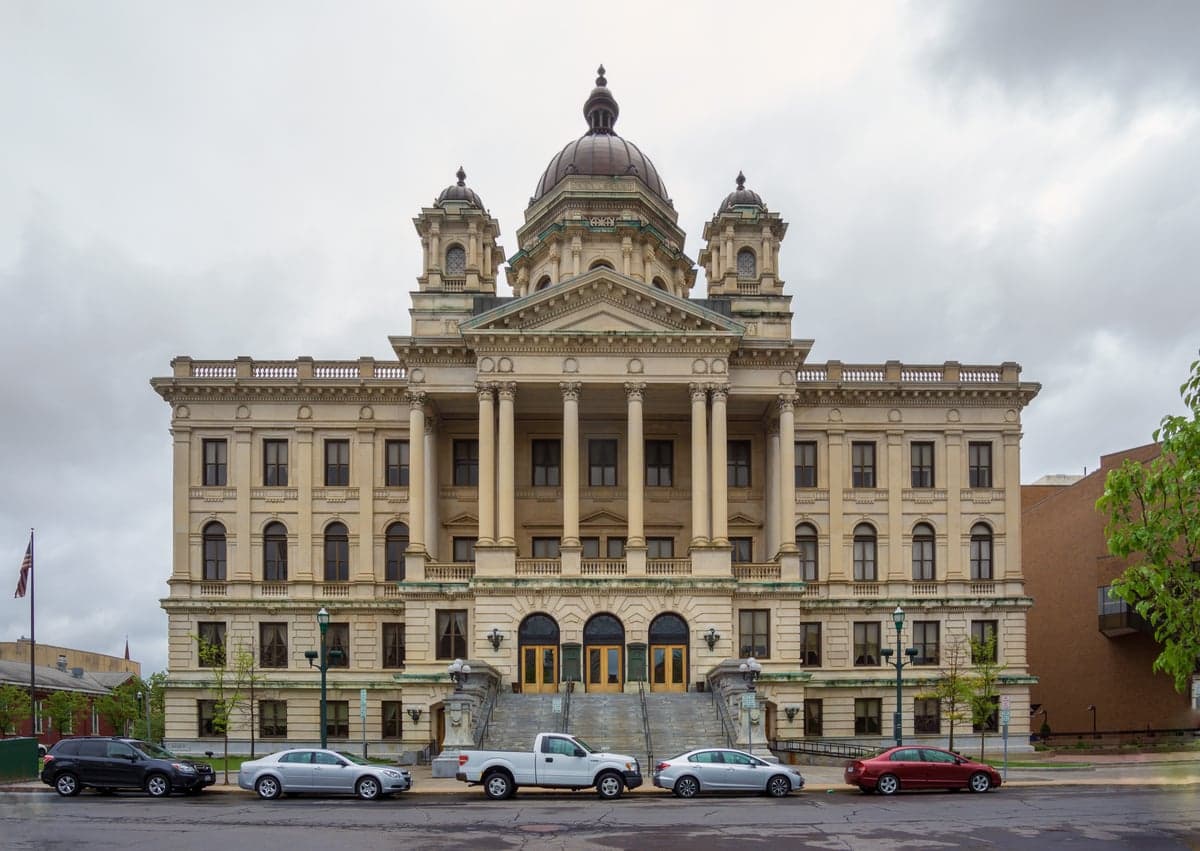
Photo: Wikipedia
Demographics of Onondaga County
Affluence Level in Onondaga County
A middle-class area roughly in line with national averages across income, home values, education, and employment.
People of Onondaga County
The people of Onondaga County, New York, today number 471,611, forming a metropolitan core that is predominantly white (74.6%) but increasingly diverse, with a Black population of 10.2%, a Hispanic population of 5.7%, and growing East/Southeast Asian (2.9%) and Indian-subcontinent (1.1%) communities. The county's character is shaped by its historic role as a Salt City industrial hub and a government and education anchor, anchored by the city of Syracuse. With a relatively low foreign-born share of 3.4% and a college-educated rate of 38.1%, the population is more settled and less immigrant-driven than many Northeast metros, but recent domestic and international arrivals are slowly reshaping its demographic profile. The county's identity remains rooted in its upstate New York heritage—pragmatic, union-friendly, and community-oriented—while suburban towns like Camillus, Clay, and Fayetteville absorb much of the growth.
Settlement & growth (pre-1960)
Long before European arrival, the region was the heartland of the Haudenosaunee Confederacy, specifically the Onondaga Nation, whose territory centered on what is now the city of Syracuse and the surrounding towns of Onondaga and LaFayette. The Onondaga were the "Keepers of the Central Fire" of the Iroquois League, and their presence remains legally and culturally significant today through the Onondaga Nation's sovereign territory south of Syracuse. European contact began with French Jesuit missionaries and fur traders in the 17th century, but sustained settlement did not begin until after the American Revolution, when the 1788 Treaty of Fort Stanwix and subsequent land cessions opened the region to Euro-American settlers.
The first major wave of American settlers arrived between the 1790s and 1820s, primarily Yankees from New England and eastern New York, drawn by the promise of fertile farmland and the salt springs near present-day Syracuse. The discovery of brine springs in the late 18th century sparked a salt industry that made Syracuse the nation's leading salt producer by the 1830s, attracting laborers and entrepreneurs. The Erie Canal, completed through the county in 1825, transformed Syracuse and the villages of Baldwinsville, Liverpool, and Manlius into bustling canal ports, funneling goods and people westward. Irish immigrants arrived in large numbers during the 1830s–1850s to dig the canal and work in the salt works, settling in Syracuse's near-west side and in the canal-side hamlets of Geddes and Solvay.
German immigrants followed in the 1840s–1860s, establishing farms in the towns of Clay, Cicero, and DeWitt, and forming a tight-knit community in Syracuse's North Side. The post-Civil War industrial boom brought waves of Italian immigrants (1880s–1910s), who concentrated in Syracuse's East Side and the village of East Syracuse, working in the city's growing manufacturing plants—typewriters, steel, and automotive parts. Polish and Eastern European immigrants arrived in the same period, settling in Syracuse's West Side and the industrial village of Solvay, where the Solvay Process Company (a chemical plant) employed generations of workers. By 1900, Syracuse was a classic immigrant industrial city, with distinct ethnic neighborhoods that persisted for decades.
The Great Migration of Black Americans from the South began during World War I and accelerated through the 1940s and 1950s, as Syracuse's manufacturing sector—General Electric, Carrier Corporation, and Chrysler—offered steady wartime and postwar jobs. Black migrants settled primarily in Syracuse's 15th Ward (near downtown) and later in the South Side and East Side neighborhoods. The county's population peaked in the 1950s at roughly 470,000, as suburbanization began pulling families into towns like Camillus, Liverpool, and Fayetteville, while the city of Syracuse itself started a long decline from its 1950 peak of 221,000 residents.
Modern era (post-1965)
The 1965 Hart-Cellar Act had a modest impact on Onondaga County compared to coastal metros, but it did open the door for new immigrant streams that have slowly diversified the population. The county's foreign-born share remains low at 3.4%, but the composition has shifted markedly. East/Southeast Asian communities—primarily Vietnamese, Chinese, and Korean—began arriving in the 1970s and 1980s, many as refugees or through family reunification, settling in Syracuse's East Side and the suburbs of DeWitt and Fayetteville. The Indian-subcontinent community (Indian, Pakistani, Bangladeshi) grew later, from the 1990s onward, drawn by professional opportunities at Syracuse University, Upstate Medical University, and the region's engineering and tech firms; they concentrate in the towns of DeWitt, Manlius, and Onondaga.
Hispanic population growth accelerated after 1990, driven by Puerto Rican migration (U.S. citizens) and, to a lesser extent, immigration from the Dominican Republic and Central America. The Hispanic community is centered in Syracuse's Near West Side and South Side, with growing numbers in the suburban towns of Clay and Cicero. The Black population, which grew through the Great Migration and subsequent decades, has stabilized at around 10.2%, with many families remaining in Syracuse's South Side and East Side, while a smaller but notable Black middle class has moved to suburbs like Clay and Liverpool.
Domestic migration patterns have been less favorable. Onondaga County, like much of Upstate New York, has experienced net domestic outmigration since the 1970s, as manufacturing jobs declined and younger residents moved to Sun Belt states. The county's population has been essentially flat for decades—hovering around 460,000–472,000—with natural increase (births minus deaths) barely offsetting outmigration. Suburbanization has continued, with the towns of Clay, Camillus, and Onondaga absorbing most of the growth, while the city of Syracuse has lost roughly a third of its peak population. The county's white population has aged and declined in share, from over 90% in 1970 to 74.6% today, while all minority groups have grown, albeit slowly.
The future
Onondaga County's population is projected to remain stable or decline slightly over the next 10–20 years, as the region's low birth rates and continued outmigration of young adults offset modest international immigration. The county is becoming more diverse, but at a slower pace than the national average. The Hispanic and East/Southeast Asian populations are expected to grow gradually, while the Indian-subcontinent community may expand more quickly if Syracuse University and the medical sector continue to recruit internationally. The Black population share is likely to remain steady, as outmigration of younger Black residents balances new arrivals.
Geographically, growth will continue to concentrate in the suburban towns of Clay, Cicero, and Onondaga, where new housing developments and commercial corridors attract families. The city of Syracuse may see a modest revival if downtown redevelopment and the I-81 viaduct replacement project succeed in drawing new residents, but the overall trend is toward a more dispersed, car-dependent county. The cultural identity of Onondaga County is evolving from a white-ethnic, industrial past toward a more multi-ethnic, service-and-education-based present, but the pace of change is slow enough that the county retains a distinctly upstate, small-city feel.
For someone moving in now, Onondaga County offers a stable, affordable, and relatively safe environment compared to larger metros, with a population that is gradually diversifying but remains predominantly white and native-born. The county's future is one of slow demographic churn rather than rapid transformation—a place where newcomers, whether from abroad or from other parts of the U.S., will find a community that is welcoming but not yet deeply multicultural. The bottom line: Onondaga County is a steady, middle-of-the-road upstate region where the population is aging and slowly diversifying, and where the best opportunities for new residents lie in the growing suburbs and the anchor institutions of Syracuse.

* Values derived from national, state, county, city and local statistics and may differ in a specific area. Last updated: 2026-06-17T14:34:23.000Z
Narrative content on this page is AI-generated and may contain mistakes. Verify any details that matter before acting on them.
ReloMaps may earn a commission from affiliate links at no extra cost to you.

