
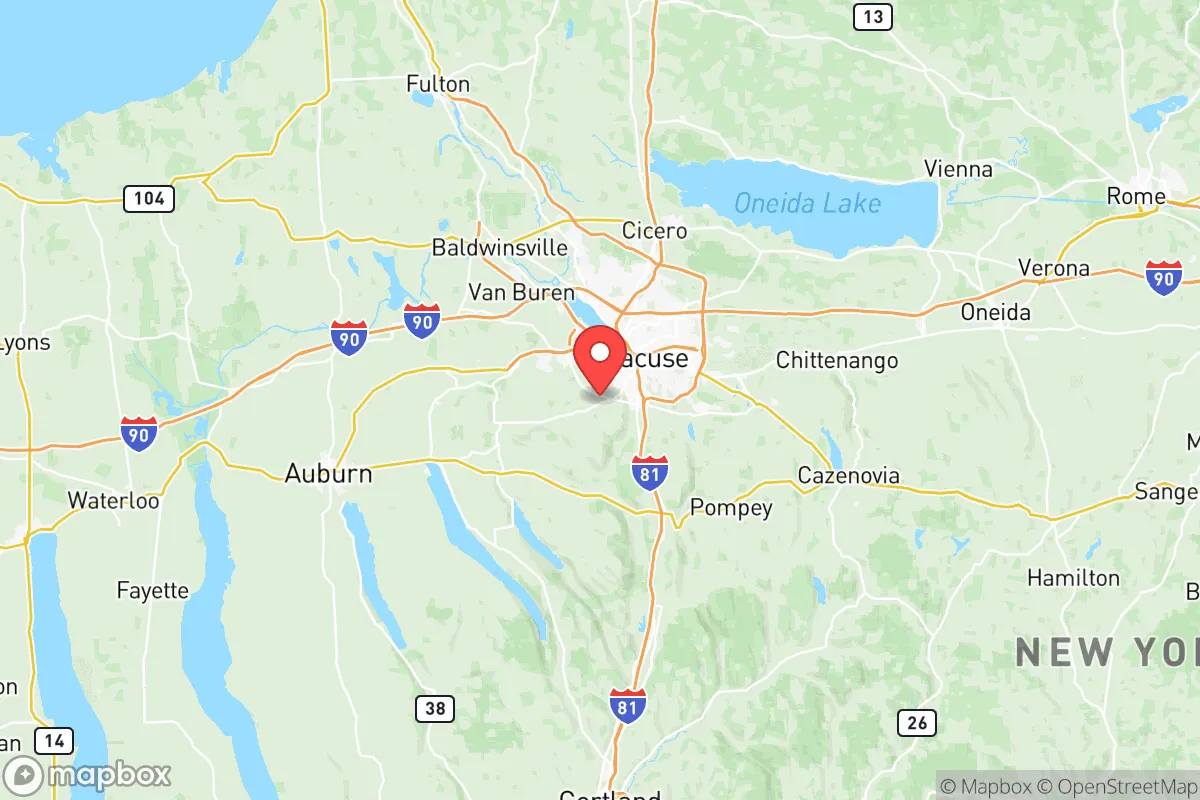
Photo: Wikipedia
Quality of Life in Onondaga County
A livable area that tracks near national norms for affordability, walkability, and neighborhood health.
What does Quality of Life tell us?
Quality of Life measures an area by evaluating factors like cost of living, nearby amenities, country club access, airport proximity, socioeconomic signals and neighborhood character. For large states, this is a general average — quality of life can vary dramatically between metro areas, suburbs, and rural communities within the same state.
What does this tell us?
Quality of Life measures an area by evaluating factors like cost of living, nearby amenities, country club access, airport proximity, socioeconomic signals and neighborhood character. For large states, this is a general average — quality of life can vary dramatically between metro areas, suburbs, and rural communities within the same state.
Cost of Living
19% below national average
141%
The Real Cost of Living in Onondaga County for 2026
| Tier | Individual | Family (4) |
|---|---|---|
| Survival | $17k | $32k |
| Comfortable | $36k | $53k |
| Luxury | $134k+ | $208k+ |
| Elite (Top 5%) | $158k+ | $245k+ |
Quality-of-Life Analysis
Onondaga County offers a broad quality-of-life spectrum, from the dense, walkable urban core of Syracuse to quiet, agricultural towns like Fabius and Tully in the southern hill towns. The county’s character shifts dramatically within a 30-minute drive, attracting a mix of professionals, students, families, and rural homesteaders. With a cost of living index of 81 (100 being the U.S. average), the county provides significant financial breathing room compared to national norms, though lifestyle options vary widely in housing stock, commute times, and access to amenities.
Largest town(s) & population centers
Syracuse is the county’s undisputed population and economic hub, home to roughly 145,000 residents. Daily life here is defined by a compact, grid-like layout, with neighborhoods ranging from the historic, tree-lined streets of the University Hill area (adjacent to Syracuse University and SUNY Upstate Medical) to the more suburban feel of the Strathmore and Sedgwick districts. The city offers a dense concentration of restaurants, cultural venues like the Everson Museum and Landmark Theatre, and the Destiny USA shopping complex. Outside the city, the suburbs of Clay (pop. ~60,000), DeWitt (pop. ~26,000), and Camillus (pop. ~24,000) form a ring of traditional suburban development. These towns feature large-lot single-family homes, regional shopping plazas, and highly-rated school districts like Jamesville-DeWitt and West Genesee. Commute times in these suburbs average near the county’s overall 20.3-minute average, making them practical for workers commuting into downtown Syracuse or the growing health-care and tech corridors along Interstate 690 and Route 481.
Smaller towns & rural pockets
Moving south from the urbanized lake plain, the landscape rises into rolling hills and farmland. Fabius and Tully, both in the southern part of the county, are classic rural hamlets with populations under 2,000. These towns offer a slower pace, with active volunteer fire departments, small-town fairs, and direct access to the Labrador Hollow Unique Area and Morgan Hill State Forest for hiking and snowmobiling. Marcellus (pop. ~6,200) and Skaneateles (pop. ~7,000) sit on the county’s western edge and are known for their historic village centers and lakefront properties. Skaneateles, in particular, draws a more affluent demographic, with a walkable village core along the northern tip of Skaneateles Lake. Further east, Manlius (pop. ~33,000) blends suburban development with preserved green spaces like the Great Swamp Conservancy, offering a middle ground between rural quiet and suburban convenience.
Cost & lifestyle range
The cost of living across Onondaga County is uniformly below the national average, but the range of housing options is wide. At the lower end, the city of Syracuse and the inner-ring suburb of Solvay offer median home values well below the county’s $185,300 median, with many starter homes and fixer-uppers available for under $100,000. Median rent in the county is $1,067, but in Syracuse’s University area, rents for a one-bedroom can dip below $800. At the higher end, Skaneateles and the lakefront portions of Onondaga Hill see median home values exceeding $350,000, with some lakefront properties surpassing $1 million. Property taxes in New York are high, but the county’s low home prices partially offset this. Lifestyle trade-offs are clear: city dwellers trade yard space for walkability and cultural access, while residents in Pompey or LaFayette gain acreage and privacy but face longer drives to grocery stores and employment centers. The county’s average commute of just over 20 minutes means even rural residents are rarely more than a half-hour from Syracuse’s hospitals, universities, and retail.
Onondaga County works best for people who want a low-cost, four-season base with genuine urban, suburban, and rural options within a short drive. Young professionals and students gravitate to Syracuse’s core, families fill the suburban towns of Clay and DeWitt, and retirees or remote workers often choose the lake villages or southern hill towns. The county’s affordability and geographic variety make it a practical choice for anyone seeking a balanced, low-stress lifestyle in Central New York.

Crime in Onondaga County
WARNING: The crime statistics are unreliable for this jurisdiction. Local authorities have either not reported or under reported their data to the FBI. This could be due to bad intentions, incompetence or technical issues. Regardless, we suggest skepticism.
Higher crime rates than 65% of comparable U.S. locations.
Violent CrimeViolent Crime Analysis
Property CrimeProperty Crime Analysis
Crime Analysis
Onondaga County, anchored by the city of Syracuse, presents a crime picture that is notably more dangerous than both New York State and national averages, driven primarily by concentrated violent crime in the city itself. The county's violent crime rate stands at 362.1 incidents per 100,000 residents, while property crime occurs at a rate of 1,536.7 per 100,000. These figures mask a stark urban-suburban divide, with the city of Syracuse shouldering the vast majority of serious offenses while surrounding towns like Camillus, Liverpool, and Manlius report significantly lower crime levels.
Crime in context
Onondaga County's violent crime rate of 362.1 per 100,000 is roughly 25% higher than the national average and more than double the New York State average, which is suppressed by low-crime upstate and downstate suburbs. Property crime in the county also exceeds state norms by a wide margin, though it tracks closer to the national figure. The disparity is almost entirely attributable to Syracuse, which consistently ranks among the most dangerous cities in New York for violent crime. The progressive policies of the Onondaga County District Attorney's office and local judges have drawn criticism for prioritizing offender rehabilitation over public safety, with critics pointing to high recidivism rates and a revolving-door justice system that keeps violent offenders on the streets. This ideological approach, while sympathetic to the circumstances of criminals, has tangible consequences for victims and law-abiding residents who face a greater risk of encountering repeat offenders.
What residents experience
For those living in the city of Syracuse, the experience of crime is often immediate and visible. Gun violence, aggravated assaults, and robberies are concentrated in neighborhoods on the city's North and South Sides, as well as parts of the Near West Side. Residents in these areas report frequent police presence, boarded-up properties, and a general sense of unease, particularly after dark. In contrast, suburban towns like Fayetteville, Baldwinsville, and Dewitt offer a dramatically different reality, with violent crime rates that are a fraction of the county average. Property crime, including theft and vehicle break-ins, is more evenly distributed but still tends to cluster near commercial corridors and transit hubs. The presence of Syracuse University in the University Hill neighborhood creates a unique dynamic, where student-oriented areas see elevated rates of theft and burglary but relatively low violent crime compared to the rest of the city.
Neighborhood-level variation within Onondaga County is extreme. The safest communities—such as Manlius, Camillus, and Lysander—routinely report violent crime rates below 100 per 100,000, making them comparable to the safest small towns in the Northeast. Meanwhile, the most dangerous census tracts in Syracuse exceed 1,500 violent crimes per 100,000, placing them among the most violent in the state. This geographic concentration means that a resident's safety is heavily determined by which side of the city line they live on. For prospective movers, the choice is clear: suburban towns offer a high degree of safety, while the city itself requires careful neighborhood selection and heightened awareness. The county's progressive criminal justice policies, which emphasize diversion programs and reduced sentencing, have done little to address the root causes of violence in Syracuse and have instead contributed to a perception that the system is soft on crime.
* Values derived from national, state, county, city and local statistics and may differ in a specific area. Last updated: 2026-06-17T14:34:23.000Z
Narrative content on this page is AI-generated and may contain mistakes. Verify any details that matter before acting on them.
ReloMaps may earn a commission from affiliate links at no extra cost to you.

