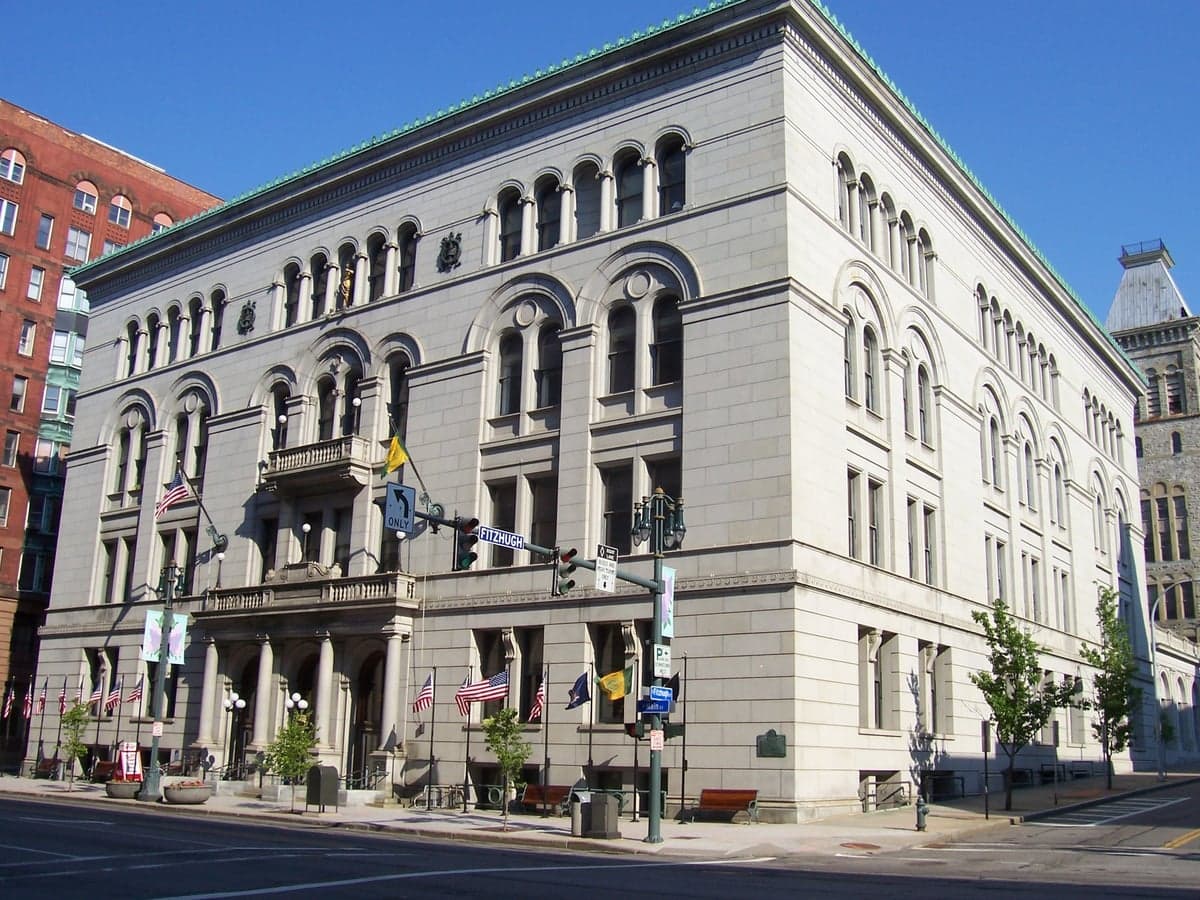
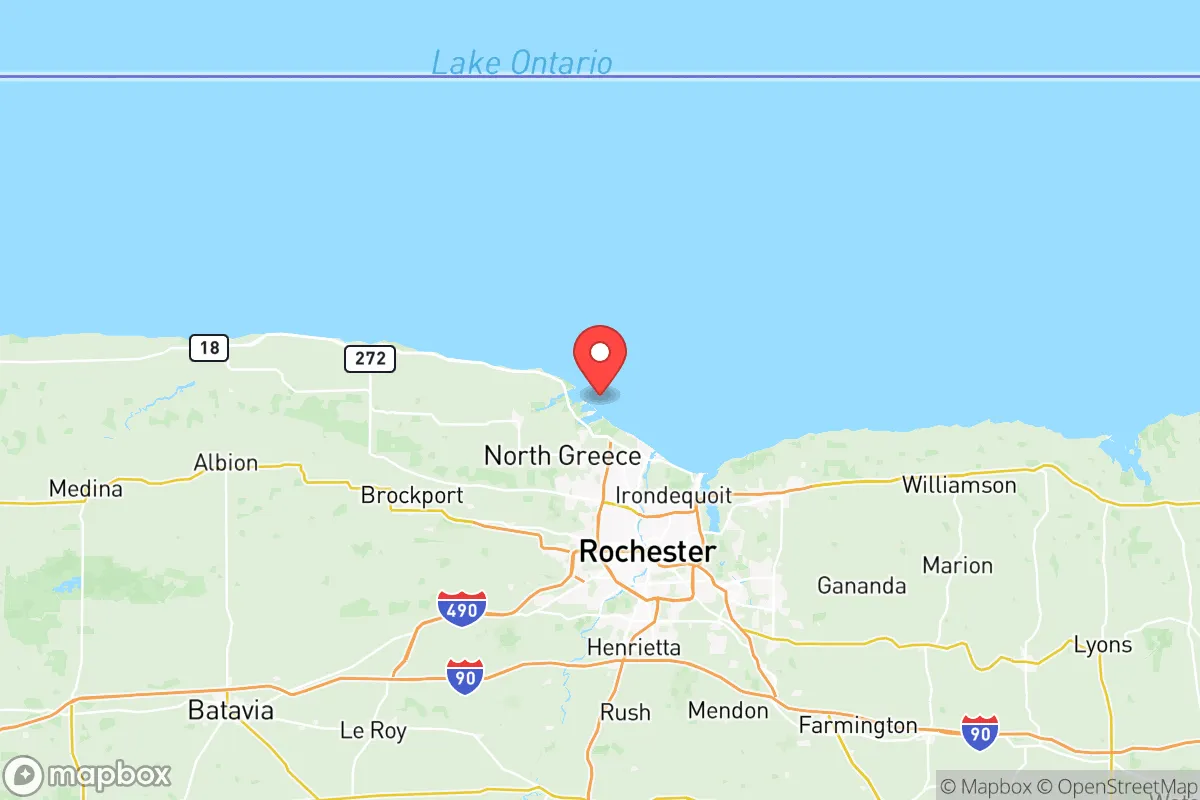
Photo: Wikipedia
Personal Sovereignty in Monroe County
Moderate friction. Expect trade-offs in some aspect of personal liberty and independence.
What does Personal Sovereignty tell us?
Personal Sovereignty measures your capacity for self-reliance and independence with minimal government friction. Higher scores mean fewer barriers between you and the way you want to live... but it assumes you have the space you need and good neighbors.
What does this tell us?
Personal Sovereignty measures your capacity for self-reliance and independence with minimal government friction. Higher scores mean fewer barriers between you and the way you want to live... but it assumes you have the space you need and good neighbors.
State Policy
Energy independence: Importer (12% of energy produced in-state)
Personal Liberty
Homesteading

Personal Liberty Analysis
Monroe County, New York, offers a more constrained personal sovereignty environment than much of the upstate region, primarily due to its location within the state’s dense regulatory framework and its mix of urban, suburban, and rural governance layers. While Rochester and its inner suburbs function under a relatively progressive local administration that tends to favor regulation, the county’s eastern and southern towns—such as Webster, Penfield, and Rush—display a more hands-off approach to property use and daily life. For a freedom-minded individual or family, the key question is not whether Monroe County feels libertarian (it does not, by state standards), but how well a specific town balances state-level constraints with local flexibility.
Tax burden and regulatory posture across Monroe County towns
New York State imposes one of the heaviest tax burdens in the nation, and Monroe County sits squarely within that reality. The combined county and town property tax rates vary significantly: Rochester city proper carries a rate of roughly $28 per $1,000 of assessed value, while towns like Pittsford and Brighton hover around $15 to $18 per $1,000, reflecting higher property values but still a notable levy. School taxes are the largest component, often exceeding $2,500 annually on a median home. Regulatory posture at the county level is moderate—permitting for home-based businesses is straightforward in most towns, but zoning in the urban core and first-ring suburbs (e.g., Irondequoit, Greece) restricts many commercial and agricultural uses. In contrast, towns like Rush and Mendon have more permissive agricultural and residential zoning, allowing accessory dwelling units and small-scale livestock operations with less red tape. Overall, the tax burden is high relative to southern and western states, but within New York, Monroe County is not the worst—that distinction belongs to counties like Westchester or Nassau. For a freedom-oriented relocator, the realistic trade-off is a higher cost of governance in exchange for robust public services and infrastructure that are not guaranteed in lower-tax regions.
Self-defense rights and gun law specifics in Monroe County
New York’s gun laws are among the most restrictive in the country, and Monroe County residents must comply with the statewide SAFE Act, which mandates universal background checks, a ban on "assault weapons" (defined by cosmetic features), and a pistol permit requirement that includes character references and a 6- to 12-month processing wait in most counties. Monroe County’s pistol permit office, located in the Hall of Justice in Rochester, historically issues permits with a "restricted" designation (carry only for hunting or target shooting) unless the applicant demonstrates a specific need—a policy that has become somewhat looser after the 2022 Supreme Court ruling in NYSRPA v. Bruen, which struck down the "proper cause" requirement. As of early 2025, the county is processing concealed carry permit applications under a "shall-issue" framework, but local sheriffs in towns like Webster and Greece have been more amenable to issuing unrestricted permits than the city-run process. For self-defense at home, ownership of handguns and long guns is legal with a permit; magazine capacity is capped at 10 rounds. The practical effect for a freedom-conscious individual is clear: any handgun ownership requires navigating a bureaucratic process that is slower and more invasive than in most of the country. Rifles and shotguns (non-"assault") remain readily available, but the culture of self-defense in Monroe County leans more toward home protection than open or daily carry. Residents of Rush and Mendon, where rural properties are common, tend to feel less friction than those in Rochester’s urban neighborhoods, where city ordinances can add further restrictions on discharge and storage.
Self-reliance and homesteading viability: lot sizes, zoning, and off-grid feasibility
Monroe County offers a spectrum of self-reliance opportunities, ranging from suburban backyard gardening in Pittsford to true rural homesteading in Rush, Mendon, and parts of Riga. Minimum lot sizes are a key constraint: in suburban towns like Henrietta and Greece, zoning typically requires 0.25 to 0.5 acres, which limits livestock and large-scale gardening. In contrast, Rush (town) mandates minimum lot sizes of 2 acres in its agricultural zones, while Mendon allows up to 5-acre parcels in rural-residential districts, making chicken coops, beekeeping, and even a few goats feasible without variance. Off-grid living—meaning no connection to municipal water, sewer, or electric—is technically possible in these outer towns, but New York State’s building code requires a permit for any dwelling, and the county health department mandates septic system approvals for wells. Solar installations require net metering agreements with RG&E, the dominant utility, and battery storage is allowed but subject to fire code. Composting toilets and rainwater catchment are legal but must meet health department standards for potable use. The biggest hurdle to complete self-reliance is the state’s property tax system, which imposes taxes on improvements even if the property is off-grid, making a truly self-sufficient homestead still a taxable asset. For a family serious about growing their own food and reducing utility dependency, towns like Rush and Mendon offer the best balance of permissive zoning and reasonable land prices (around $15,000–$25,000 per acre), compared to $50,000+ per acre in the suburbs. However, complete off-grid independence is rare here; most homesteaders still maintain a grid connection for backup and resale value.
Personal liberties: parental rights, medical autonomy, speech, and property
In Monroe County, personal liberties are shaped more by state law than local ordinance, leaving limited room for town-level variation. Parental rights in education are a sensitive and evolving area: following the 2023 New York law prohibiting school districts from disclosing a student’s gender identity or sexual orientation to parents without the child’s consent, towns like Webster and Penfield have seen local school board activism pushing for opt-out policies, though the state mandate holds. Medical autonomy is constrained by New York’s universal vaccine mandates for schoolchildren (including COVID-19, though that was not added to the list) and its strict telemedicine laws for controlled substances; parental choice in medical decisions for minors remains subject to state child welfare oversight. Free speech is protected under the First Amendment, but local noise ordinances and permitting for public gatherings in Rochester’s city parks have been points of friction for political demonstrations. Property rights are robust for existing owners—eminent domain is rarely used—but new development faces state environmental review (SEQRA) and local planning board approval, which can delay building permits by months, especially in suburban towns like Brighton and Greece. In Rush and Mendon, the review process is faster, often taking 4–6 weeks for standard residential projects. Overall, personal liberties in Monroe County are comparable to other New York suburbs: high in day-to-day speech and association, but constrained in education, medical decisions, and property development by state-level mandates that local governments cannot override.
Compared to other parts of New York, Monroe County sits in the middle of the liberty spectrum—more permissive than downstate counties like Westchester or Nassau (where taxes and gun restrictions are even tighter), but less so than rural upstate counties like Wyoming or Livingston, where zoning is lighter and pistol permits are issued faster. For a freedom-oriented relocator, the best strategy is to target outer towns like Rush, Mendon, or Riga for a blend of lower property taxes (relative to the city), permissive rural zoning, and a gun culture that is more DIY than bureaucratic. The county’s overall sovereignty is moderate—it will not disappoint those who understand New York’s regulatory baseline, but it will frustrate anyone expecting a wide-open frontier.

* Values derived from national, state, county, city and local statistics and may differ in a specific area. Last updated: 2026-06-29T00:14:24.000Z
Narrative content on this page is AI-generated and may contain mistakes. Verify any details that matter before acting on them.
ReloMaps may earn a commission from affiliate links at no extra cost to you.

