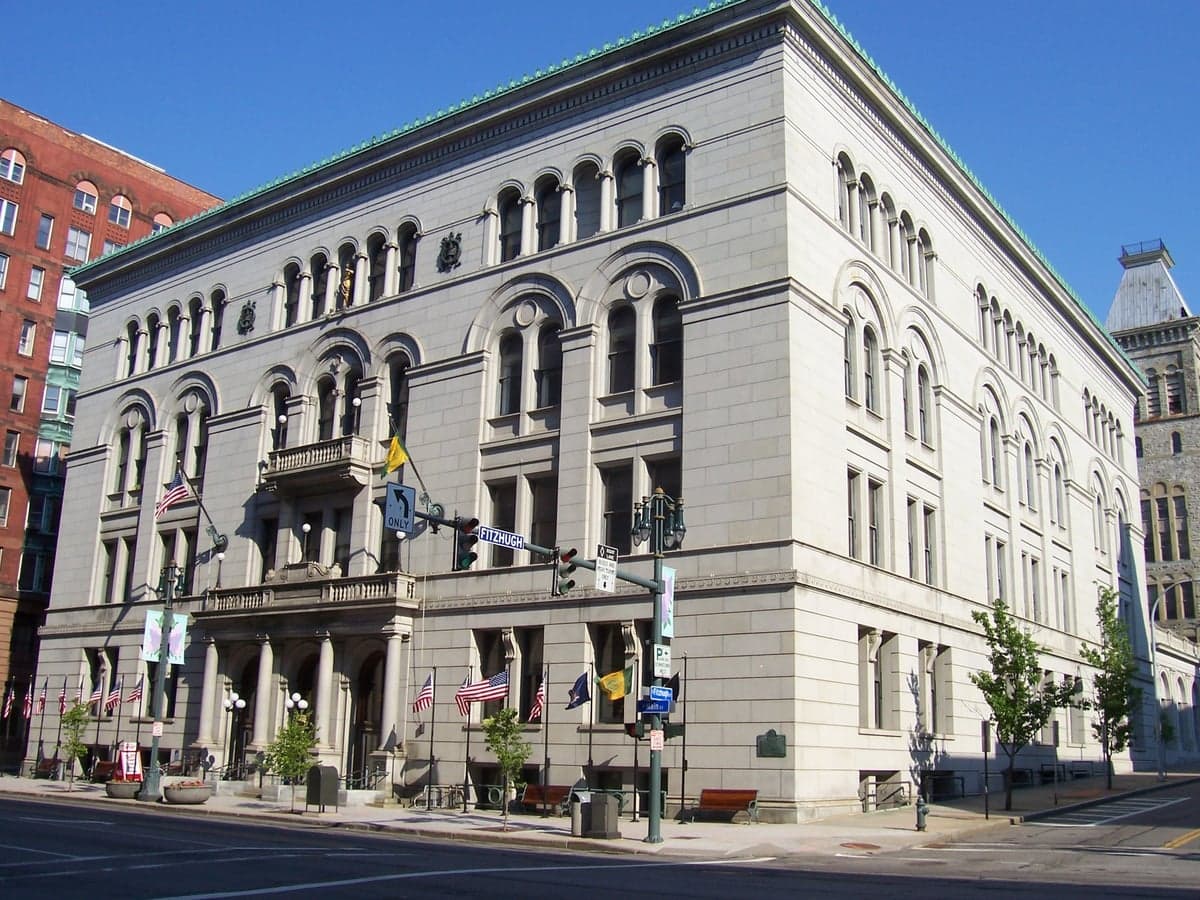
Photo: Wikipedia
Demographics of Monroe County
Affluence Level in Monroe County
A middle-class area roughly in line with national averages across income, home values, education, and employment.
People of Monroe County
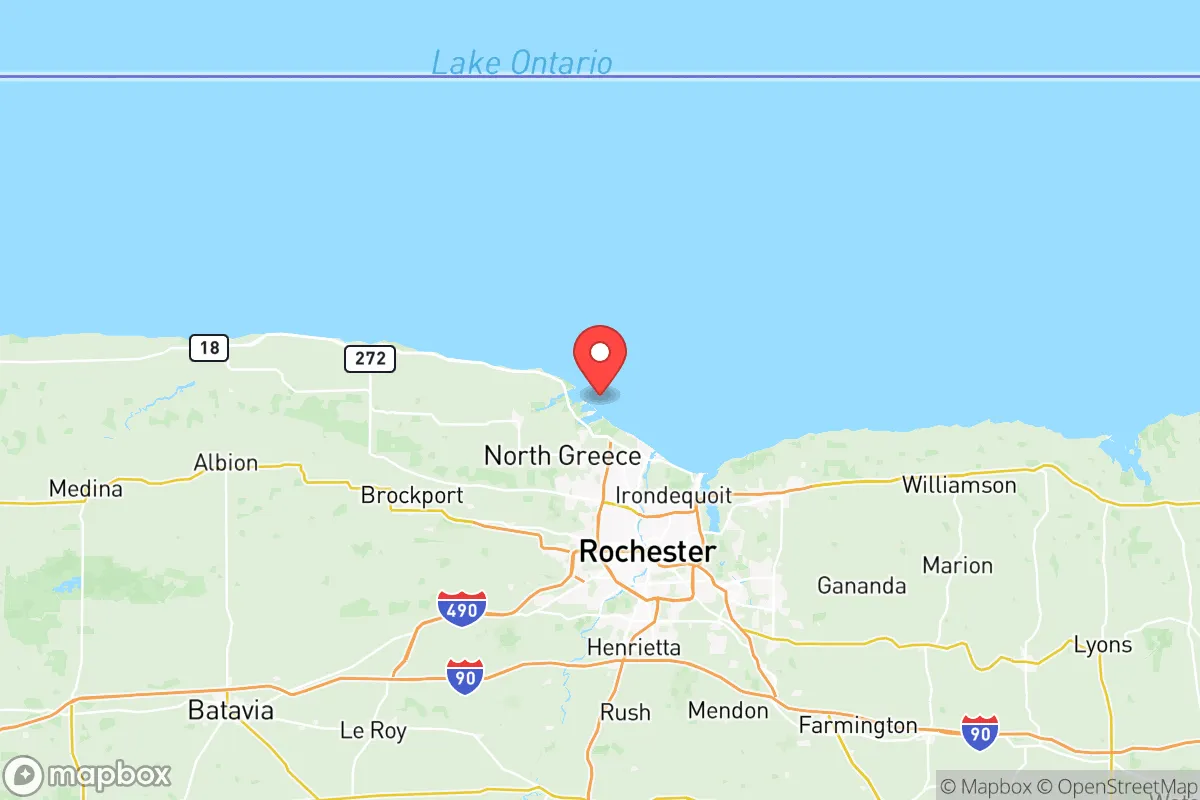
Monroe County, New York, is home to roughly 754,000 residents, making it the third most populous county in the state outside of New York City. Its population is predominantly white (68.4%) but is notably more diverse than the surrounding Finger Lakes region, with a significant Black community (13.8%) and a growing Hispanic population (9.8%). The county’s identity is shaped by its history as a manufacturing and transportation hub, anchored by the city of Rochester, and its evolution into a center for optics, imaging, and higher education, giving it a character that is both industrially grounded and increasingly professional.
Settlement & growth (pre-1960)
Before European settlement, the region was the domain of the Seneca Nation, one of the five nations of the Iroquois Confederacy, who controlled the Genesee River valley and its fertile lands. French explorers and missionaries passed through in the 17th century, but sustained European settlement did not begin until after the American Revolution. The Phelps and Gorham Purchase of 1788 opened the area to New Englanders—primarily from Massachusetts and Connecticut—who were the first wave of settlers. These Yankees founded the towns of Pittsford (1789) and Henrietta (1790), establishing a rural, Protestant, and commercially minded society along the Genesee River.
The completion of the Erie Canal through the county in 1823 transformed the region. The canal made Rochester a boomtown, nicknamed the "Flour City" for its massive grain-milling industry. This period attracted a second wave: Irish immigrants fleeing the Great Famine in the 1840s and 1850s. They settled in Rochester’s Corn Hill neighborhood and along the canal corridor, providing labor for the mills, the canal itself, and the growing railroad network. By 1855, one in five Rochester residents was Irish-born.
German immigrants arrived in large numbers from the 1840s through the 1880s, drawn by the region’s agricultural land and industrial jobs. They concentrated in Irondequoit and the northeastern parts of Rochester, establishing breweries, churches, and tight-knit communities. The Germans were followed by Italian immigrants (1890s–1920s), who settled in Rochester’s Lyell Avenue and Joseph Avenue neighborhoods, working in construction, the garment industry, and the city’s burgeoning optical shops. Eastern European Jews, fleeing pogroms in Russia and Poland, arrived in the same period, forming a vibrant community on the city’s west side, particularly around Joseph Avenue and Clinton Avenue.
The Great Migration of African Americans from the South began during World War I and accelerated through the 1940s and 1950s. Black families moved to Rochester for jobs at Eastman Kodak, Bausch & Lomb, and Xerox—the "Big Three" that defined the region’s postwar prosperity. They settled primarily in Rochester’s Seventh Ward and the Plymouth-Exchange neighborhood, creating a cultural and civic hub. By 1960, Rochester’s Black population had grown to roughly 7% of the city’s total, though suburban communities like Greece and Brighton remained almost entirely white.
Modern era (post-1965)
The 1965 Hart-Cellar Act reshaped Monroe County’s demographics, though the changes were slower and less dramatic than in coastal metros. The county’s foreign-born population today stands at just 2.9%, well below the national average, reflecting the region’s limited role as a primary immigrant destination. However, the post-1965 period did bring new groups. Puerto Ricans began arriving in the 1960s and 1970s, drawn by manufacturing jobs; they now form the largest Hispanic subgroup, with the county’s overall Hispanic population at 9.8%. Their communities are concentrated in Rochester’s Northeast and Maplewood neighborhoods, as well as in the town of Gates.
East and Southeast Asian immigration (2.2% of the population) grew steadily after 1965, driven by professional opportunities at the University of Rochester, the Rochester Institute of Technology, and the region’s optics and imaging firms. Chinese and Vietnamese families settled in Brighton and Pittsford, drawn by top-rated school districts. Indian-subcontinent immigration (1.5%) followed a similar pattern, with professionals in engineering and medicine clustering in Victor and Fairport.
Domestic migration reshaped the county even more than international immigration. The decline of Kodak, Xerox, and Bausch & Lomb from the 1980s onward triggered a population loss in the city of Rochester, which fell from a peak of 332,000 in 1950 to roughly 210,000 today. White flight to the suburbs accelerated, with Greece, Penfield, and Webster absorbing much of the outflow. At the same time, the county’s Black population suburbanized: Irondequoit and Greece saw significant Black growth after 2000, while the city’s Black share remained high (roughly 40% of Rochester’s population). The county’s overall Black share is 13.8%, reflecting both the city’s concentration and suburban dispersion.
The future
Monroe County’s population is projected to remain stable or decline slightly over the next decade, as outmigration of young adults continues and the region’s birth rate remains below replacement. The county is becoming more diverse, but slowly. The Hispanic and Asian shares are expected to grow modestly, driven by second-generation families and continued professional immigration to the suburbs. The Black population is likely to continue suburbanizing, particularly in Greece and Irondequoit, while the city of Rochester may see a slight uptick in white residents as downtown revitalization attracts some young professionals.
The county’s cultural identity is evolving from a white, industrial, union-stronghold past toward a more diverse, service-oriented, and college-educated present. With 41.2% of adults holding a bachelor’s degree or higher, the county is increasingly split between a well-educated suburban population and a city population facing higher poverty and lower educational attainment. The political implications are clear: Monroe County is a swing county in a blue state, with the city voting heavily Democratic and the outer suburbs trending Republican.
For someone moving in now, Monroe County offers a mix of urban amenities and suburban stability, with a population that is older and less diverse than the national average but gradually shifting. The region’s identity remains rooted in its industrial past, but its future lies in education, healthcare, and optics—industries that attract a professional, globally connected workforce. The county is not a boomtown, but it is a place of steady, incremental change, where newcomers will find established communities and a pace of life that balances work and leisure.

* Values derived from national, state, county, city and local statistics and may differ in a specific area. Last updated: 2026-06-29T00:14:24.000Z
Narrative content on this page is AI-generated and may contain mistakes. Verify any details that matter before acting on them.
ReloMaps may earn a commission from affiliate links at no extra cost to you.

