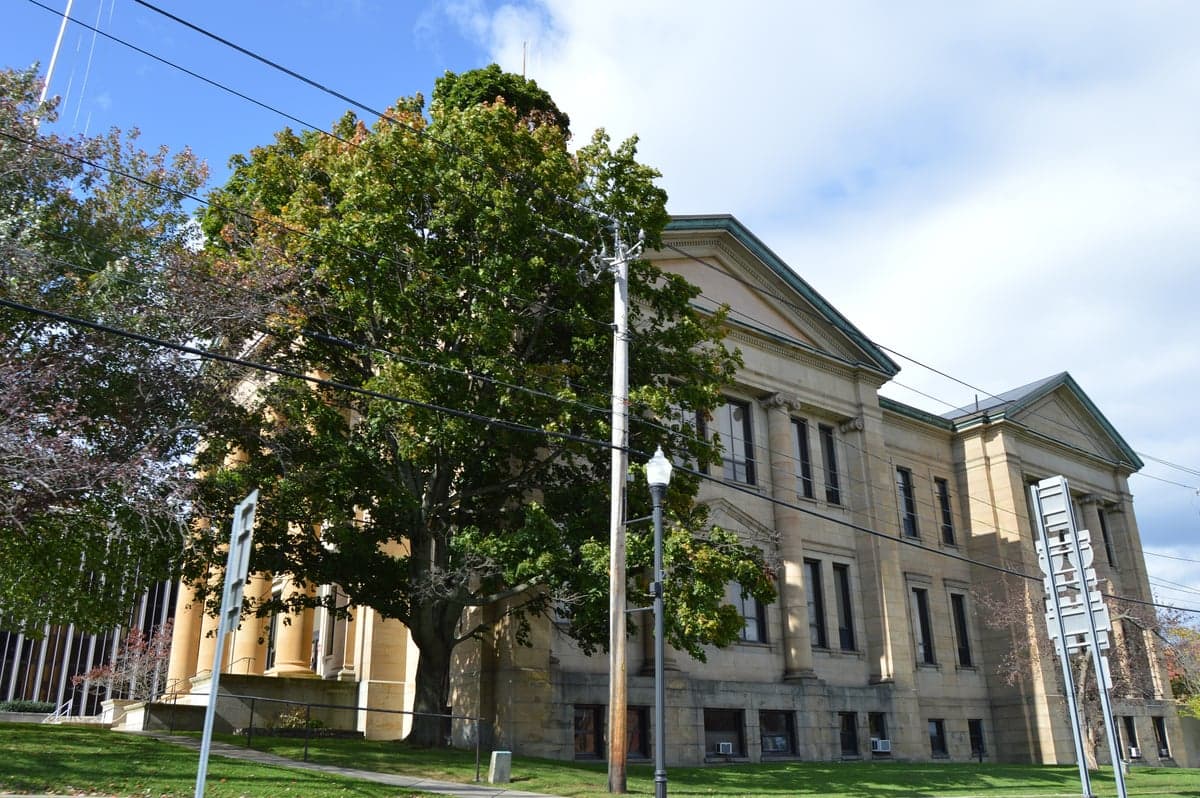
Photo: Wikipedia
Political ClimatePolitical Climate in Chautauqua County
Showing district-level results — no local-only data available.
Local Political AnalysisPolitical Analysis of Chautauqua County
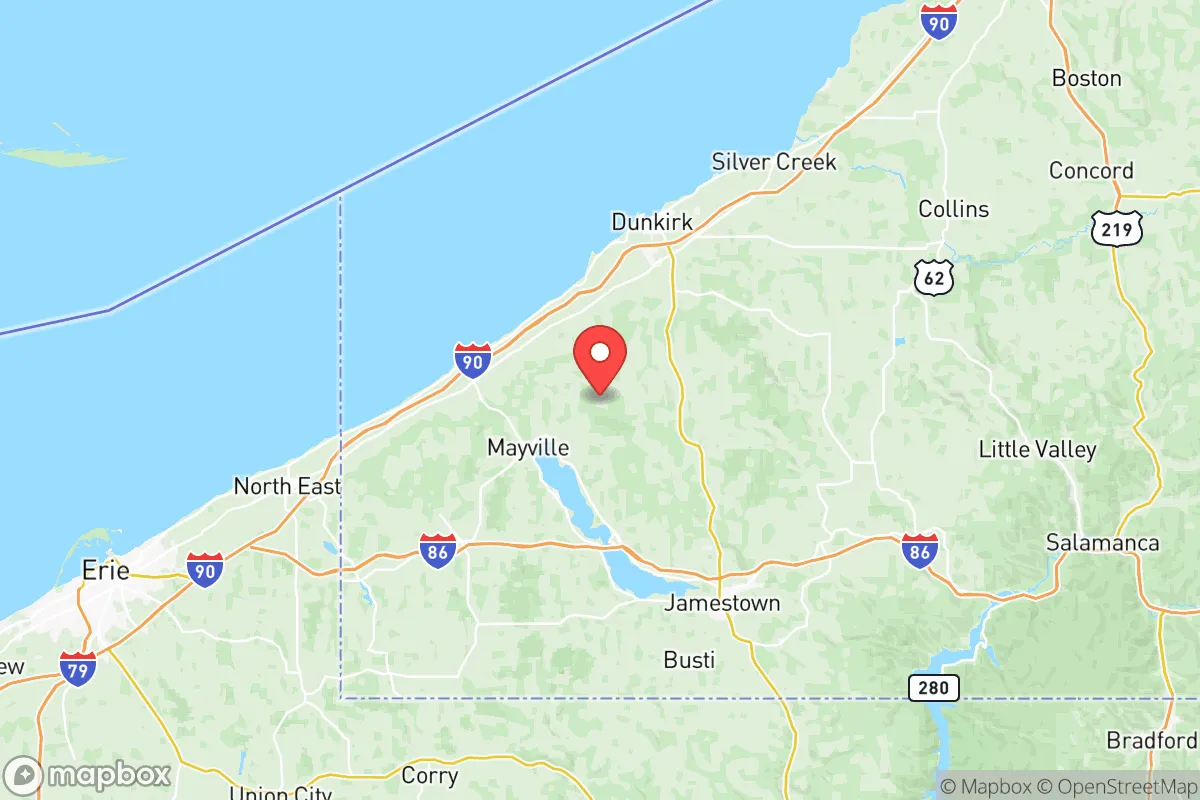
Chautauqua County is a reliably Republican stronghold in Western New York, with a Cook Partisan Voting Index of R+10, meaning it votes about ten points more Republican than the national average. This isn't a new development—the county has been trending redder for decades, though the shift has accelerated since 2016. The rural and small-town character of most of the county drives this lean, but there are notable exceptions: the city of Jamestown and the village of Fredonia consistently vote blue, while the towns of Chautauqua, Sherman, and Clymer are deep red. The swing precincts are often found in the suburban fringe around Jamestown, like the town of Ellicott, where local races can flip depending on turnout.
How it compares
Comparing Chautauqua County to New York City is like comparing two different countries politically. New York City's Cook PVI is not publicly calculated in the same way, but it's safe to say it's D+30 or more—a massive contrast to Chautauqua's R+10. In the 2024 presidential election, Chautauqua County went for Donald Trump by about 18 points, while New York City went for Joe Biden by over 50 points. This isn't just a numbers game; it reflects fundamentally different priorities. In Chautauqua, you hear a lot about property taxes, Second Amendment rights, and opposition to state-level energy policies like the Climate Leadership and Community Protection Act. In New York City, the conversation is about subway funding, rent control, and public school equity. The state government in Albany is dominated by New York City's interests, which creates a persistent tension—many Chautauqua residents feel their votes are drowned out by the city's population.
What this means for residents
For conservative residents, Chautauqua County feels like a refuge. Local government is overwhelmingly Republican—the county legislature has a 17-2 Republican majority, and the sheriff, district attorney, and most town boards are GOP-held. Gun laws are enforced lightly, and there's a strong culture of self-reliance. For liberal residents, it can be isolating. Progressive candidates rarely win countywide, and issues like climate change or racial justice get little traction in local politics. However, the blue pockets—especially Fredonia, home to SUNY Fredonia—offer a counterbalance. The university brings a younger, more diverse population, and local Democrats have had success in village and town races there. The practical effect is that a liberal resident can find community in Fredonia or Jamestown's liberal-leaning neighborhoods, but they'll still feel the weight of the county's conservative majority in county-level decisions.
Culturally, Chautauqua County is distinct from New York City in ways that go beyond politics. The county is home to the Chautauqua Institution, a historic summer assembly that draws a liberal, intellectual crowd—a fascinating outlier in an otherwise conservative area. Policy-wise, the county has pushed back on state mandates, like the SAFE Act gun control law, with local resolutions declaring the county a "Second Amendment Sanctuary." Property taxes are a perennial issue, with many residents feeling squeezed by state-level school funding formulas that favor downstate districts. The overall vibe is one of quiet independence—people here value their privacy and their ability to live without much interference, whether from Albany or from neighbors. It's a place where you can still have a conversation across the aisle, but the aisle is getting wider every election cycle.

State Political ClimatePolitical Climate in New York
State Political AnalysisPolitical Environment in the State
New York State has been a solidly Democratic stronghold for decades, but its political reality is far more complex than the simple "blue state" label suggests. The state’s overall partisan lean is driven overwhelmingly by New York City and its immediate suburbs, which deliver massive Democratic margins. Over the last 10-20 years, the state has shifted leftward on social and cultural issues, while the upstate and rural regions have swung hard in the opposite direction, creating one of the most pronounced urban-rural divides in the country. For a conservative-leaning relocator, the practical takeaway is that your experience will vary dramatically depending on whether you land in Manhattan, Buffalo, or a small town in the Southern Tier.
Urban vs. rural divide
The political map of New York is a tale of two states. New York City—the five boroughs of Manhattan, Brooklyn, Queens, the Bronx, and Staten Island—is the engine of Democratic dominance, routinely delivering 70-85% of its vote to Democratic candidates. The city’s population density, diverse economy, and large immigrant communities create a political culture that is reliably progressive on issues like housing, transit, and social services. The immediate suburbs—Nassau and Westchester counties—are also Democratic-leaning, though with more moderate pockets. In contrast, the vast majority of the state’s landmass is deeply Republican. Counties like Wyoming, Orleans, and Allegany in western New York, and Hamilton, Essex, and Franklin in the Adirondacks, routinely vote 60-70% Republican. The divide is stark: in the 2022 gubernatorial race, Democrat Kathy Hochul won New York City by over 1.2 million votes, but lost every single county outside the city and its immediate suburbs. Even traditionally purple areas like Erie County (Buffalo) and Monroe County (Rochester) have shifted left in their urban cores while their rural outskirts have hardened Republican. A notable exception is Staten Island, which is the only NYC borough that has voted Republican in recent presidential elections, reflecting its more suburban, blue-collar character. For a conservative relocator, the upstate cities of Buffalo, Rochester, and Syracuse offer a more mixed political environment, with Democratic city governments but Republican-leaning surrounding counties.
Policy environment
New York’s policy environment is defined by high taxes, extensive regulation, and a strong social safety net. The state has a progressive income tax with rates ranging from 4% to 10.9% for top earners, and property taxes are among the highest in the nation, particularly in the downstate suburbs. The regulatory posture is business-friendly in some sectors (finance, tech) but burdensome in others (energy, manufacturing, housing). Education policy is centralized, with the state controlling curriculum standards and funding formulas; the state’s public schools are among the best-funded in the country, but outcomes vary widely between wealthy suburbs and struggling rural districts. Healthcare is heavily regulated, with the state operating its own health insurance exchange and expanding Medicaid under the Affordable Care Act. Election laws are among the most liberal in the nation: New York has no-excuse absentee voting, early voting, and same-day registration, though it was slow to adopt these compared to other blue states. For a conservative, the policy environment means higher taxes and more government involvement in daily life, but also robust public services and infrastructure.
Recent policy direction
Over the past five years, New York has moved decisively left on a range of issues that matter to relocators. On gun policy, the state passed the SAFE Act in 2013 (one of the nation’s strictest gun laws) and followed up with the 2022 Concealed Carry Improvement Act, which requires a "proper cause" showing for a permit and bans firearms in most public places—a law currently being challenged in court. On parental and education rights, the state has expanded gender-inclusive policies in schools and mandated LGBTQ+ curriculum, while also passing a law that allows parents to opt their children out of certain instruction. On speech and privacy, New York has a strong data privacy law (the SHIELD Act) and has restricted the use of facial recognition in schools, but also has a history of aggressive libel laws that some argue chill speech. On medical and bodily autonomy, the state has codified abortion rights into law (the Reproductive Health Act of 2019) and expanded access to gender-affirming care for minors, making it a sanctuary for those seeking such services. Property rights are constrained by the state’s rent stabilization laws in NYC and its strict environmental regulations, which can delay development. On voting, the state has expanded mail-in voting and automatic voter registration, but also drew heavily criticized gerrymandered congressional maps in 2022 (later struck down by the courts). For a conservative, the recent direction means a state that is actively expanding government control over guns, education, and healthcare, while also protecting individual liberties on abortion and gender identity.
Civil unrest & political movements
New York has a long history of political activism, and recent years have seen both left- and right-wing movements make their presence felt. The 2020 Black Lives Matter protests in New York City were among the largest in the nation, leading to reforms in policing (the repeal of 50-a, which had shielded police disciplinary records) and a push for defunding the police, though actual budget cuts were modest. On the right, the "New York State of Mind" movement and local Republican parties have organized around Second Amendment rights, school choice, and opposition to COVID-19 mandates. Immigration politics are a flashpoint: New York City is a self-declared sanctuary city, and the state has laws limiting cooperation with federal immigration enforcement. The influx of asylum seekers from the southern border in 2022-2023 overwhelmed the city’s shelter system and sparked intense debate. Election integrity controversies have been relatively muted compared to other states, though the 2020 and 2022 elections saw lawsuits over ballot counting and absentee ballots. A new resident would notice the visible presence of political activism in NYC—protests, rallies, and street-level advocacy—while upstate, the political energy is more subdued but still present in county-level party organizations and local school board meetings.
Projection
Over the next 5-10 years, New York’s political trajectory is likely to continue its current path: the downstate urban core will remain deeply Democratic, while upstate rural areas will become even more Republican. The key demographic shift is out-migration: New York has lost population for three consecutive years, driven by people moving to lower-tax states like Florida and Texas. This exodus is disproportionately from the upstate and suburban areas, which could further concentrate Democratic power in the city and its immediate suburbs. However, the influx of new immigrants (both legal and asylum-seeking) into NYC could offset some of that loss and reinforce the city’s progressive lean. The state’s fiscal situation is a wild card: high taxes and pension obligations could force future tax increases or service cuts, which might accelerate out-migration. For a conservative moving in now, expect to see a state that remains firmly Democratic at the state level, with continued expansion of gun control, abortion access, and LGBTQ+ protections, but with growing Republican strength in the state legislature as rural districts gain relative power. The practical implication is that your political influence will be limited to local and county elections unless you live in a swing district.
For a conservative-leaning relocator, the bottom line is that New York offers a deeply mixed experience. If you choose a city like Buffalo or a suburb like Staten Island, you’ll find a more moderate political environment with some Republican representation. If you choose a rural county like Wyoming or Hamilton, you’ll be in a solidly Republican area with low taxes and a conservative culture, but you’ll still be subject to state-level policies you may disagree with. The state’s high taxes and regulatory environment are a real cost, but they fund excellent public services and infrastructure. The key is to pick your location carefully: the political climate of New York is not monolithic, and your daily experience will be shaped more by your county and town than by Albany. If you value low taxes and limited government, New York is a tough sell. If you value robust public services and are willing to accept higher costs, it can work—especially if you find your political tribe in the right corner of the state.
* Values derived from national, state, county, city and local statistics and may differ in a specific area. Last updated: 2026-07-16T05:23:35.000Z
Narrative content on this page is AI-generated and may contain mistakes. Verify any details that matter before acting on them.
ReloMaps may earn a commission from affiliate links at no extra cost to you.

