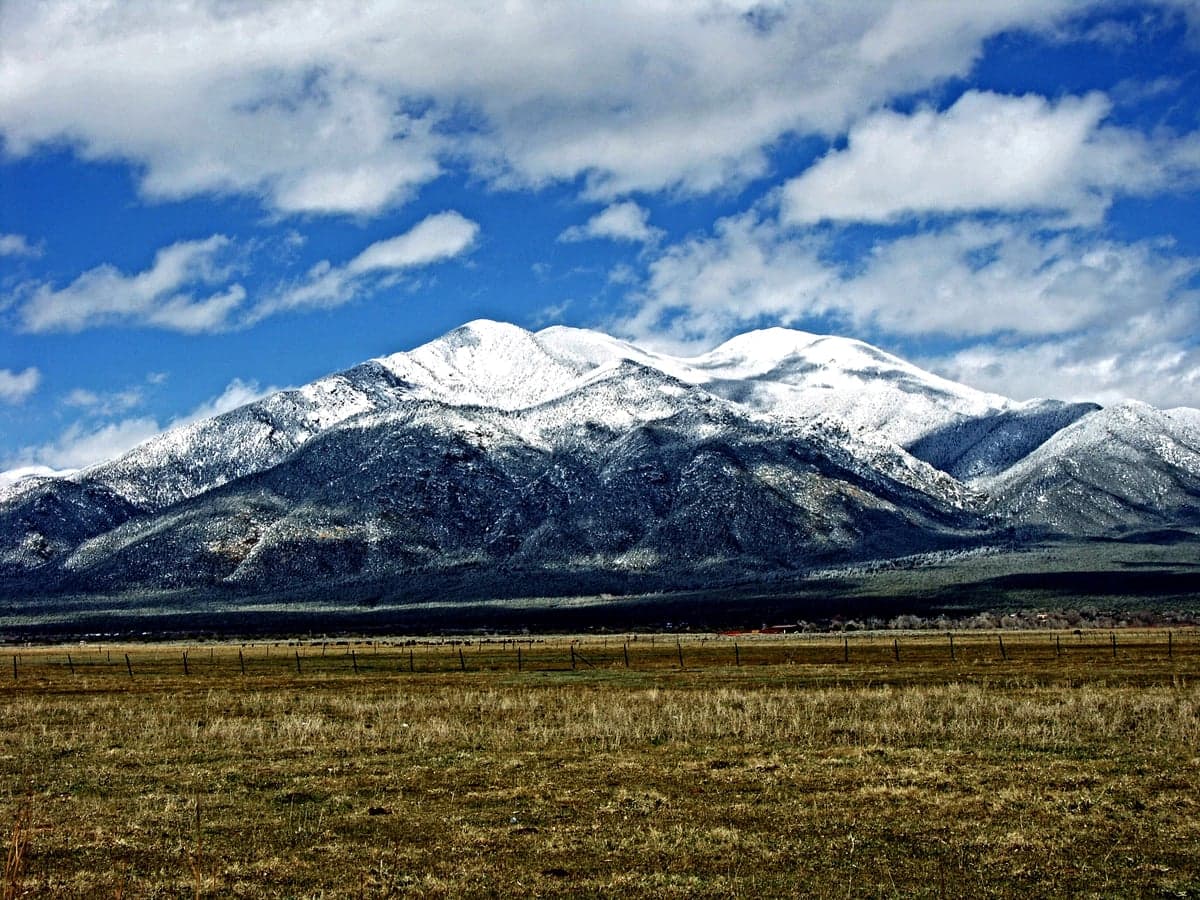
Photo: Wikipedia
Political ClimatePolitical Climate in Taos County
Showing district-level results — no local-only data available.
Local Political AnalysisPolitical Analysis of Taos County
Taos County has long been a Democratic stronghold in northern New Mexico, but its politics are more nuanced than a simple party label suggests. The county carries a Cook Partisan Voting Index (PVI) of D+3, meaning it votes about three points more Democratic than the national average — identical to the state of New Mexico as a whole. That D+3 rating has held steady for the past several cycles, but beneath the surface, the county is shifting in ways that surprise both longtime locals and newcomers. The Democratic margin in presidential elections has narrowed from double digits in 2008 and 2012 to single digits in 2020 and 2024, driven largely by a growing libertarian-leaning population and a small but vocal conservative contingent in the county's rural reaches.
How it compares
At first glance, Taos County and New Mexico share the same D+3 PVI, but the resemblance ends there. New Mexico's D+3 is a product of deep-blue urban centers like Albuquerque and Santa Fe balancing out red rural counties in the eastern plains and the southwest. Taos County's D+3, by contrast, comes from a much smaller, more homogeneous population where the political divide is less about urban vs. rural and more about geography within the county itself. The town of Taos — the county seat and cultural hub — leans solidly blue, with precincts around the historic plaza and the ski valley routinely delivering 65-70% of the vote to Democratic candidates. Head south to Ranchos de Taos or El Prado, and you'll find swing precincts where the margin is often within 5 points. Push farther out to the rural communities of Arroyo Hondo, Arroyo Seco, or the high-desert subdivisions near the Rio Grande Gorge, and you'll see precincts that have voted Republican in every election since 2016. The county's conservative vote is concentrated in these outlying areas, where property rights, water access, and opposition to land-use regulations drive turnout more than national culture-war issues.
What this means for residents
For liberal residents, Taos County remains a comfortable place to live politically. The county government, school board, and most municipal councils are reliably Democratic, and progressive policies around renewable energy, affordable housing, and environmental protection generally advance without major opposition. But the narrowing margins mean that conservative residents are not without influence. In practice, the county's D+3 lean translates to a government that must negotiate with a vocal minority on issues like short-term rental regulations, wildfire mitigation funding, and water rights — topics where rural conservative voices carry weight even in a blue county. The real tension isn't between Democrats and Republicans so much as between longtime Hispanic families who have lived here for generations and newer arrivals from out of state, many of whom bring progressive politics but also drive up housing costs. That dynamic cuts across party lines and shapes local elections more than national partisanship does.
Culturally, Taos County stands apart from the rest of New Mexico in its fierce independence. The county has a long tradition of third-party and independent candidates performing well — in 2020, Libertarian and Green Party candidates pulled nearly 5% of the vote in some precincts, double the state average. The local political culture prizes self-reliance and skepticism of both state government in Santa Fe and federal land management agencies, a sentiment shared by liberals and conservatives alike. Policy-wise, the county has been an early adopter of community land trusts and local food system initiatives, but it has also resisted some state-level mandates on oil and gas development and land-use planning. For anyone moving here, the takeaway is simple: Taos County votes blue, but it thinks for itself. The D+3 label captures the outcome, not the character, of its politics.

State Political ClimatePolitical Climate in New Mexico
State Political AnalysisPolitical Environment in the State
New Mexico has a solid Democratic lean at the state level, with a Cook PVI of D+3, but that number hides a deeply fractured political reality. The state is essentially a three-way tug-of-war between the liberal stronghold of Albuquerque and Santa Fe, the conservative oil-and-gas counties in the southeast, and a large, politically mixed Hispanic electorate that often breaks for moderate Democrats. Over the last 20 years, the state has drifted left on social and environmental policy, but it remains far more fiscally moderate than coastal blue states, and the rural-urban divide has actually widened since 2020.
Urban vs. rural divide
The political map of New Mexico is stark. Bernalillo County (Albuquerque) and Santa Fe County together cast roughly 45% of the state's vote, and they are overwhelmingly Democratic. Santa Fe is the most liberal city in the state, with a heavy concentration of government workers, artists, and retirees from California and Colorado. Albuquerque is more mixed — its East Mountains and far Northeast Heights lean Republican, while the South Valley and downtown core are solidly blue. The real Republican strongholds are the southeastern counties: Lea, Eddy, and Chaves counties (home to Hobbs, Carlsbad, and Roswell) routinely vote 70-75% Republican, driven by the oil and gas industry. The northwestern corner, including Farmington and the Four Corners area, is also conservative but less reliably so, with a significant Native American vote that leans Democratic. Las Cruces in the south is a swing area — Doña Ana County has been trending blue, but the city itself is more moderate than Santa Fe, with a large military and border-patrol presence that tempers the leftward drift.
Policy environment
New Mexico's tax structure is relatively moderate for a blue state. There is no state inheritance tax, and the top income tax rate is 5.9%, which kicks in above $210,000 for joint filers. Property taxes are among the lowest in the nation, averaging about 0.55% of assessed value, which is a major draw for retirees and families from high-tax states. The state has a gross receipts tax (essentially a sales tax on services and goods) that varies by locality, often landing between 7% and 9%. On the regulatory side, New Mexico has a strong environmental review process, particularly for oil and gas permitting, and the state has adopted California-style clean car standards. Education policy is a perennial battleground: the state has a constitutional right to education, but funding is heavily reliant on oil and gas revenue, creating boom-and-bust cycles. Healthcare is a mixed bag — the state expanded Medicaid under the Affordable Care Act, and the Health Insurance Exchange is robust, but provider shortages are severe in rural areas. Election laws are relatively accessible: same-day registration is available, and the state mails a ballot to every active voter, though you can opt out.
Recent policy direction
The last five years have seen a clear leftward shift on social and environmental issues, but with some notable exceptions. In 2021, the state passed the Energy Transition Act, which mandates a 100% carbon-free electricity grid by 2045. In 2023, the legislature passed a bill banning "conversion therapy" for minors and expanded abortion access by repealing a pre-Roe ban that was still on the books. On gun policy, New Mexico passed a red-flag law in 2020 and a ban on carrying firearms at polling places and government buildings in 2023, but it remains a shall-issue state for concealed carry permits, and open carry is legal without a permit. The state has not passed a magazine capacity ban or an assault weapons ban. On parental rights, the 2023 legislative session saw a bill to require schools to notify parents if a child changes their gender identity or pronouns — it failed. On property rights, the state has a strong "right to farm" law that protects agricultural operations from nuisance lawsuits, and there is no statewide rent control. On voting, the state moved to automatic voter registration at the DMV in 2021, and the 2024 session saw a bill to ban firearms at polling places, which passed. The overall direction is toward more regulation on energy and firearms, but the state remains far more permissive on property rights and taxation than Colorado or California.
Civil unrest & political movements
New Mexico has a history of low-boil political tension rather than large-scale civil unrest. The most visible flashpoint in recent years has been the debate over the state's sanctuary policies. In 2019, the legislature passed a law prohibiting state and local law enforcement from detaining people based solely on immigration status, which led to a backlash in conservative counties. Otero County (Alamogordo) and Lea County passed resolutions declaring themselves "Second Amendment sanctuaries" in response. The 2020 protests over George Floyd's death were large in Albuquerque and Santa Fe but did not lead to sustained unrest. The 2022 Supreme Court decision overturning Roe v. Wade prompted a surge of out-of-state patients seeking abortions in New Mexico, which in turn led to several conservative municipalities, including Hobbs and Clovis, passing local ordinances attempting to restrict abortion access — those ordinances are currently tied up in court. The state also saw a high-profile election integrity controversy in 2022 when a county commissioner in Otero County refused to certify primary election results, citing unfounded concerns about Dominion voting machines; the state Supreme Court ultimately forced certification. The "New Mexico secession" movement, which has flickered in the conservative eastern plains for decades, remains a fringe sentiment with no real political traction.
Projection
Over the next 5-10 years, New Mexico is likely to become slightly more Democratic at the statewide level, but the rural-urban divide will deepen. The state is growing fastest in the liberal-leaning Albuquerque and Santa Fe areas, while the conservative oil patch counties are seeing population stagnation or decline as the energy transition accelerates. The Hispanic electorate, which has historically been a moderating force, is slowly shifting left, particularly among younger voters. However, the state's low cost of living and low property taxes are attracting a steady stream of remote workers and retirees from blue states, which could accelerate the leftward drift on social issues. The wild card is the oil and gas industry: if global demand for fossil fuels declines faster than expected, the state's budget — which is heavily dependent on severance taxes — could crater, forcing a reckoning on tax policy. A new resident moving in now should expect the state to continue passing environmental and social legislation that aligns with national Democratic priorities, but with a pragmatic, deal-making culture in the legislature that often moderates the most aggressive proposals.
For a conservative-leaning family or individual, the bottom line is that New Mexico offers a surprisingly favorable tax environment and a strong property rights framework, but you will be living under a state government that is increasingly progressive on social and environmental issues. The practical trade-off is clear: you get low property taxes and a relatively hands-off approach to land use and firearms, but you will see your state government expand abortion access, restrict oil and gas development, and mandate clean energy. The best places for a conservative relocator are the southeastern oil patch cities like Hobbs and Carlsbad, or the more moderate suburbs of Albuquerque like Rio Rancho and the East Mountains. If you move to Santa Fe or the North Valley of Albuquerque, you will be in a deep-blue environment where your political views will be in the minority. The state is not hostile to conservatives — it's too poor and too independent for that — but it is clearly trending in a direction that will feel increasingly unfamiliar to someone used to living in a red state.
* Values derived from national, state, county, city and local statistics and may differ in a specific area. Last updated: 2026-07-01T22:06:06.000Z
Narrative content on this page is AI-generated and may contain mistakes. Verify any details that matter before acting on them.
ReloMaps may earn a commission from affiliate links at no extra cost to you.

