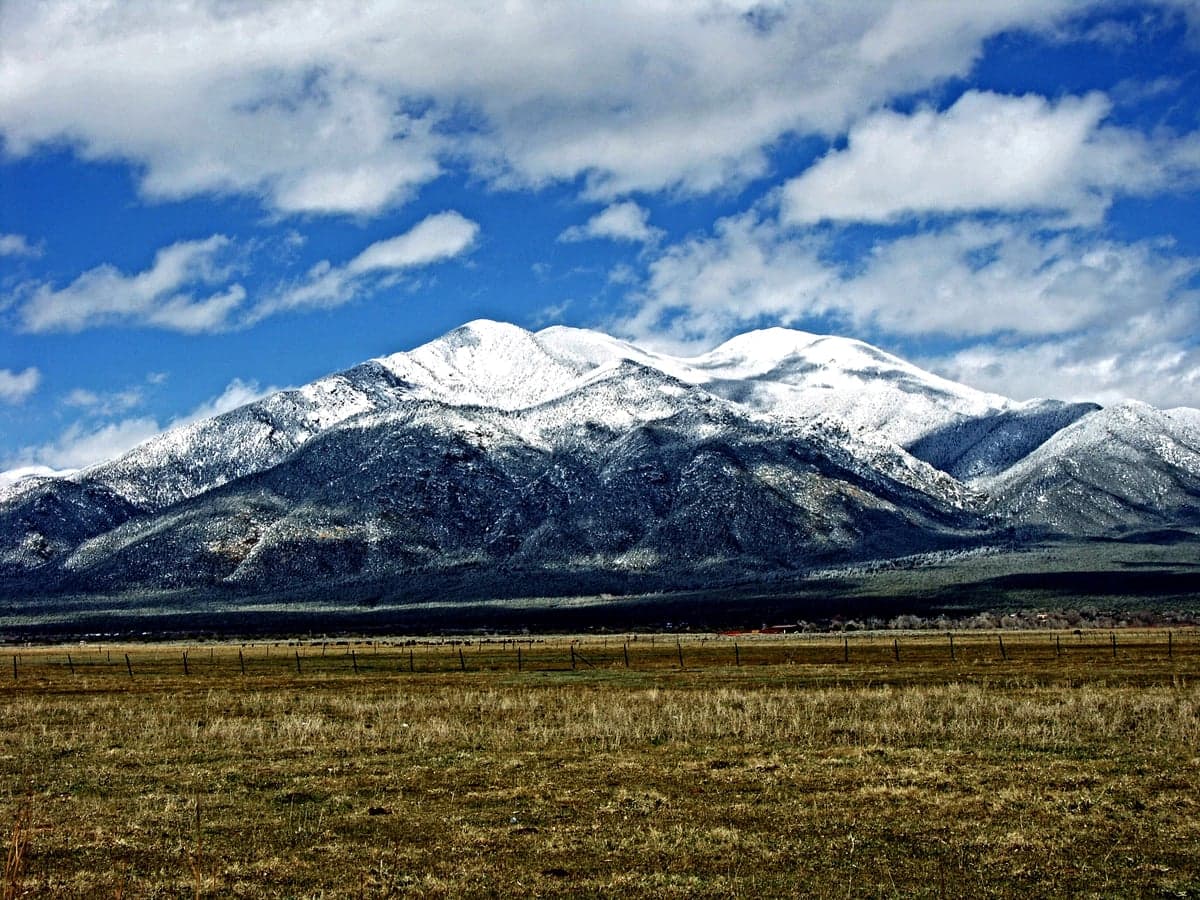
Photo: Wikipedia
Demographics of Taos County
Affluence Level in Taos County
A middle-class area roughly in line with national averages across income, home values, education, and employment.
People of Taos County
Taos County, New Mexico, is home to 34,516 residents, a population defined by its deep-rooted Hispanic and Native American heritage, with 50.8% identifying as Hispanic and 40.5% as White. The county’s character is shaped by a blend of centuries-old Pueblo communities, Spanish colonial land grants, and a later influx of artists and counterculture seekers, creating a distinctive tri-cultural identity. With a foreign-born population of just 3.9% and a college-educated rate of 37.1%, Taos County remains a relatively insular, culturally rich area where traditional lifeways persist alongside a vibrant arts scene. This is a place where the past is not just remembered but actively lived, from the acequia irrigation systems to the annual fiestas.
Settlement & growth (pre-1960)
The human history of Taos County begins with the Tiwa-speaking Pueblo peoples, who have inhabited the Taos Valley for over a millennium. The Taos Pueblo, a UNESCO World Heritage Site located just north of the town of Taos, is one of the oldest continuously inhabited communities in the United States, with its multi-storied adobe structures dating back to 1000 AD. These Native communities established a settled agricultural society along the Rio Grande and its tributaries, a foundation that would shape all subsequent settlement.
Spanish colonization arrived in the late 16th century, but permanent European settlement in the Taos area solidified after the 1692 reconquest of New Mexico following the Pueblo Revolt. The Spanish crown and later the Mexican government issued large land grants, such as the Sangre de Cristo Land Grant and the Taos Land Grant, which attracted Hispanic settlers to establish farming and ranching communities. These settlers, a mix of Spanish colonists and mestizo populations, founded the villages that still dot the county today: the town of Taos (the county seat), Ranchos de Taos, Arroyo Seco, and Questa. The Hispanic population became the dominant demographic force, establishing a pattern of small, self-sufficient agricultural communities centered around the Catholic faith and acequia-based irrigation.
The American period began after the Mexican-American War in 1848, but the region’s isolation meant that Anglo-American settlement was slow and sparse for decades. The 1847 Taos Revolt, a brief but bloody uprising against the new U.S. territorial government, underscored the cultural friction of the era. Throughout the late 19th and early 20th centuries, the population remained overwhelmingly Hispanic and Native American, with the economy based on subsistence farming, sheep ranching, and small-scale mining in the Sangre de Cristo Mountains. The arrival of the railroad in nearby locations in the 1880s provided a tenuous link to the outside world, but Taos County remained one of the most isolated areas in the continental United States.
The first significant wave of Anglo-American migration came not from farmers or miners, but from artists and writers in the early 20th century. The Taos Society of Artists, formed in 1915, drew painters and photographers to the area’s dramatic landscapes and unique light, settling primarily in the town of Taos and the surrounding valley. This artistic colony, which included figures like Georgia O’Keeffe (who later moved to Abiquiú), established Taos as a cultural destination. However, this was a small, elite migration that did not fundamentally alter the county’s ethnic composition. By 1960, Taos County remained a predominantly rural, Hispanic, and Native American area, with a population of around 15,000, largely untouched by the post-war suburbanization that was transforming other parts of the country.
Modern era (post-1965)
The post-1965 era in Taos County was not defined by the Hart-Cellar Act’s immigration waves, as the county’s foreign-born population remains very low at 3.9%. Instead, the major demographic shift came from domestic migration—a steady influx of Anglo-Americans drawn by the counterculture movement, the arts, and a search for an alternative lifestyle. Beginning in the late 1960s and accelerating through the 1970s and 1980s, "back-to-the-land" migrants, spiritual seekers, and second-home buyers arrived from California, the East Coast, and other parts of the Southwest. They settled in the town of Taos, the rural areas around El Prado, and the scenic communities of Arroyo Hondo and San Cristobal, often purchasing former Hispanic homesteads or building new homes on subdivided land.
This migration has significantly altered the county’s demographic balance. The White (non-Hispanic) population now stands at 40.5%, a share that has grown substantially since 1960, while the Hispanic population, though still a majority at 50.8%, has seen its relative share decline. This has created a cultural dynamic that is sometimes described as "two Taoses"—a long-established Hispanic and Native community with deep roots, and a newer, more affluent Anglo population that is often involved in the arts, tourism, and real estate. The Black population remains negligible at 0.3%, and East and Southeast Asian communities account for just 0.6%, reflecting the county’s lack of the economic drivers that attract more diverse immigrant populations. The Indian (subcontinent) population is a statistically insignificant 0.1%.
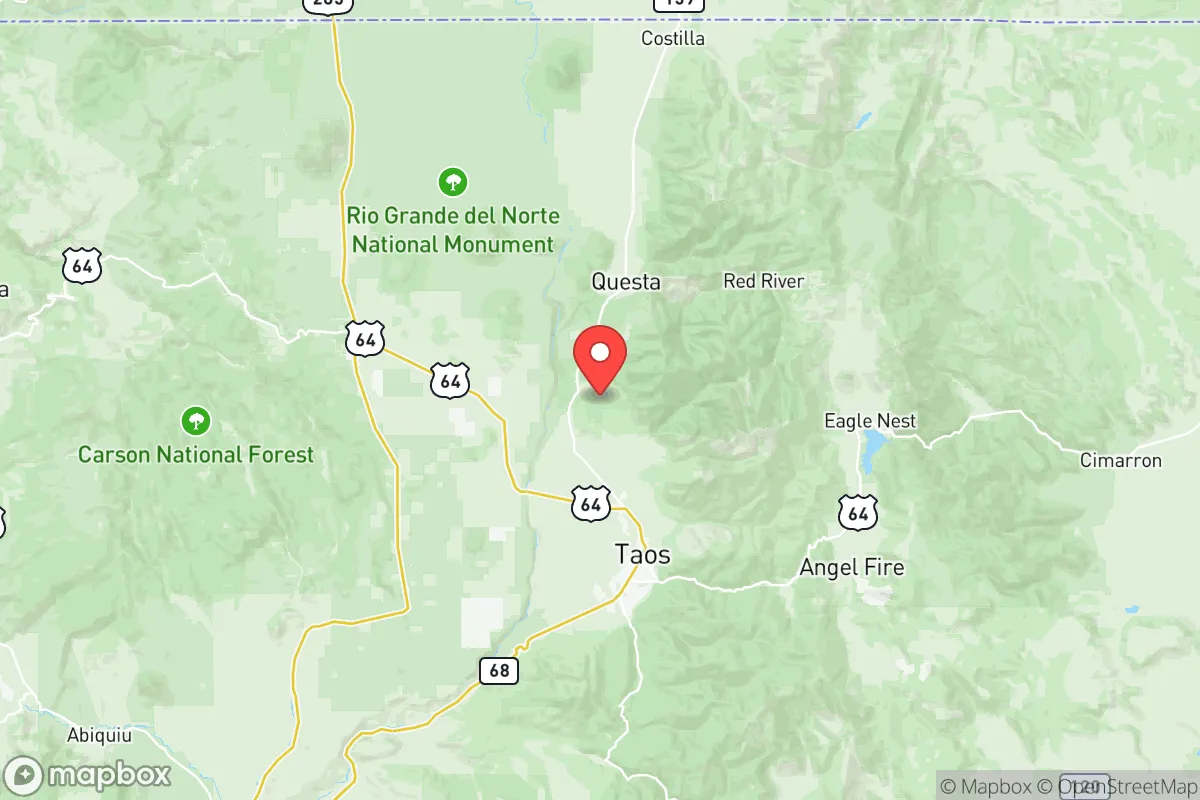
Suburbanization has been limited in Taos County due to its mountainous terrain, protected federal lands (including the Carson National Forest and the Rio Grande del Norte National Monument), and a strong local preservation ethic. The town of Taos has seen some commercial and residential expansion, but there are no large-scale suburbs. Instead, growth has taken the form of scattered rural subdivisions and a concentration of second homes in areas with scenic views. The county’s economy has shifted from agriculture to tourism, arts, and retirement services, with the Taos Ski Valley and the town’s historic plaza serving as major draws. This economic shift has increased property values and contributed to a housing affordability crisis for many long-term Hispanic residents.
The future
The population of Taos County is projected to remain relatively stable or experience very slow growth, constrained by limited economic diversification, water scarcity, and high housing costs. The county is becoming slightly more diverse in terms of the Anglo-Hispanic balance, but this is driven by continued in-migration of White retirees and remote workers, not by new immigrant communities. The Hispanic population, while still a majority, is aging, and younger Hispanic residents are often leaving for job opportunities in Albuquerque, Santa Fe, or Denver, a trend that could slowly erode the county’s traditional cultural base.
Future demographic trends will likely see a continued dispersion of new residents into the unincorporated areas around Taos, as well as into smaller villages like Arroyo Seco and Ranchos de Taos, as the town of Taos itself becomes increasingly expensive. The county’s cultural identity is evolving into a more self-conscious, curated version of its tri-cultural heritage, driven by tourism marketing and the preferences of incoming residents. For someone moving in now, Taos County offers a deeply rooted, scenic, and culturally rich environment, but one where the cost of entry is rising and where the traditional Hispanic and Pueblo communities face ongoing pressure from gentrification and out-migration. The county is becoming a place where the past is preserved as a commodity, even as the people who created that past find it harder to stay.

* Values derived from national, state, county, city and local statistics and may differ in a specific area. Last updated: 2026-07-01T22:06:06.000Z
Narrative content on this page is AI-generated and may contain mistakes. Verify any details that matter before acting on them.
ReloMaps may earn a commission from affiliate links at no extra cost to you.

