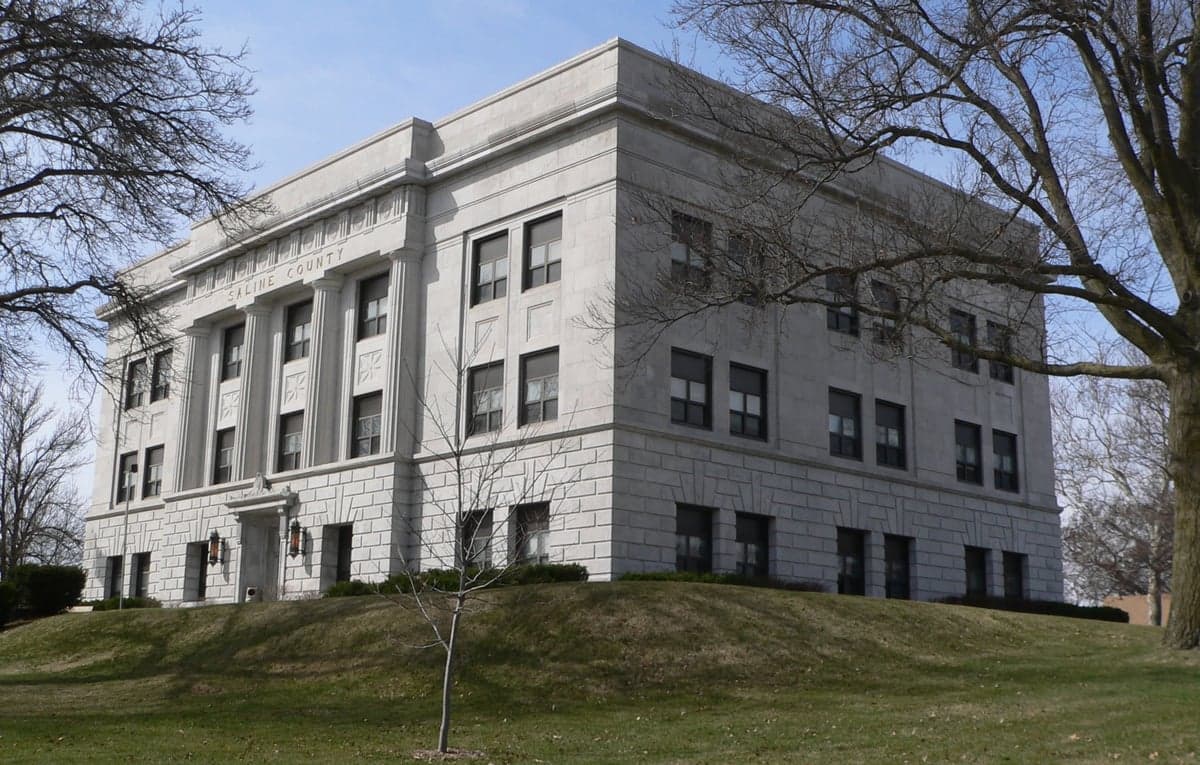
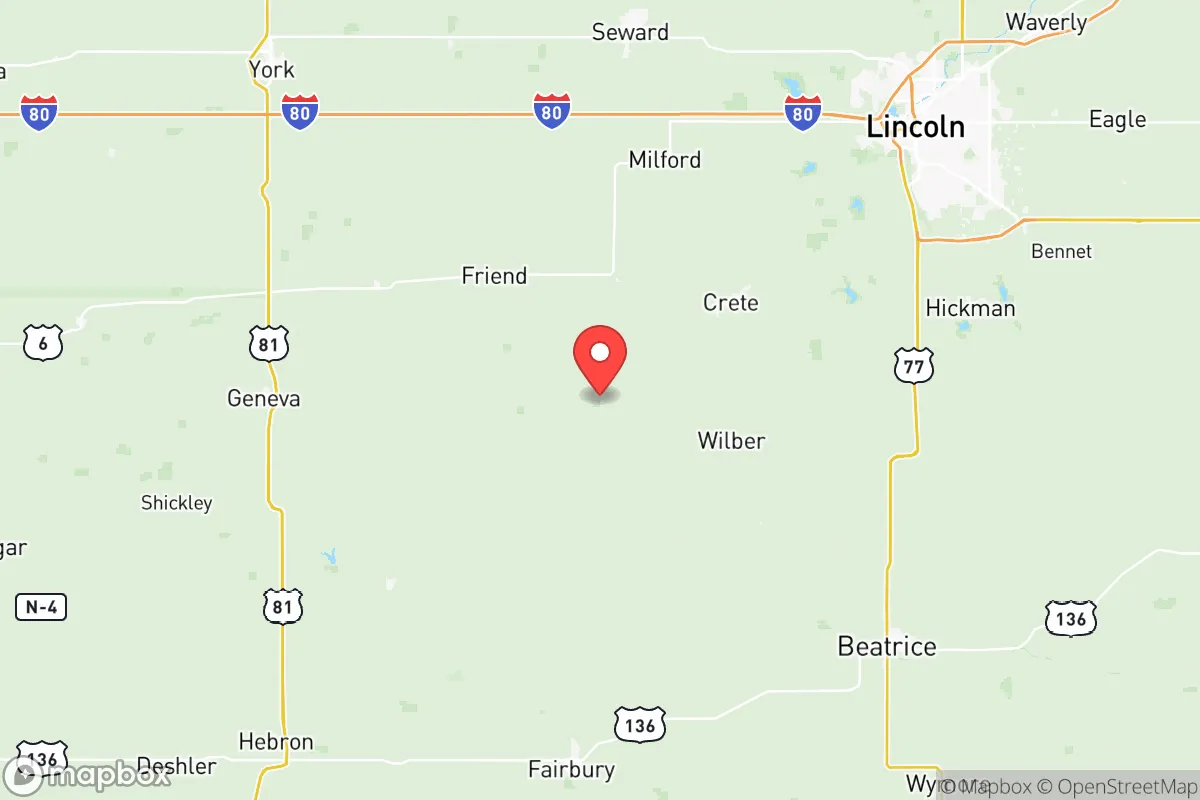
Photo: Wikipedia
Political ClimatePolitical Climate in Saline County
Showing district-level results — no local-only data available.
Local Political AnalysisPolitical Analysis of Saline County
Saline County, Nebraska, is a deeply conservative area, carrying a Cook Partisan Voting Index of R+27 — meaning it votes nearly 27 points more Republican than the national average. That’s a stark contrast to the state of Nebraska as a whole, which sits at R+10, and it places Saline County among the most reliably red counties in the state. The county’s politics have been stable for decades, with no real sign of a shift toward the center; if anything, the rural-urban divide within the county has sharpened slightly since 2020, with small towns like Wilber and Crete showing different voting patterns than the open countryside.
How it compares
Nebraska’s statewide R+10 index already reflects a solid Republican lean, but Saline County’s R+27 is in a different league — it’s more comparable to counties like Thayer or Fillmore to the west. The main driver is the county’s agricultural base and small-town culture, where conservative social and fiscal values dominate. However, there’s a notable exception: Crete, the county’s largest town (population roughly 7,000), is a genuine swing precinct. Crete’s mix of a sizable Hispanic community (around 30% of the population), a small liberal arts college (Doane University), and light manufacturing jobs creates a more diverse electorate. In the 2024 presidential race, Crete’s precincts split roughly 50-50, while surrounding towns like Wilber (the Czech capital of the U.S.) and Friend voted 70-30 or more for the Republican candidate. De Witt and Dorchester lean red but with slightly less intensity — closer to 60-40 — thanks to a few commuters who work in Lincoln and bring more moderate views home. So the county isn’t a monolith; it’s a patchwork where the rural precincts are deep red, Crete is purple, and the smaller towns fall somewhere in between.
What this means for residents
For conservative residents, Saline County is a comfortable fit. Republican candidates rarely face serious challenges in county-level races, and local government — from the county board to school boards — tends to reflect traditional values. Tax policy is generally low, and gun rights are widely supported. For liberal residents, the reality is more nuanced. In Crete, you’ll find a small but active Democratic group that holds meetups and canvasses during elections, and the town’s diversity means progressive voices on immigration or education reform get a hearing. But outside Crete, being openly liberal can feel isolating; many left-leaning residents in Wilber or Friend simply avoid political talk in public settings. The practical impact is that county-level decisions — like zoning, road funding, or school consolidation — rarely spark partisan fights, because the Republican majority is so large that debates are more about personality than ideology. That said, the county’s deep red lean means national issues like abortion or gun control are non-starters in local policy, which can frustrate liberals who want to see change.
Culturally, Saline County stands apart from Nebraska’s more moderate eastern counties (like Lancaster or Douglas) by its strong Czech heritage, celebrated annually in Wilber’s Czech Festival. This heritage fosters a distinct local identity that’s less about national politics and more about community traditions — polka music, kolaches, and family farms. Policy-wise, the county has resisted state-level pushes for expanded gambling or marijuana legalization, reflecting a socially conservative streak that’s stronger than in Lincoln or Omaha. For anyone moving here, the takeaway is simple: if you’re conservative, you’ll feel right at home; if you’re liberal, you’ll find your niche in Crete but should expect to be in the minority everywhere else. The county’s trajectory suggests this balance won’t change much in the next decade — the rural areas are aging and staying red, while Crete’s growth might nudge it slightly left, but not enough to flip the county’s overall lean.

State Political ClimatePolitical Climate in Nebraska
State Political AnalysisPolitical Environment in the State
Nebraska is a solidly Republican state with a Cook PVI of R+10, but its politics are far more nuanced than that number suggests. The state has a strong conservative majority, driven by its vast rural expanses and the reliably red suburbs of Omaha, yet it also contains a significant and growing liberal stronghold in Lincoln and a more competitive, diverse Omaha metro. Over the past 10-20 years, the state has shifted slightly rightward in presidential races, but the real story is the deepening urban-rural chasm and the rise of a unique, pragmatic strain of conservatism in the state legislature.
Urban vs. rural divide
The political map of Nebraska is a textbook case of the urban-rural split. The two major population centers, Omaha (Douglas County) and Lincoln (Lancaster County), are the state's blue dots. Omaha, home to a growing Latino and African American population and a strong union presence, has been trending Democratic for decades. In 2020, Joe Biden won Douglas County by about 6 points. Lincoln, anchored by the University of Nebraska, is a classic college-town liberal enclave; Biden carried Lancaster County by nearly 11 points. These two counties alone account for over half the state's population. Outside of them, the political landscape is overwhelmingly red. The vast, sparsely populated Sandhills and the Panhandle are among the most conservative regions in the country. A telling example is the 2022 Senate race: Republican Deb Fischer won the state by 12 points, but she lost Douglas and Lancaster counties. The real action is in the suburbs. Sarpy County, south of Omaha (including cities like Bellevue and Papillion), is a fast-growing, reliably Republican suburban stronghold that has become a key battleground for the GOP's future. Meanwhile, the 3rd Congressional District, which covers the rest of the state, is one of the most Republican districts in the nation, with a Cook PVI of R+29.
Policy environment
Nebraska's policy environment is a mix of traditional Midwestern conservatism and a unique, nonpartisan legislative structure. The state has a unicameral, officially nonpartisan legislature, which often leads to more pragmatic, less overtly partisan outcomes than in other states. There is no state income tax on Social Security benefits, and the state has a flat income tax rate of 5.84% (with a scheduled reduction to 5.5% by 2027). Property taxes are a perennial hot-button issue, consistently ranking among the highest in the nation relative to home values. The state is a "right-to-work" state, and its regulatory posture is generally business-friendly. On education, Nebraska has a robust system of public schools, but school choice has become a major flashpoint, with recent legislation creating a controversial school voucher program. Healthcare policy is largely status quo, with the state expanding Medicaid under the Affordable Care Act in 2020. Election laws are relatively moderate: Nebraska has same-day voter registration and no-excuse absentee voting, but also requires a photo ID to vote, a law passed in 2023.
Recent policy direction
The last five years have seen Nebraska's legislature move decisively to the right on several fronts, while maintaining a pragmatic streak on others. In 2023, the legislature passed a near-total abortion ban after 12 weeks of pregnancy, with exceptions for rape, incest, and to save the mother's life. This was a major shift, replacing a previous 20-week ban. On gun rights, Nebraska is a "constitutional carry" state, allowing permitless concealed carry for residents 21 and older. The state also has a "Stand Your Ground" law. On parental rights, the legislature passed the "Parents' Bill of Rights" in 2023, which requires schools to notify parents about curriculum and medical services. On the economic front, the state has aggressively cut taxes, including a phased reduction of the corporate income tax rate to 5.5%. However, the state has also shown a willingness to buck national trends. For example, it has maintained a robust public-private partnership for economic development, and it has not pursued the kind of hardline anti-immigration legislation seen in states like Texas or Florida. The state's approach to voting access remains relatively open, with the new voter ID law being implemented in a way that is seen as less restrictive than in many other Republican-led states.
Civil unrest & political movements
Nebraska is not a hotbed of civil unrest, but it has seen its share of organized political movements. The most visible flashpoint in recent years has been the abortion debate. Following the 2023 abortion ban, there were large, sustained protests at the state capitol in Lincoln, organized by groups like Planned Parenthood and the Women's Fund of Omaha. These protests were largely peaceful but highly visible. On the right, the most organized movement is the "school choice" and parental rights coalition, which has been highly effective in lobbying the legislature. Immigration politics are less volatile than in border states, but there is a persistent undercurrent of concern, particularly in rural areas where meatpacking plants employ a significant number of immigrant workers. The city of Omaha has a "Welcoming City" ordinance, which limits local police cooperation with federal immigration enforcement, a policy that has been a source of tension with state-level Republicans. There have been no serious secession or nullification movements. The most notable recent controversy was the 2020 election, where Nebraska's unique system of splitting its electoral votes by congressional district led to a national focus on Omaha's 2nd Congressional District, which ultimately cast one electoral vote for Joe Biden. This has led to ongoing, but so far unsuccessful, efforts by state Republicans to change the system to a winner-take-all model.
Projection
Over the next 5-10 years, Nebraska's political trajectory is likely to be one of continued, but moderated, conservative governance. The key demographic driver is the growth of the Omaha and Lincoln metros, which are becoming more diverse and more Democratic. This will make the 2nd Congressional District a perennial battleground and could eventually put pressure on the state's overall partisan lean. However, the rural areas are not shrinking as fast as in some other Plains states, and the suburbs of Sarpy County are growing and solidifying their Republican identity. The most likely scenario is that Nebraska remains a solidly Republican state, but with a more competitive and visible urban-liberal minority. The legislature will likely continue to push conservative policies on taxes, education, and social issues, but the nonpartisan structure may temper the most extreme impulses. A new resident moving in now should expect a state where conservative values dominate state policy, but where a vocal and organized liberal opposition exists in the cities. The practical reality is that a conservative will feel very much at home in most of the state, while a liberal will find a strong community in Lincoln and parts of Omaha, but will be in the minority at the state level.
For a new resident, the bottom line is this: Nebraska offers a stable, predictable political environment with a clear conservative majority. Your day-to-day life will be shaped by low taxes, a business-friendly climate, and a culture of self-reliance. If you are a conservative, you will find your values reflected in state law and local governance. If you are a liberal, you will find a vibrant, active community in the cities, but you will need to accept that state-level policy will often not align with your views. The state's politics are serious, but not volatile, and the nonpartisan legislature provides a degree of stability and pragmatism that is increasingly rare in American politics.
* Values derived from national, state, county, city and local statistics and may differ in a specific area. Last updated: 2026-07-02T05:41:16.000Z
Narrative content on this page is AI-generated and may contain mistakes. Verify any details that matter before acting on them.
ReloMaps may earn a commission from affiliate links at no extra cost to you.

