
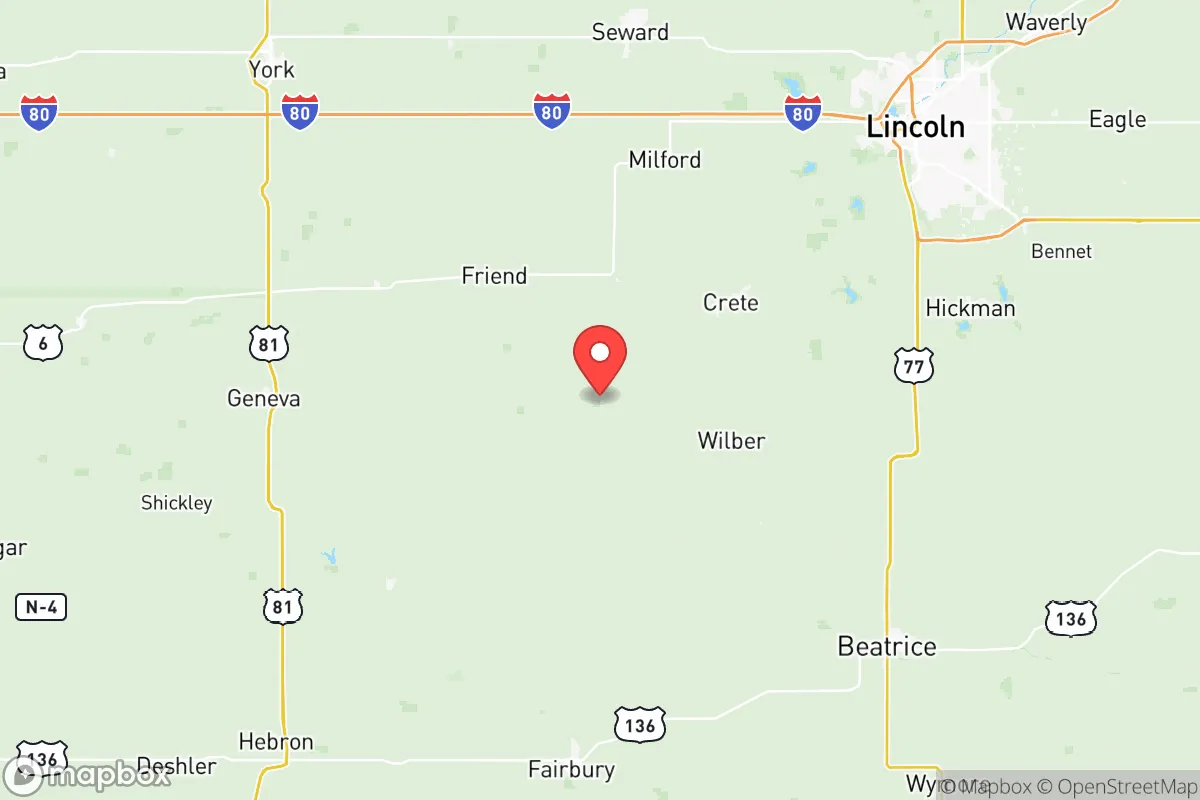
Photo: Wikipedia
Personal Sovereignty in Saline County
Viable for self-reliance. Generally workable, though some barriers may limit total independence.
What does Personal Sovereignty tell us?
Personal Sovereignty measures your capacity for self-reliance and independence with minimal government friction. Higher scores mean fewer barriers between you and the way you want to live... but it assumes you have the space you need and good neighbors.
What does this tell us?
Personal Sovereignty measures your capacity for self-reliance and independence with minimal government friction. Higher scores mean fewer barriers between you and the way you want to live... but it assumes you have the space you need and good neighbors.
State Policy
Energy independence: Importer (35% of energy produced in-state)
Personal Liberty
Homesteading

Personal Liberty Analysis
Saline County, Nebraska, offers a notably high degree of personal sovereignty, grounded in the state’s strong tradition of local control and limited government intervention. For individuals and families prioritizing autonomy, the county presents a regulatory environment that is generally light-touch, with property rights, self-defense, and self-reliance deeply embedded in the local culture. While Nebraska’s state-level framework provides a baseline of freedoms, Saline County’s specific mix of rural character, small-town governance, and proximity to larger cities like Lincoln creates a distinct sovereignty profile that varies across its communities.
Tax burden and regulatory posture in Saline County
Nebraska’s tax structure is a mixed bag for those seeking low fiscal interference. The state has a progressive income tax with rates ranging from 2.46% to 6.64% (2025), and a state sales tax of 5.5% (plus local options). Saline County itself imposes a local sales tax of 1.5%, bringing the combined rate in places like Wilber and Crete to 7.0%. Property taxes in Nebraska are among the highest in the nation relative to home values, with Saline County’s effective rate hovering around 1.7% of assessed value. However, the county’s regulatory posture is decidedly hands-off. There is no county-wide zoning in unincorporated areas, meaning residents in towns like De Witt or Western can build, fence, or modify property with minimal bureaucratic hurdles. Building permits are generally only required for new structures or major renovations in incorporated towns, and the county’s planning department is small and responsive. For a reader accustomed to urban permit delays or restrictive land-use codes, Saline County’s approach feels refreshingly direct—most projects can proceed with a simple conversation and a modest fee.
Self-defense and gun law specifics in Saline County
Nebraska is a shall-issue state for concealed carry permits, and Saline County’s sheriff’s office processes permits efficiently, typically within 30 days. The state does not require a permit to open carry, and as of 2023, permitless (constitutional) carry is legal for residents 21 and older. Saline County’s gun culture is robust but not aggressive; you’ll see firearms in vehicles and on private property regularly, but public carry is more common in rural areas like Swanton or Tobias than in the more populated Crete. The county has no local ordinances restricting firearm possession beyond state law, and the sheriff’s office is known for a pro-Second Amendment stance. Stand-your-ground laws apply statewide, and there is no duty to retreat in any place where a person has a legal right to be. For families, this means self-defense rights are clearly defined and respected. The only notable restriction is that concealed carry is prohibited in certain state-owned buildings and schools, but private property rights are strongly upheld—homeowners can post signage to exclude firearms without legal penalty, though few do.
Self-reliance and homesteading viability in Saline County
Homesteading and off-grid living are highly viable in Saline County, particularly outside its incorporated towns. Unincorporated areas have no zoning restrictions on alternative energy, rainwater collection, or composting toilets, making it straightforward to set up a self-sufficient property. Lot sizes in rural areas start at 1 acre and commonly range from 5 to 40 acres, with prices averaging $3,000–$5,000 per acre for raw land. Towns like Friend and Dorchester have more permissive ordinances for backyard chickens, small livestock, and gardens than larger Nebraska municipalities. Off-grid feasibility is strong: the county has ample groundwater, and solar installations are common, with no permitting hurdles beyond standard electrical inspections. The Nebraska Public Power District provides grid backup, but many residents in areas like Pleasant Dale (just west of the county line) operate fully independent systems. The main constraint is that the county enforces state well-drilling and septic regulations, which require permits and inspections—but these are straightforward and inexpensive compared to coastal states. For a family wanting to raise animals, grow food, and minimize utility dependence, Saline County’s regulatory environment is among the most accommodating in the eastern half of Nebraska.
Personal liberties in Saline County: parental rights, medical autonomy, speech, and property
Parental rights are strongly protected in Nebraska, and Saline County reflects this. The state has a parental bill of rights (LB 1082, 2024) that affirms parents’ authority over education, healthcare, and religious upbringing. Local school boards in Crete and Wilber are responsive to parental input, and there is no county-level mandate for mask or vaccine requirements in schools. Medical autonomy is similarly broad: Nebraska does not have a state-level vaccine mandate for adults, and the county health department focuses on voluntary services. Speech rights are robust, with no local ordinances restricting public expression beyond standard nuisance laws. Property rights are the bedrock of local sovereignty. Saline County has no county-wide rental registration or short-term rental bans, so owning and leasing property is largely unregulated. Eminent domain is rarely exercised, and the county assessor’s office is known for transparent valuation processes. The only notable limitation is that the county enforces state setback requirements for structures near property lines, but these are standard and easily navigable.
Overall, Saline County ranks among the more sovereignty-friendly areas in Nebraska, especially when compared to the more regulated environments of Lincoln or Omaha. The combination of low zoning, strong gun rights, permissive homesteading, and protected parental authority creates a landscape where personal independence is the default rather than the exception. For a conservative-leaning individual or family seeking a place where government stays out of daily life, Saline County delivers a balanced mix of rural freedom and practical governance—without the extreme isolation of western Nebraska or the regulatory creep of the state’s urban centers. The key is choosing the right community: Wilber offers a tight-knit Czech heritage with minimal bureaucracy, Crete provides more services but slightly more oversight, and the unincorporated areas around De Witt and Western offer near-total autonomy for those willing to handle their own infrastructure.

* Values derived from national, state, county, city and local statistics and may differ in a specific area. Last updated: 2026-07-02T05:41:16.000Z
Narrative content on this page is AI-generated and may contain mistakes. Verify any details that matter before acting on them.
ReloMaps may earn a commission from affiliate links at no extra cost to you.

