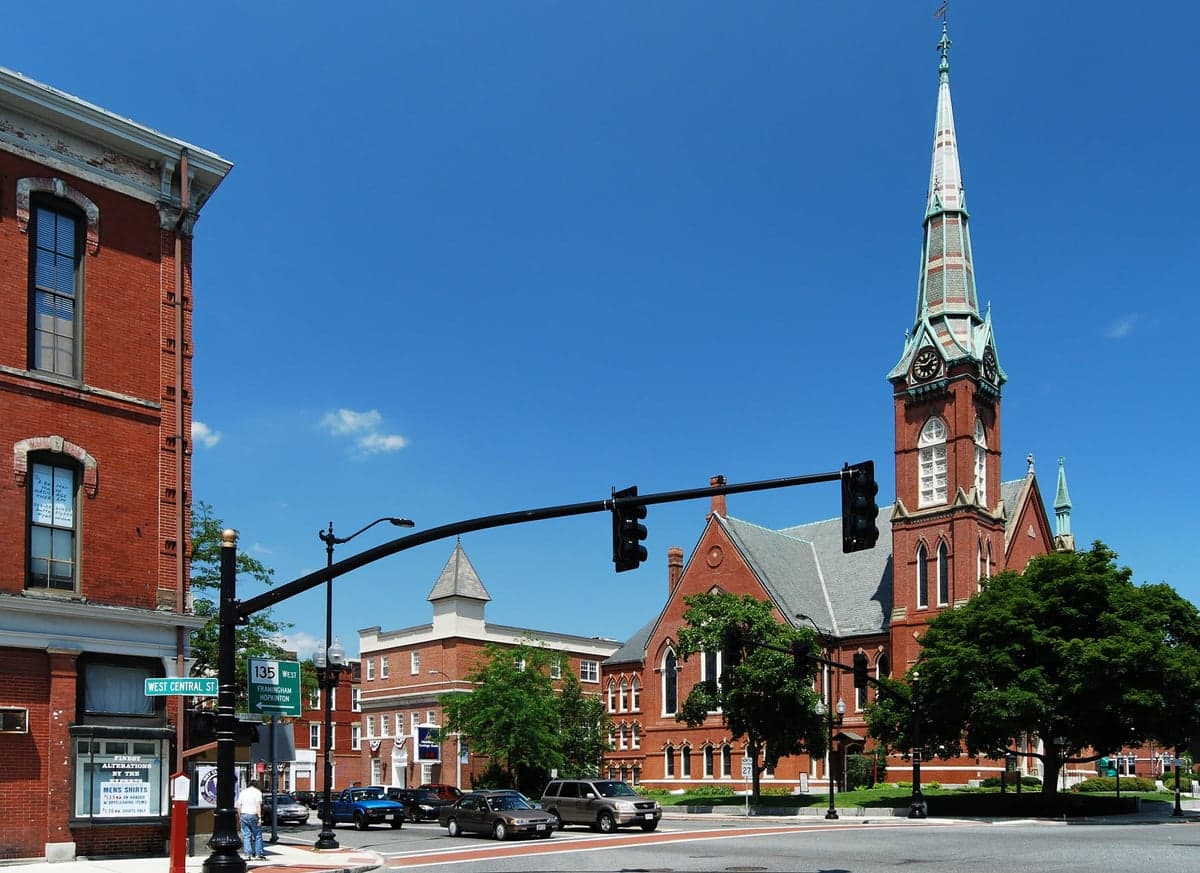
Photo: Wikipedia
Political ClimatePolitical Climate in Natick, MA
District shown is the primary district for this city’s centroid. Cities may span multiple districts.
Local Political AnalysisPolitical Analysis of Natick, MA
Natick, Massachusetts, is a reliably Democratic town that has been trending further left over the past decade, with a Cook Partisan Voting Index (PVI) of D+24. That’s a full nine points more Democratic than the state of Massachusetts as a whole, which sits at D+15. In practical terms, this means that in a presidential election year, Natick delivers margins for the Democratic candidate that are roughly 60-40 or even 65-35, while the state overall is closer to a 58-42 split. The shift has been gradual but steady: as recently as 2012, the town was still a bit more moderate, but the nationalization of local politics and an influx of younger, college-educated families from Boston and Cambridge have accelerated the move left.
How it compares
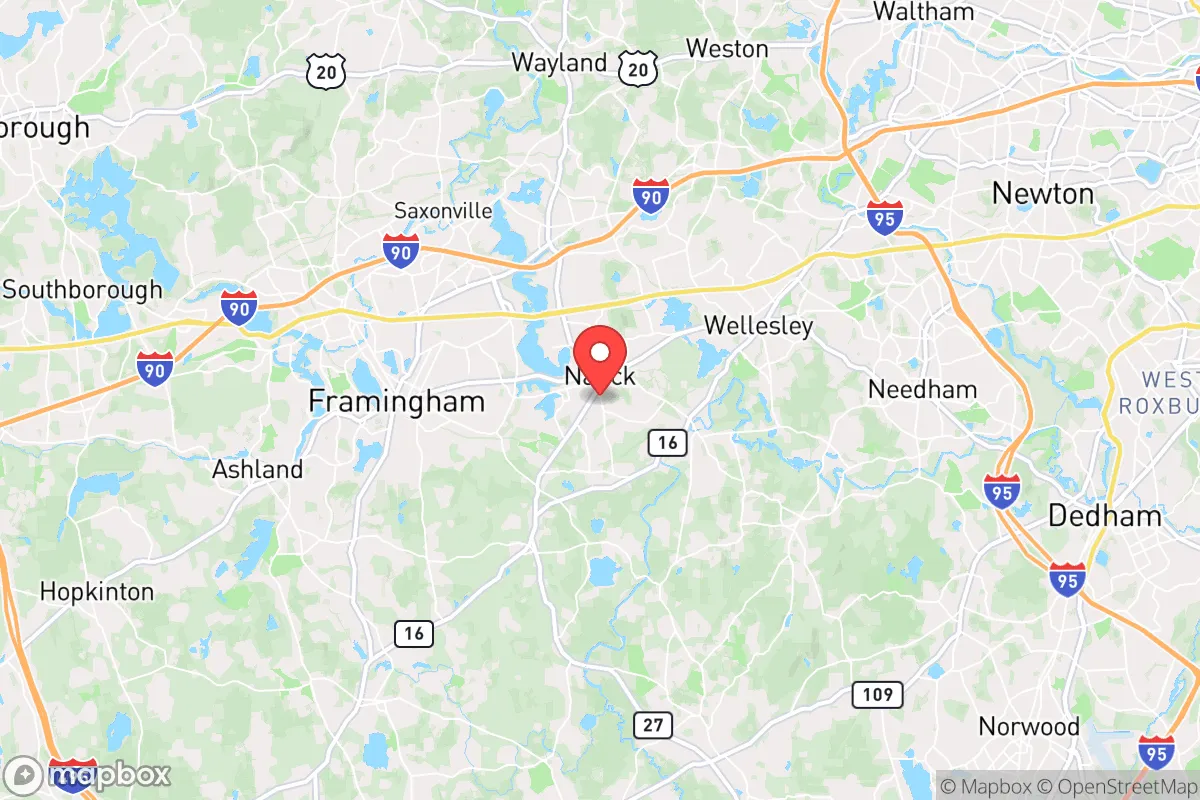
Natick’s D+24 PVI places it among the most Democratic suburbs in the MetroWest region. For context, neighboring towns like Wellesley (D+18) and Needham (D+20) are also strongly blue, but Natick is noticeably more progressive than Framingham (D+16) or Wayland (D+15). The real contrast, however, is with towns just a few miles west. Hopkinton (D+8) and Southborough (D+6) are still Democratic-leaning but far more competitive, with a visible Republican minority that can win local races. Head further west to Hudson (D+4) or Marlborough (D+2), and you’ll find swing towns where both parties have a real shot. So while Natick is solidly blue, it’s not an outlier—it’s just the left edge of a spectrum that runs from deep blue in the east to purple in the central part of the state.
What this means for residents
For liberal residents, Natick is a comfortable place to live. Town government is dominated by Democrats, and progressive policies—like the town’s Community Preservation Act funding for affordable housing, a robust public school system that spends over $18,000 per pupil, and a plastic bag ban—pass easily. Conservative residents, however, aren’t exactly shut out. The town still has a small but active Republican Town Committee, and local races for Select Board or School Committee often feature at least one Republican or unenrolled candidate who gets 35-40% of the vote. The real friction point is taxes: Natick’s property tax rate is moderate for the area, but the town’s high home values (median around $750,000) mean that even a modest rate produces a hefty bill. Conservative residents often grumble about school spending and zoning changes, but they’re a minority voice in a town where the default assumption is that government action is a net positive.
One cultural distinction worth noting is Natick’s relationship with its own history. The town is the site of the Natick Mall, one of the largest shopping centers in New England, and that commercial base has made it a regional hub. But the town also has a strong preservationist streak—the historic village of South Natick, with its 19th-century homes and the old Bacon Free Library, is fiercely protected. This tension between development and preservation often plays out along political lines, with newer residents pushing for more density near the commuter rail and longer-term homeowners resisting change. It’s a classic suburban dynamic, but in Natick, the progressive majority usually wins the argument, even if the pace of change frustrates everyone. If you’re moving here, expect a town that votes blue, spends freely on schools and services, and debates its future in terms of how to grow, not whether to grow.

State Political ClimatePolitical Climate in Massachusetts
State Political AnalysisPolitical Environment in the State
Massachusetts is one of the most reliably Democratic states in the country, with a Cook Partisan Voting Index of D+15, meaning it votes about 15 points more Democratic than the national average in presidential elections. Over the past 20 years, the state has shifted further left, driven by the consolidation of the Boston metro area and the collapse of once-competitive Republican strongholds in the suburbs. While the state still elects moderate Republican governors (Charlie Baker served until 2023), the legislature is overwhelmingly Democratic, and the state has not voted for a Republican presidential candidate since 1984.
Urban vs. rural divide
The political map of Massachusetts is defined by the Boston metro area, which accounts for roughly 70% of the state’s population and votes heavily Democratic. Boston itself, along with Cambridge, Somerville, and Brookline, are among the most liberal jurisdictions in the country, routinely giving Democrats 80-90% of the vote. The western part of the state, including Springfield and Pittsfield, also leans Democratic, though less intensely. The rural areas—especially in central and southeastern Massachusetts—are more competitive. For example, Worcester County, home to the city of Worcester, has a mix of blue-collar and suburban voters that sometimes elect Republicans at the local level. The Cape Cod and Islands region (Barnstable, Dukes, Nantucket counties) is a swing area, with wealthy retirees and seasonal residents who lean moderate. The only reliably Republican areas are small towns in the far western Berkshires (like Sandisfield) and a few exurban pockets in Plymouth and Bristol counties. In 2024, the state’s most Republican county was Barnstable, which still voted for Kamala Harris by about 8 points.
Policy environment
Massachusetts has a high-tax, high-service policy environment. The state income tax is a flat 5% (reduced from 5.15% in 2023), and the sales tax is 6.25%. Property taxes are moderate by national standards but high for New England, averaging around 1.2% of home value. The state has a strong regulatory posture on housing, environmental, and labor issues. Education policy is a major focus: Massachusetts consistently ranks first in the nation for K-12 test scores, and the state has universal pre-K and a robust public university system (UMass Amherst, UMass Boston, etc.). Healthcare is heavily regulated, with near-universal coverage under the state’s 2006 health reform law (the model for the ACA). Election laws are among the most liberal: no-excuse mail-in voting, same-day registration, and early voting are all permanent. The state also has a strict gun control regime, including a ban on assault weapons, a licensing system for handguns, and a “red flag” law. Self-defense laws are restrictive; there is no “stand your ground” statute, and the duty to retreat is enforced.
Recent policy direction
In the last five years, Massachusetts has moved decisively left on several fronts. In 2022, the state passed the Work and Family Mobility Act, allowing undocumented immigrants to obtain driver’s licenses. In 2023, the legislature overrode Governor Maura Healey’s veto to pass a law expanding abortion access, including protections for providers and patients traveling from other states. On gun policy, the 2024 H.4885 law banned the possession of “ghost guns” and expanded the state’s assault weapons ban to include more models. On education, the state has moved toward a “whole child” approach, with new mandates for social-emotional learning and diversity, equity, and inclusion training in public schools. Parental rights have been a flashpoint: in 2023, the state passed a law requiring schools to adopt policies that affirm transgender students’ gender identity, including allowing them to use preferred names and pronouns without parental consent. On property rights, the state has implemented a transfer fee on real estate transactions over $1 million (the “millionaire’s tax” surcharge of 4% on income over $1 million, passed in 2022). Voting access has been expanded: the 2022 VOTES Act made mail-in voting permanent and added same-day registration. On privacy and surveillance, the state has a strong wiretap law requiring two-party consent, but police use of facial recognition is largely unregulated. Medical and bodily autonomy is broadly protected: gender-affirming care for minors is legal, and the state is a “sanctuary” for abortion seekers.
Civil unrest & political movements
Massachusetts has a long history of organized political activism, mostly on the left. The Boston area saw large Black Lives Matter protests in 2020, and the state has a vibrant climate activist scene (e.g., Extinction Rebellion protests in Cambridge). On the right, the state has a small but active conservative movement, centered around groups like the Massachusetts Fiscal Alliance and the Massachusetts Republican Party. Immigration politics are a major flashpoint: the state is a “sanctuary state” under a 2017 executive order (codified in 2023), meaning local law enforcement does not cooperate with federal immigration detainers. This has led to tensions in cities like Boston and Lawrence, where immigrant populations are large. Election integrity controversies have been minimal; the state’s mail-in voting system has been widely accepted, and there have been no major fraud allegations. Secession or nullification rhetoric is virtually nonexistent. The most visible flashpoint for a new resident would be the contrast between the liberal urban core and the more moderate rural areas, especially around issues like mask mandates (which were strictly enforced in Boston but lax in the Berkshires) and school curriculum.
Projection
Over the next 5-10 years, Massachusetts is likely to become even more Democratic, driven by in-migration from other blue states (especially New York and California) and the continued growth of the Boston metro area. The state’s population is aging, but the influx of young professionals and immigrants is keeping the electorate liberal. The Republican Party is in a long-term decline: the last Republican to win a statewide election was Charlie Baker in 2018, and the party has lost its foothold in the suburbs. The state’s tax and regulatory environment will likely remain high, with potential for a wealth tax or increased corporate taxes. The biggest wild card is housing: the state’s high cost of living is driving out middle-class families, which could shift the electorate toward even higher-income, more liberal voters. A conservative relocator should expect to be in a permanent minority, with little chance of changing state-level policy. A liberal relocator will find a state that is largely aligned with their values, but with high costs and a competitive housing market.
For a new resident, the bottom line is that Massachusetts is a state where your vote in state and local elections will have limited impact if you lean conservative—the legislature is supermajority Democratic, and the governor is a Democrat. However, the state’s high quality of life (top-ranked schools, excellent healthcare, low crime) is real, and many conservative-leaning residents find they can live comfortably in the more moderate suburbs or rural areas. If you value personal liberty on issues like gun rights or parental control over education, you will face significant restrictions. If you prioritize social services, environmental protection, and a strong safety net, the state delivers. The key is to choose your town carefully: a conservative family might find a better fit in a town like Sandisfield or Plymouth, while a liberal family will feel at home in Cambridge or Northampton. The state’s political trajectory is clear, and it’s not changing course anytime soon.
* Values derived from national, state, county, city and local statistics and may differ in a specific area. Last updated: 2026-10-12T21:22:36.000Z
Narrative content on this page is AI-generated and may contain mistakes. Verify any details that matter before acting on them.
ReloMaps may earn a commission from affiliate links at no extra cost to you.

