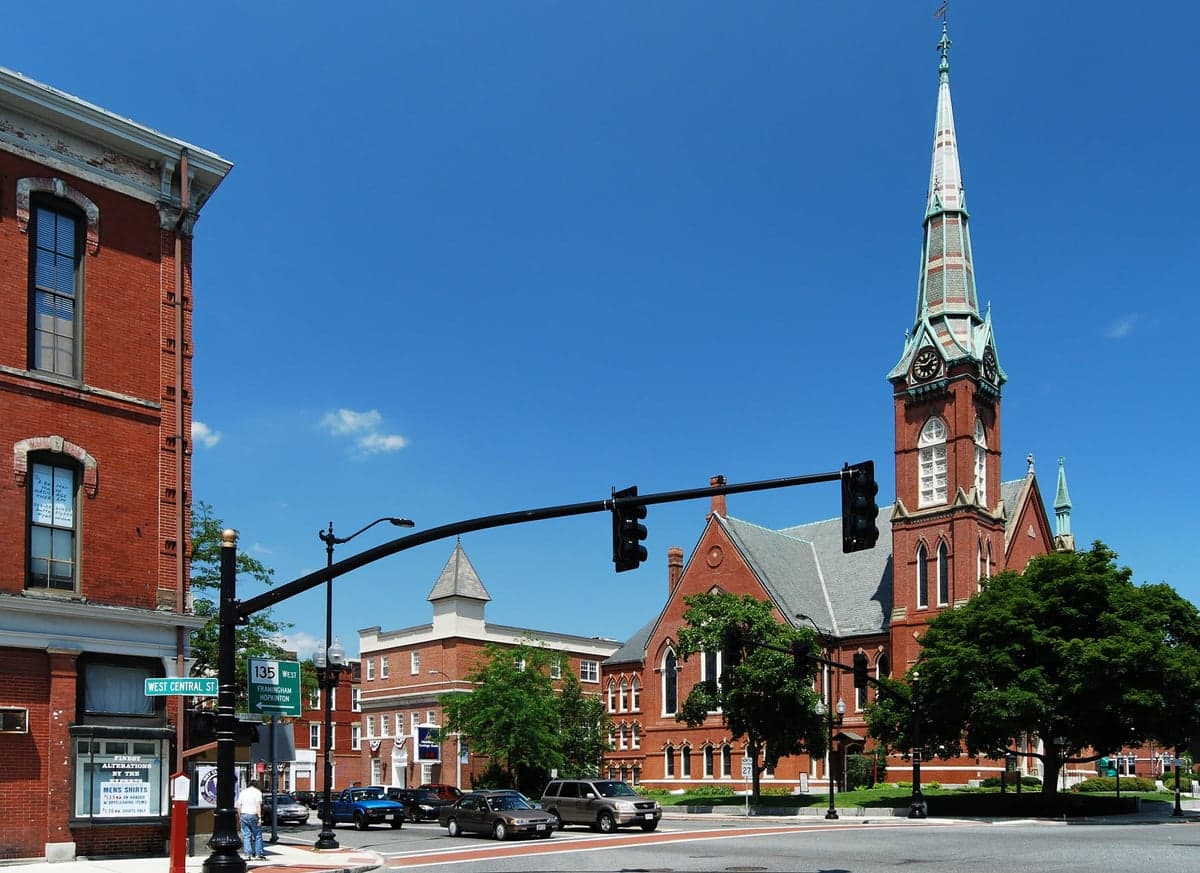
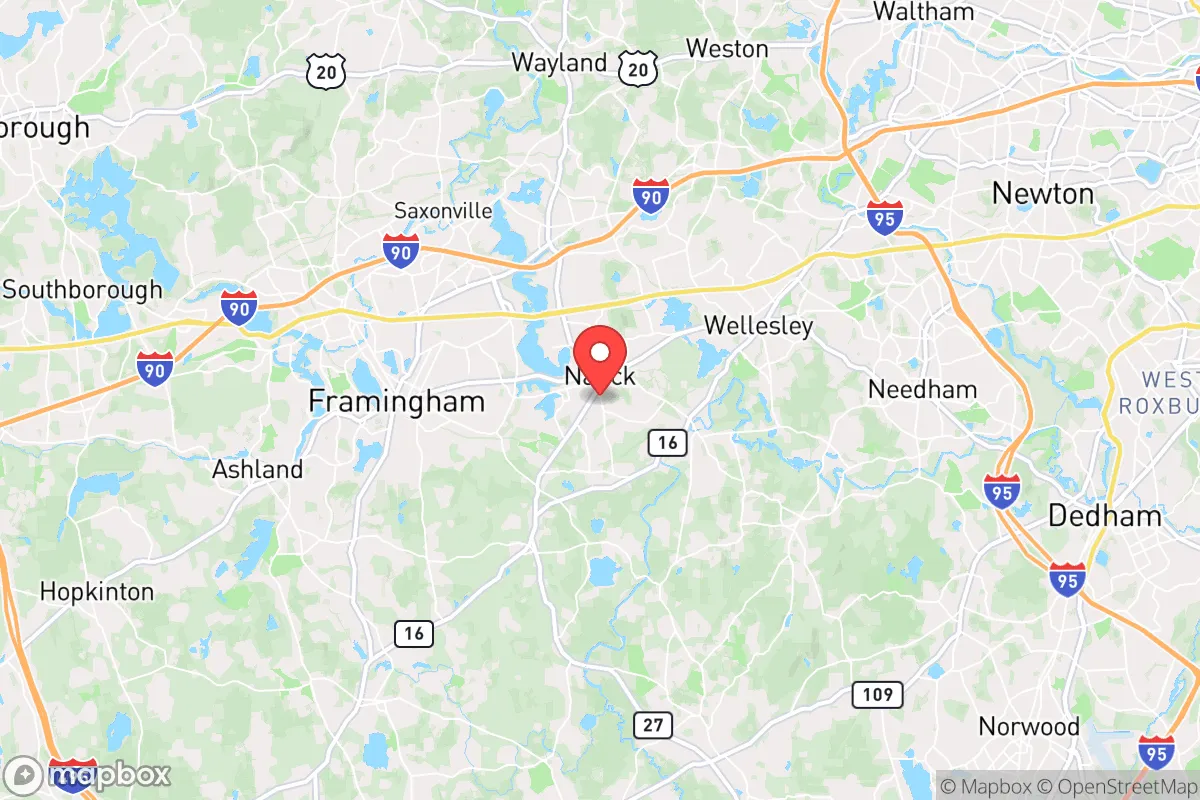
Photo: Wikipedia
Demographics of Natick, MA
Affluence Level in Natick, MA
An upper-middle-class area. Household wealth, education levels, and homeownership run ahead of national benchmarks.
People of Natick, MA
Natick, Massachusetts, is a small, highly educated community of 5,275 residents where 61.2% of adults hold a college degree, a figure that places it among the most credentialed towns in the state. The population is predominantly white (82.7%), but the town has seen notable growth in East/Southeast Asian (5.3%) and Indian-subcontinent (3.9%) communities, giving it a quietly diverse, professional character. With a foreign-born share of just 2.2%, Natick remains a largely native-born, family-oriented suburb where generational roots run deep. Its identity is shaped by a blend of historic Yankee stock, mid-century suburban expansion, and recent waves of highly skilled immigrants drawn to the area’s top-ranked schools and proximity to Boston’s tech corridor.
How the city was settled and grew
Natick’s original population was built on a unique foundation: it was one of the first “praying towns” established by Puritan missionary John Eliot in the 1650s, where local Native American groups were resettled and converted to Christianity. The town’s name comes from the Nipmuc word for “place of hills,” and the original settlement centered around what is now South Natick, along the Charles River. After the colonial period, Natick’s growth was slow and agricultural until the mid-19th century, when the arrival of the railroad and the rise of shoe manufacturing transformed it into a small industrial center. Irish immigrants came first to work in the factories, settling in the Natick Center area near the mills and rail depot, followed by French-Canadian and Italian laborers who built homes in the Pleasant Street and West Natick neighborhoods. By 1900, Natick was a classic New England mill town with a mix of Yankee farmers and Catholic immigrant workers, a pattern that held steady through the Great Depression and World War II.
Modern era (post-1965)
The post-1965 period brought two major shifts to Natick’s population. First, the completion of the Massachusetts Turnpike (I-90) and the expansion of Route 9 turned the town into a desirable bedroom community for professionals working in Boston and the growing Route 128 tech belt. This drew a wave of domestic in-migration from other parts of Massachusetts and the Northeast, accelerating suburbanization and pushing development into the North Natick area, where larger single-family homes and new subdivisions replaced former farmland. Second, the 1980s and 1990s saw the arrival of the first significant non-European populations, primarily East/Southeast Asian families—many of Chinese and Korean origin—who were attracted by Natick’s excellent public schools and safe neighborhoods. These families concentrated in the North Natick and East Natick areas, near the high school and the commuter rail station. More recently, the 2010s brought a smaller but notable influx of Indian-subcontinent professionals, many working in tech and biotech, who have settled in the same school-accessible neighborhoods. The Hispanic population (4.9%) and Black population (0.6%) remain small, with Hispanic residents dispersed across the town rather than concentrated in any single district.
The future
Natick’s population is projected to remain stable in size—the town is largely built out with limited land for new development—but its demographic composition will continue to diversify slowly. The East/Southeast Asian and Indian-subcontinent shares are likely to grow modestly as existing families expand and new professionals are drawn by the school system and the proximity to major employers like MathWorks, TJX Companies, and the Natick Soldier Systems Center. The white share, while still dominant, will gradually decline as older Yankee and Irish-Italian families age out and younger, more diverse households move in. New construction is limited to a few infill projects and the redevelopment of the Natick Mall area, which is adding luxury apartments and attracting a younger, more transient population of renters. The town’s cultural identity is evolving from a quiet, insular suburb into a more cosmopolitan, knowledge-economy hub, though it remains overwhelmingly family-oriented and politically moderate. The next decade will likely see Natick become slightly more Asian and Indian, slightly less white, and even more educated, but it will retain its core character as a safe, high-opportunity community for professionals.
For someone moving in now, Natick offers a stable, low-crime environment with exceptional schools and a population that is increasingly diverse in background but unified by high educational attainment and professional ambition. It is not a place of rapid change or ethnic enclaves, but rather a quietly evolving suburb where new residents—whether from Boston, China, or India—are absorbed into a well-established, predominantly white community. The bottom line: Natick is becoming a more global, more credentialed version of its former self, ideal for families who prioritize education and safety over cultural vibrancy or urban energy.

* Values derived from national, state, county, city and local statistics and may differ in a specific area. Last updated: 2026-10-12T21:22:36.000Z
Narrative content on this page is AI-generated and may contain mistakes. Verify any details that matter before acting on them.
ReloMaps may earn a commission from affiliate links at no extra cost to you.

