
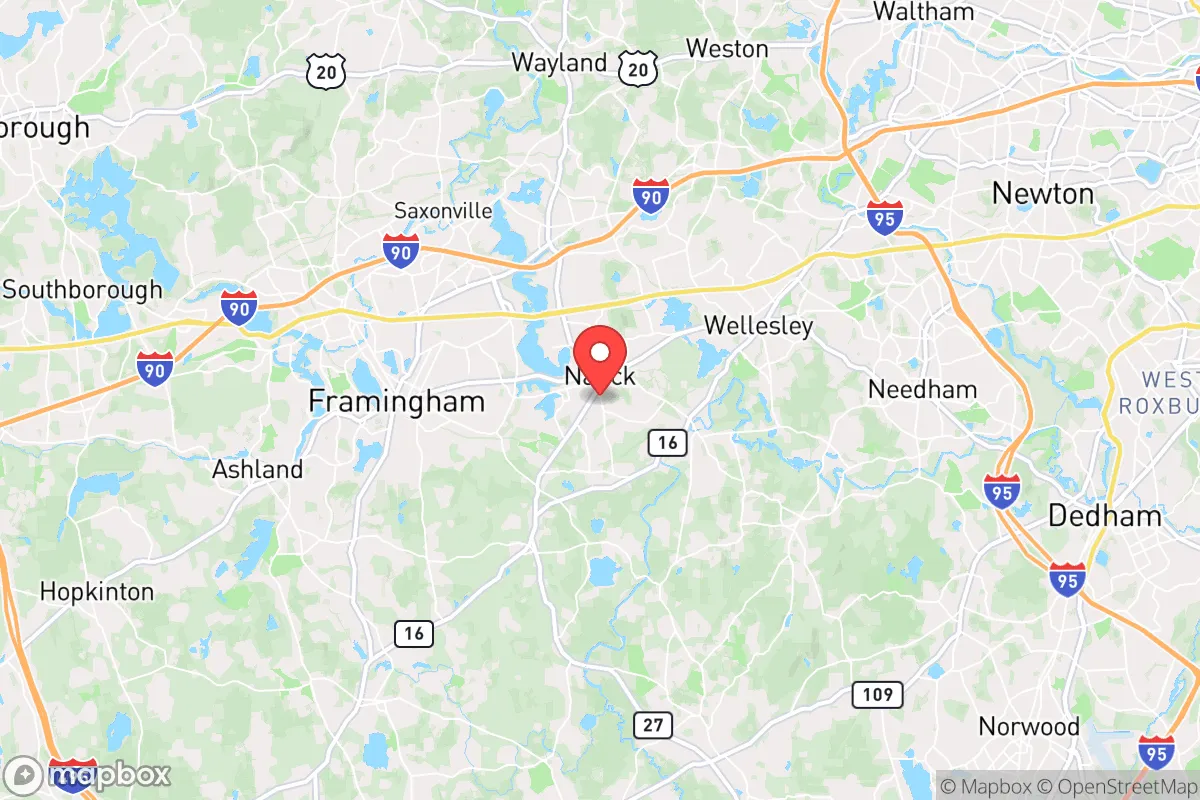
Photo: Wikipedia
Personal Sovereignty in Natick, MA
Viable for self-reliance. Generally workable, though some barriers may limit total independence.
What does Personal Sovereignty tell us?
Personal Sovereignty measures your capacity for self-reliance and independence with minimal government friction. Higher scores mean fewer barriers between you and the way you want to live... but it assumes you have the space you need and good neighbors.
What does this tell us?
Personal Sovereignty measures your capacity for self-reliance and independence with minimal government friction. Higher scores mean fewer barriers between you and the way you want to live... but it assumes you have the space you need and good neighbors.
State Policy
Energy independence: Importer (5% of energy produced in-state)
Personal Liberty
Homesteading

Personal Liberty Analysis
Natick, Massachusetts, presents a complex environment for personal sovereignty, where a high degree of local affluence and progressive state governance create a tightly regulated, high-tax landscape that significantly constrains individual autonomy in several key areas. While the town offers excellent public services and a safe, well-maintained community, residents face substantial limitations on self-defense rights, property use, and tax freedom compared to many other regions of the country. For a relocation-minded individual or family prioritizing personal independence, Natick requires a careful trade-off: accepting a heavy regulatory and fiscal burden in exchange for top-tier education, infrastructure, and low crime.
Tax burden and regulatory posture in Natick
Massachusetts is a high-tax state, and Natick residents feel this acutely. The state imposes a flat 5.0% personal income tax on all earned income, with no standard deduction or personal exemption, meaning every dollar earned is taxed from the first dollar. Property taxes in Natick are significant, with a 2025 rate of approximately $11.50 per $1,000 of assessed value, applied to some of the highest home values in the MetroWest region—median home prices routinely exceed $800,000. This combination yields an effective total tax burden that ranks among the highest in the nation. The regulatory posture is similarly heavy. Massachusetts has a robust state-level building code, strict environmental regulations (including the Wetlands Protection Act), and a powerful state Department of Environmental Protection that reviews nearly all significant property alterations. Local zoning in Natick is detailed and enforced, with most residential lots in single-family zones requiring a minimum of 20,000 square feet and strict setback rules. Permitting for even minor home improvements can take months, and any project touching a wetland buffer—common in this area—triggers a lengthy, expensive local conservation commission review. The state also mandates paid family and medical leave (PFML) funded by a payroll tax, and a separate short-term disability insurance program. For a reader accustomed to lighter-touch governance, Natick’s regulatory environment feels pervasive and costly.
Self-defense and gun law specifics in Natick
Massachusetts has some of the most restrictive gun laws in the United States, and Natick fully enforces them. The state requires a License to Carry (LTC) for any handgun possession, whether open or concealed, and issuance is at the discretion of the local police chief. While Natick is generally considered a "shall-issue" town in practice, the process is onerous: applicants must complete a state-approved safety course, provide references, undergo a background check including fingerprints, and pay fees. The license is valid for up to six years, but renewal requires repeating much of the process. Massachusetts bans "assault weapons" by name and feature, effectively prohibiting many common semi-automatic rifles and shotguns. Magazine capacity is capped at 10 rounds for rifles and handguns. The state also has a strict "safe storage" law requiring all firearms to be locked in a container or with a trigger lock when not in use, even inside the home. There is no "stand your ground" law; instead, Massachusetts imposes a "duty to retreat" in public places before using deadly force, unless the person is in their own home. For a reader who views the right to self-defense as a core personal liberty, Natick and Massachusetts represent a deeply restrictive environment. Carrying a firearm for personal protection is legally possible but bureaucratically burdensome, and the legal landscape strongly discourages defensive gun use outside the home.
Self-reliance and homesteading viability in Natick
Homesteading and off-grid living are effectively non-viable within Natick’s borders. The town is a densely developed inner suburb of Boston, with a population density of over 2,500 people per square mile. Typical residential lots in established neighborhoods range from 0.25 to 0.5 acres, with newer subdivisions often on smaller parcels. Zoning regulations prohibit keeping livestock—including chickens, goats, or bees—on standard residential lots without a special permit, which is rarely granted. The town’s health department strictly regulates composting, rainwater collection, and any structure not connected to municipal water and sewer. Off-grid energy systems are effectively illegal because all homes must be connected to the electrical grid per the state building code, and net metering rules are complex and utility-controlled. Growing a substantial portion of one’s own food is limited by small lot sizes, restrictive homeowners’ association covenants in many neighborhoods, and the short New England growing season. For a reader seeking land for a garden, a workshop, or any degree of subsistence living, Natick offers almost no opportunity. The regulatory environment is designed to maintain a uniform, suburban aesthetic and to ensure all properties meet modern infrastructure standards, leaving little room for independent, self-reliant living arrangements.
Personal liberties in Natick: parental rights, medical autonomy, speech, and property
Personal liberties in Natick are shaped by a strong state government that often preempts local control. Parental rights in education are a contested area: Massachusetts has a comprehensive sex education law (Chapter 71, Section 32A) that requires schools to teach age-appropriate, medically accurate information, and the state has resisted opt-out provisions for specific topics. The state also mandates that schools adopt policies supporting transgender students, including allowing them to use facilities matching their gender identity, without parental notification requirements. Medical autonomy is similarly constrained. Massachusetts was an early adopter of mandatory childhood vaccination for school attendance, with only narrow medical exemptions (no religious or philosophical exemptions). During the COVID-19 pandemic, the state imposed one of the nation’s longest-lasting mask mandates in schools and a vaccine mandate for healthcare workers, though these have since been lifted. Free speech is protected by the First Amendment, but Massachusetts has a strict anti-SLAPP law that can be used to deter certain types of public commentary, and the state’s public nuisance laws have been used to restrict expressive activities on private property. Property rights are heavily circumscribed by the state’s Chapter 40B affordable housing law, which allows developers to override local zoning if a town has less than 10% affordable housing—Natick is currently just above that threshold, but the threat remains. For a reader who values maximum personal discretion in medical decisions, education, and property use, Natick’s environment is notably restrictive compared to states with stronger protections for individual choice.
Overall, Natick offers a very low level of personal sovereignty relative to most of the United States. The combination of high taxes, stringent gun control, dense zoning that precludes self-reliance, and a state government that actively limits parental and medical autonomy creates an environment where individual freedom is consistently subordinated to collective public policy goals. For a relocation-minded individual or family who prioritizes personal independence—whether through lower taxes, the right to self-defense, the ability to homestead, or freedom from government mandates in education and healthcare—Natick is a poor fit. It is best suited for those who value excellent public schools, low crime, and robust public services enough to accept a heavily regulated, high-cost, and autonomy-limited lifestyle. Readers seeking greater personal sovereignty would find more alignment in states like New Hampshire, Texas, or Florida, where tax burdens are lower, gun laws are more permissive, and local zoning allows for greater self-reliance.

* Values derived from national, state, county, city and local statistics and may differ in a specific area. Last updated: 2026-10-12T21:22:36.000Z
Narrative content on this page is AI-generated and may contain mistakes. Verify any details that matter before acting on them.
ReloMaps may earn a commission from affiliate links at no extra cost to you.

