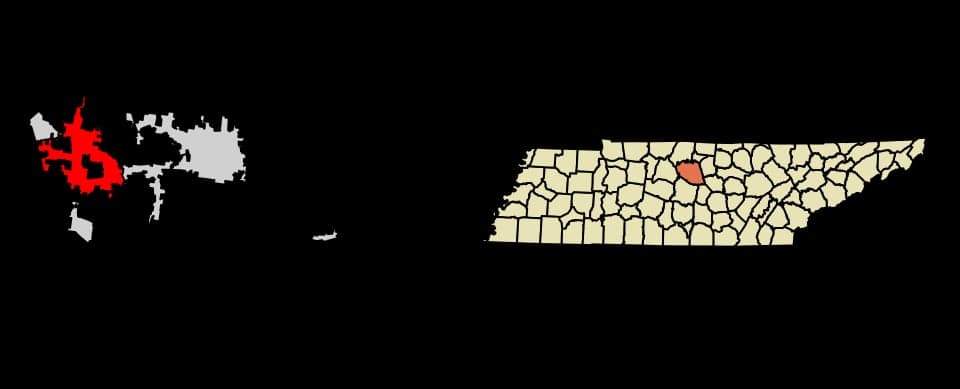
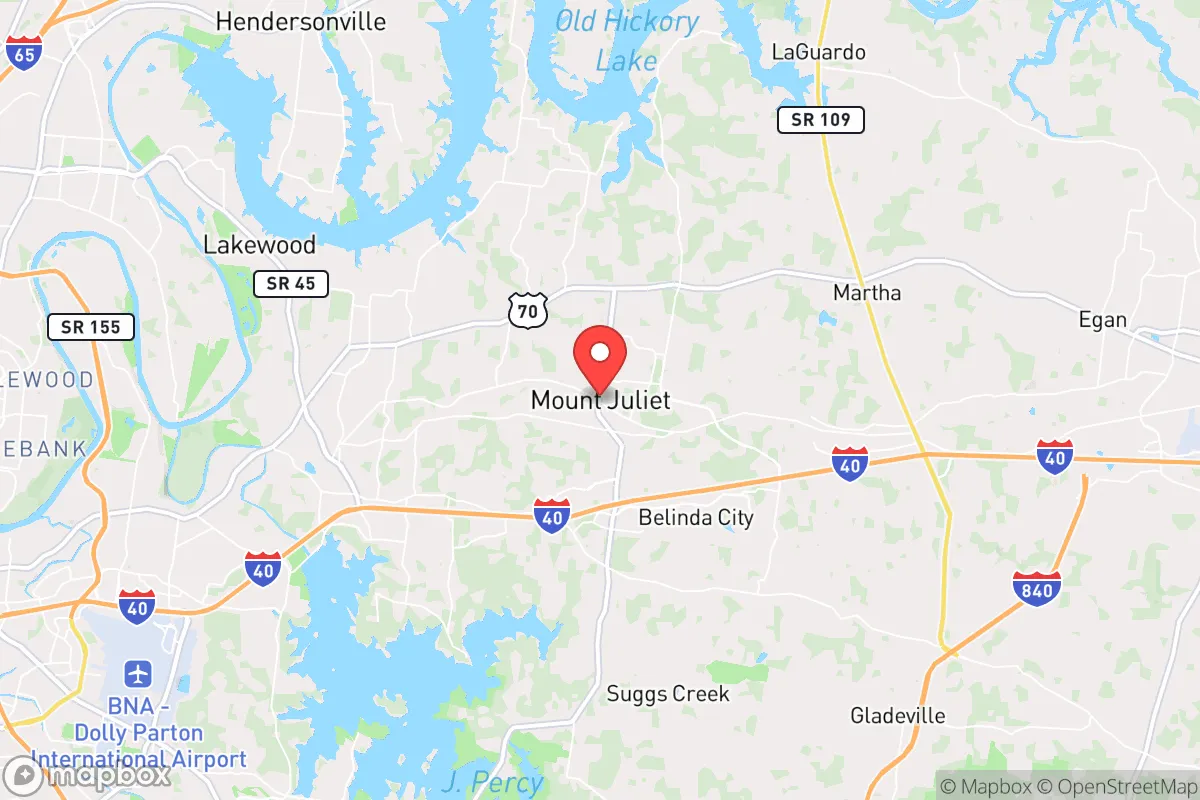
Photo: Wikipedia
Political ClimatePolitical Climate in Mt. Juliet, TN
District shown is the primary district for this city’s centroid. Cities may span multiple districts.
Local Political AnalysisPolitical Analysis of Mt. Juliet, TN
Mt. Juliet is a reliably Republican suburb, and it’s been trending that way for a generation. The city sits in Wilson County, which anchors the eastern edge of the Nashville metro, and the politics here are decidedly more conservative than what you’d find just 20 miles west in Davidson County. With a Cook PVI of R+17, Mt. Juliet is about four points more Republican than the state of Tennessee as a whole, which sits at R+13. That gap might sound small, but in practice it means this is one of the most dependable red strongholds in Middle Tennessee, and it’s only getting redder as new subdivisions fill up with families who moved here specifically for the schools and the lower taxes.
How it compares
The contrast with nearby cities is stark. Nashville, just a short drive down I-40, is a deep blue island in a red state, with a Cook PVI of roughly D+28. Lebanon, the county seat of Wilson County, is also Republican but a bit more moderate in tone, often splitting its votes between establishment and populist wings of the GOP. Franklin and Brentwood, to the southwest, are Republican but lean more toward the country-club, business-friendly wing of the party. Mt. Juliet, by contrast, feels more like a working-class and upper-middle-class exurb where the dominant political energy is cultural conservatism — think Second Amendment rights, school choice, and a general suspicion of Metro Nashville’s zoning and spending policies. The city’s own municipal elections are nonpartisan, but the local commission and mayor’s office have been consistently conservative for decades, and there’s little appetite for changing that.
What this means for residents
For conservative residents, Mt. Juliet is about as comfortable as it gets in Tennessee. The Wilson County GOP is well-organized, and local races are often decided in the Republican primary rather than the general election. You’ll see plenty of yard signs for statewide and federal candidates, and the county reliably delivers 65-70% of its vote to the GOP presidential nominee. For liberal residents, the reality is that you’re in a clear minority, but you’re not isolated. Nashville’s progressive politics are close enough for day trips, and there are active Democratic groups in Wilson County that meet monthly, though they rarely win local office. The practical effect is that public policy here skews toward low taxes, minimal regulation, and a strong emphasis on law-and-order — Wilson County consistently funds its sheriff’s department generously and has resisted some of the criminal justice reforms that Nashville has embraced.
One thing that sets Mt. Juliet apart from the rest of Tennessee is its rapid growth and the tension that comes with it. The city has been one of the fastest-growing in the state for over a decade, and that growth has brought a new wave of residents — many from out of state — who are often more moderate than the old guard. You can see the friction in local debates over density, traffic, and school crowding. The old-timers want to keep things rural and slow; the newcomers want amenities and infrastructure. So far, the conservative majority has held the line on zoning, but the trajectory suggests that within a decade, Mt. Juliet could start to look a bit more like a purple suburb, even if it never comes close to flipping blue. For now, though, if you’re looking for a place where the politics are predictable, the taxes are low, and the neighbors wave back, this is it.

State Political ClimatePolitical Climate in Tennessee
State Political AnalysisPolitical Environment in the State
Tennessee has shifted from a reliably red state to a deep-red stronghold over the past two decades, now carrying a Cook PVI of R+13 — meaning it votes about 13 points more Republican than the nation as a whole. The state hasn't backed a Democrat for president since Bill Clinton in 1996, and the GOP now holds supermajorities in both chambers of the General Assembly. The real story isn't just the margin, though; it's the direction — Tennessee has moved rightward faster than almost any other Southern state since 2010, driven by a mix of rural consolidation, suburban realignment, and a steady stream of conservative in-migration from California, Illinois, and the Northeast.
Urban vs. rural divide
The political map of Tennessee is a study in stark contrasts. The four major metros — Nashville, Memphis, Knoxville, and Chattanooga — anchor the state's Democratic vote, but only two of them are genuinely blue. Nashville (Davidson County) and Memphis (Shelby County) are the Democratic engines, together producing roughly 40% of the state's Democratic votes. Knoxville and Chattanooga, by contrast, are conservative-leaning metros surrounded by deep-red suburbs and exurbs; Hamilton County (Chattanooga) has trended Republican in recent cycles, while Knox County hasn't voted Democratic for president since 2000.
The rural and small-town expanse between these metros is where the state's Republican supermajority is built. Counties like Williamson (south of Nashville), Wilson, and Rutherford have flipped from swing to solidly Republican over the past decade, driven by affluent, family-oriented newcomers. Meanwhile, the state's rural western counties — like Weakley, Gibson, and Carroll — vote 75-80% Republican. The one notable exception to the rural red wave is the Mississippi Delta region around Memphis, where majority-Black counties like Haywood and Lauderdale remain heavily Democratic. The net effect: a state where a Democrat can win Nashville and Memphis by 40-point margins and still lose the statewide popular vote by 30.
Policy environment
Tennessee's policy posture is aggressively conservative, and it's been engineered that way deliberately. The state has no income tax — not just no personal income tax, but no tax on wages, interest, or dividends at all. The Hall Income Tax on investment earnings was fully repealed in 2021, making Tennessee one of just nine states with zero income tax. Sales tax is the trade-off: a state rate of 7%, plus local add-ons that push the combined rate to 9.75% in Nashville and Memphis — among the highest in the nation.
Regulatory posture is light-touch by design. Tennessee is a right-to-work state, has no state-level minimum wage (federal $7.25 applies), and has become a magnet for corporate relocations — most notably the Ford BlueOval City EV plant near Memphis and the massive Oracle campus in Nashville. Education policy has shifted sharply toward school choice: the state's Education Savings Account program, initially limited to Nashville and Memphis, was expanded statewide in 2024. Healthcare is a mixed bag — Tennessee rejected Medicaid expansion under the Affordable Care Act, leaving roughly 300,000 residents in the coverage gap, yet the state has one of the nation's most robust rural hospital networks. Election laws have tightened: voter ID requirements, stricter absentee ballot rules, and a 2023 law making it a felony for election officials to send unsolicited absentee ballot applications.
Recent policy direction
The last five years have seen Tennessee move decisively on several fronts that matter to relocators weighing personal liberty and government reach. On guns, the state became a constitutional carry state in 2021 — no permit required to carry a handgun, openly or concealed, for anyone 21 or older. On education and parental rights, the 2022 "Parental Bill of Rights" (SB 1804) requires schools to notify parents of any changes to a student's mental or physical health services, and the 2023 "Age-Appropriate Materials Act" restricts classroom content on sexual orientation and gender identity. The state also passed a 2023 law requiring public school teachers to out transgender students to their parents.
On speech and privacy, Tennessee has been a leader in the conservative legal fight against federal overreach — the state's 2023 "Tennessee Works Act" includes a provision barring state contracts with companies that discriminate against firearm businesses, and the attorney general has filed suit against the Biden administration's Title IX rules. On medical and bodily autonomy, the state enacted a near-total abortion ban in 2022 with no exceptions for rape or incest, and in 2024 passed a law allowing parents to sue schools for providing gender-affirming care without consent. Property rights have been strengthened through a 2023 law limiting the use of eminent domain for private development. On voting, the state has moved to require proof of citizenship for new voter registrations — a policy that passed in 2024 and is currently facing legal challenge.
Civil unrest & political movements
Tennessee hasn't seen the kind of sustained civil unrest that has marked states like Oregon or New York, but there have been flashpoints. The 2020 protests following George Floyd's death in Nashville and Memphis were significant — the Nashville protest drew thousands and resulted in the toppling of a statue of Edward Carmack, a former U.S. senator and white supremacist. More recently, the 2023 Covenant School shooting in Nashville triggered a wave of pro-gun-control activism that has been notably unsuccessful in moving the legislature, which instead passed a law allowing teachers to carry firearms on campus.
Immigration politics have become a visible flashpoint. Tennessee passed a 2024 law requiring local law enforcement to cooperate with federal immigration authorities, and the state has seen a surge of "sanctuary city" rhetoric — though no Tennessee city has actually adopted sanctuary policies. The state's Republican leadership has also embraced election integrity rhetoric, with the 2023 creation of a new Bureau of Election Integrity within the Secretary of State's office. On the left, the Tennessee Three — two Black Democratic lawmakers expelled from the House in 2023 for leading a gun-control protest on the chamber floor — became a national symbol of the state's partisan divide. On the right, the state has seen growing influence from groups like Moms for Liberty and the Tennessee Firearms Association, which have successfully pushed legislation through the supermajority.
Projection
Over the next 5-10 years, Tennessee's political trajectory points further right, not toward the center. The state's population growth — roughly 80,000 new residents per year, largely from California, Illinois, and New York — is disproportionately conservative-leaning, and the newcomers are settling in the already-red suburbs of Nashville, Knoxville, and Chattanooga. The rural-urban divide will likely widen as Nashville and Memphis continue to grow more Democratic while the rest of the state consolidates Republican. The 2026 gubernatorial race will be a test of whether the state's rightward momentum continues — the current governor, Bill Lee, is term-limited, and the Republican primary is expected to be a contest between establishment and more hardline factions. One wildcard: the state's growing Hispanic population, concentrated in Nashville and Memphis, could shift the electoral math in the metros over the next decade, but it's unlikely to change the statewide outcome. A new resident moving in now should expect the state to remain solidly Republican, with continued movement on school choice, gun rights, and immigration enforcement — and little appetite for compromise on any of them.
For a new resident, the practical takeaway is straightforward. If you're conservative, Tennessee is about as aligned with your values as any state in the country — low taxes, strong gun rights, school choice, and a legislature that moves quickly on conservative priorities. If you're liberal, you'll find welcoming communities in Nashville and Memphis, but you'll be living in a state where your vote is unlikely to change statewide outcomes and where the legislature will continue to pass laws you likely oppose. The state's political reality is not subtle — it's a place where the majority rules decisively, and the minority's best strategy is to focus on local elections and the two blue metros. Either way, Tennessee is a state in motion, and the direction is clear.
* Values derived from national, state, county, city and local statistics and may differ in a specific area. Last updated: 2026-10-09T04:27:40.000Z
Narrative content on this page is AI-generated and may contain mistakes. Verify any details that matter before acting on them.
ReloMaps may earn a commission from affiliate links at no extra cost to you.

