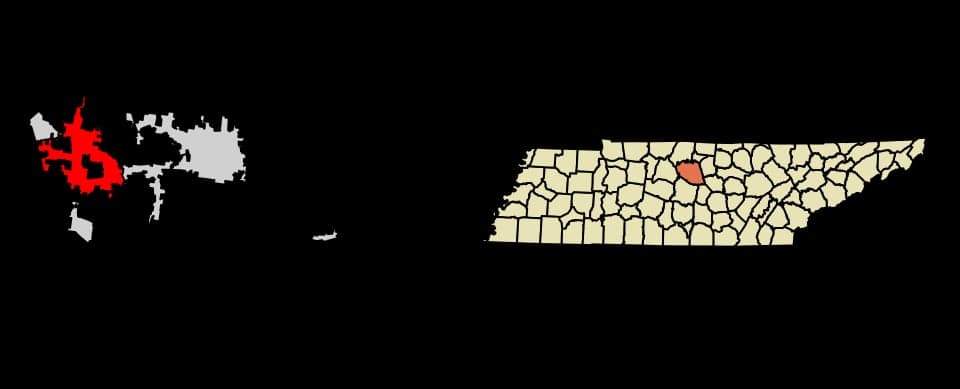
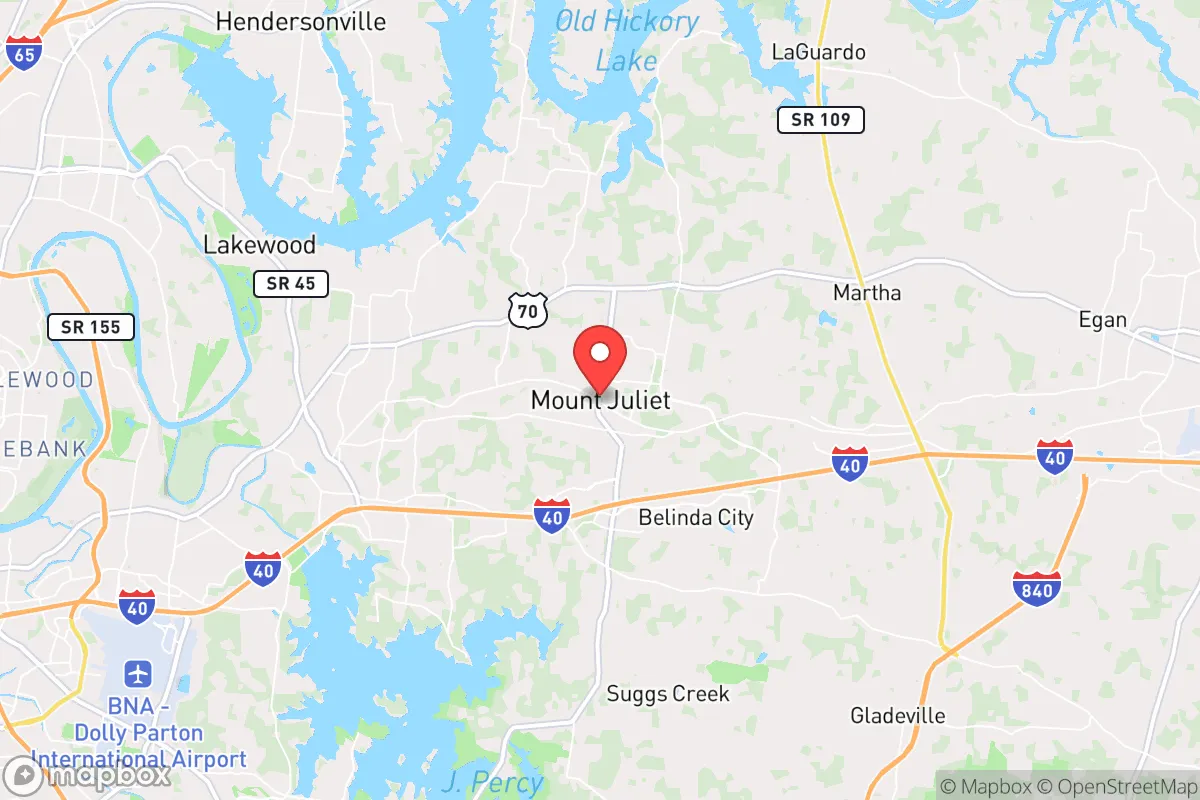
Photo: Wikipedia
Personal Sovereignty in Mt. Juliet, TN
Moderate friction. Expect trade-offs in some aspect of personal liberty and independence.
What does Personal Sovereignty tell us?
Personal Sovereignty measures your capacity for self-reliance and independence with minimal government friction. Higher scores mean fewer barriers between you and the way you want to live... but it assumes you have the space you need and good neighbors.
What does this tell us?
Personal Sovereignty measures your capacity for self-reliance and independence with minimal government friction. Higher scores mean fewer barriers between you and the way you want to live... but it assumes you have the space you need and good neighbors.
State Policy
Energy independence: Importer (25% of energy produced in-state)
Personal Liberty
Homesteading

Personal Liberty Analysis
Mt. Juliet, Tennessee, offers one of the strongest personal sovereignty environments in the Southeast, anchored by Tennessee’s absence of a state income tax and a firmly established constitutional carry regime. For a single individual or family weighing independence, the city’s regulatory posture is decidedly light-touch compared to neighboring states like Illinois or New York, though it operates within Wilson County’s broader zoning and development framework. The practical result is a place where the state government steps back from your wallet and your holster, but the local municipality still exerts meaningful control over land use and property development.
Tax burden and regulatory posture: how Tennessee’s fiscal structure boosts autonomy
Tennessee’s tax code is the single biggest lever for personal sovereignty in Mt. Juliet. The state levies no personal income tax on wages, and the Hall Tax on dividend and interest income was fully repealed in 2021, meaning your investment earnings are entirely yours. The state’s combined state and local sales tax rate in Wilson County sits around 9.75%, which is high but predictable, and property taxes remain modest — Wilson County’s effective rate is roughly $2.10 per $100 of assessed value, well below the national average. For a family earning $100,000 annually, the difference between Tennessee and a high-tax state like California or New Jersey can exceed $8,000 per year in retained income, money that directly funds private choices rather than public programs.
Regulatory posture at the state level is equally restrained. Tennessee is a right-to-work state, has no state-level occupational licensing for dozens of common trades, and maintains a permitting process for new businesses that ranks among the fastest in the country. However, Mt. Juliet itself is not a regulatory free-for-all. The city operates under a unified development code that enforces minimum lot sizes, setback requirements, and stormwater management rules. If you plan to run a home-based business, the city requires a basic home occupation permit, but it generally approves low-impact operations like consulting or online retail without public hearings. The regulatory environment is best described as state-level libertarian, municipal-level pragmatic — you won’t fight a zoning war to start a side hustle, but you also won’t get a blank check to build whatever you want on your property.
Self-defense and gun law specifics: constitutional carry and castle doctrine in practice
Tennessee is a constitutional carry state, meaning that as of July 1, 2021, any legal resident aged 21 or older can carry a handgun openly or concealed without a permit. Mt. Juliet sits in Wilson County, where the sheriff’s office historically issues concealed carry permits within days, though the permit is now optional for most residents. The state’s castle doctrine is unambiguous: you have no duty to retreat in your home, vehicle, or place of business, and you are legally presumed to have acted reasonably if you use force against an unlawful intruder. Tennessee also passed a "stand your ground" law in 2007, extending the no-retreat rule to any place where you are lawfully present.
For practical purposes, this means a Mt. Juliet resident can carry a firearm to the grocery store, the local Green Hill Park, or the Providence Marketplace shopping center without a license, provided they are not on posted private property or in a prohibited federal zone like a post office. The city itself has no local gun ordinances that exceed state law, and Wilson County is a strong Second Amendment jurisdiction — the county commission has passed resolutions affirming its status as a "Second Amendment sanctuary" in prior years. One caveat: Tennessee law prohibits carrying in establishments that derive 51% or more of their revenue from alcohol sales, so a stop at a local bar with a firearm is still off-limits. For a family, the legal framework is about as permissive as it gets in the continental United States, with the notable exception that firearm possession by individuals under 21 remains restricted to private property and hunting contexts.
Self-reliance and homesteading viability: lot sizes, zoning, and off-grid feasibility
Mt. Juliet’s homesteading potential is a mixed bag, heavily dependent on which side of the city you choose. The city’s zoning code establishes a minimum lot size of 12,000 square feet in most residential districts, which is roughly a quarter-acre, but the eastern and northern fringes of Wilson County offer agricultural zoning with minimum lot sizes of one to five acres. If you want chickens, a large garden, or a modest workshop, the city allows accessory structures and backyard livestock on standard lots, though roosters are prohibited within city limits and there are noise ordinances that limit early-morning activity.
Off-grid feasibility is limited but not impossible. Tennessee has no state law prohibiting solar panel installation, and net metering is available through the local utility, Wilson Electric Membership Corporation, which serves much of the county. However, Mt. Juliet’s building code requires connection to the municipal water and sewer system in most subdivisions, so a fully self-contained rainwater catchment and septic system is only viable on unincorporated Wilson County land outside the city’s utility service area. Rainwater harvesting is legal statewide, but the city’s stormwater regulations require permits for any significant cistern installation. For a family seeking true off-grid independence, the practical play is to buy land in the county’s rural eastern corridor, near the Cedars of Lebanon State Park area, where zoning is far more permissive and the county does not enforce municipal utility hookups. Within Mt. Juliet proper, you can achieve meaningful self-reliance — a large garden, solar panels, and a backup generator — but you will still pay a city water bill.
Personal liberties: parental rights, medical autonomy, speech, and property
Tennessee has become a national leader in parental rights legislation. The state’s 2022 "Parental Bill of Rights" (SB 1816) grants parents explicit authority over their children’s education, healthcare, and moral upbringing, and it requires schools to notify parents before any medical or counseling service is provided to a minor. In Mt. Juliet, the Wilson County School District has implemented these provisions with a conservative school board that has restricted certain library materials and maintained a strict curriculum transparency policy. For parents who want to homeschool, Tennessee requires only a simple notice of intent filed with the local school district, and there is no state testing requirement for homeschooled students — one of the most permissive homeschool laws in the country.
Medical autonomy is similarly robust. Tennessee does not mandate COVID-19 vaccinations for any resident, and a 2023 state law prohibits employers from requiring a vaccine as a condition of employment unless specific exemptions apply. The state also protects medical freedom through a 2022 law that allows patients to access investigational treatments for terminal illnesses without FDA approval barriers. On speech, Tennessee has no state-level hate speech law, and Mt. Juliet has no local ordinances restricting signage, political expression, or public assembly beyond standard noise and time-place-manner rules. Property rights are protected by Tennessee’s 2021 "Property Protection Act," which requires local governments to compensate landowners for any reduction in property value caused by zoning changes — a meaningful check on municipal overreach. The one notable limitation on personal liberty is Tennessee’s strict abortion law, which bans the procedure at approximately six weeks of gestation with narrow exceptions, a factor that will weigh heavily for some families considering relocation.
Overall, Mt. Juliet’s sovereignty profile is among the strongest in the mid-South. The combination of no income tax, constitutional carry, strong parental rights, and a county government that resists state-level mandates places it well ahead of most suburban communities in the Northeast or West Coast. The trade-offs are real — municipal zoning limits true off-grid living, and the city’s utility requirements add a layer of dependency — but for a family or individual who values keeping their money, their guns, and their children’s education under their own control, Mt. Juliet delivers a regulatory environment that is far closer to the libertarian ideal than the national median.

* Values derived from national, state, county, city and local statistics and may differ in a specific area. Last updated: 2026-10-09T04:27:40.000Z
Narrative content on this page is AI-generated and may contain mistakes. Verify any details that matter before acting on them.
ReloMaps may earn a commission from affiliate links at no extra cost to you.

