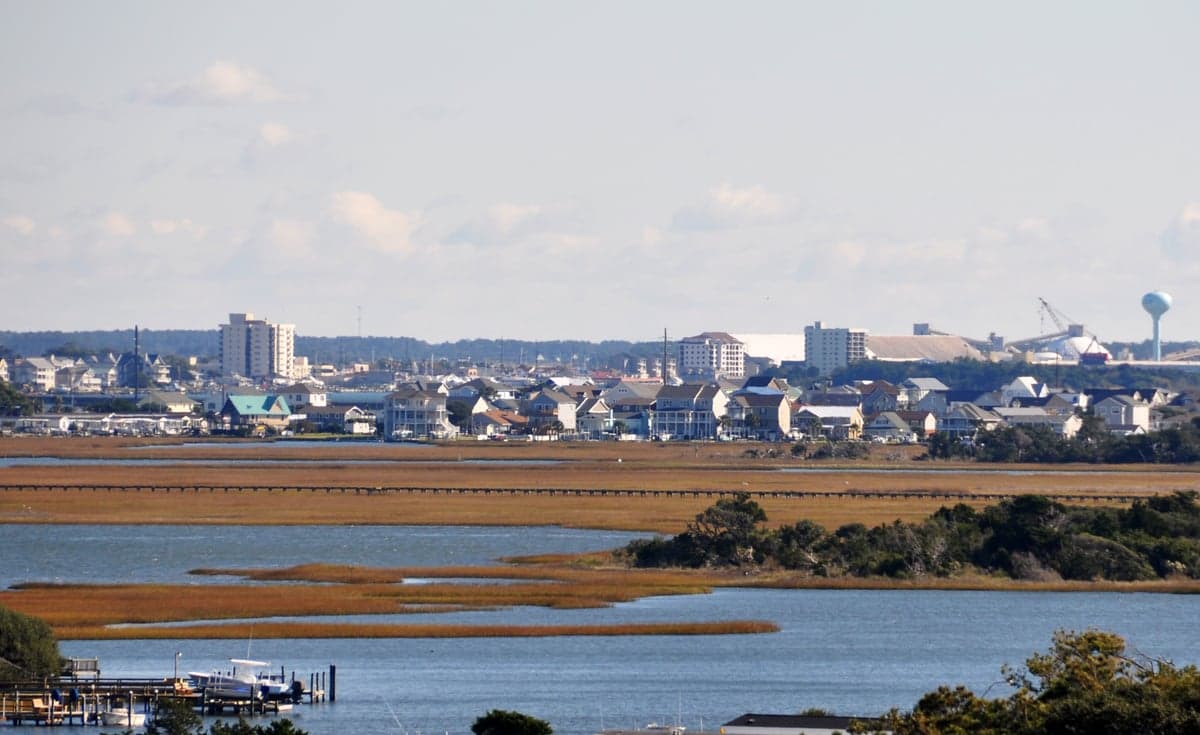
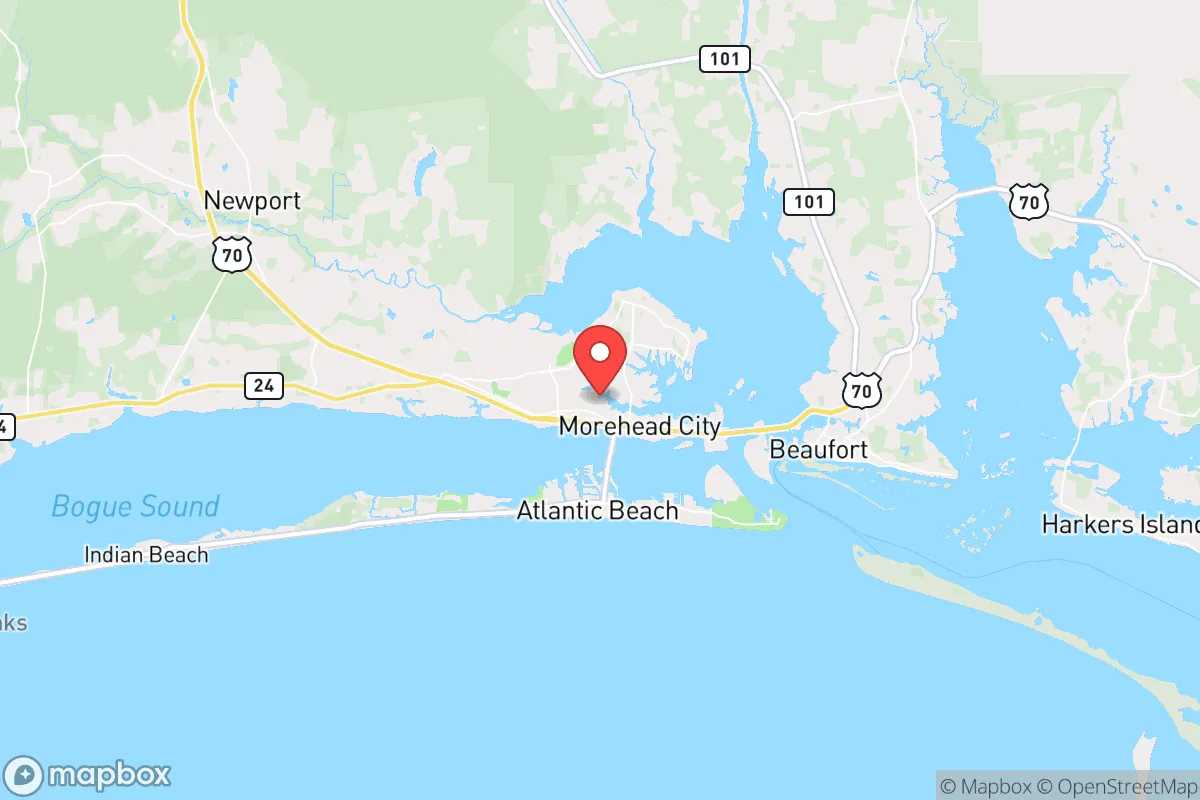
Photo: Wikipedia
Demographics of Morehead City, NC
Affluence Level in Morehead City, NC
A middle-class area roughly in line with national averages across income, home values, education, and employment.
People of Morehead City, NC
The people of Morehead City, North Carolina, today number roughly 9,700, forming a predominantly white (77.6%) community with a notable Hispanic minority (9.9%) and smaller Black (5.5%) and Indian-subcontinent (1.0%) populations. The city’s character is shaped by its working waterfront, a strong military and maritime presence from nearby Marine Corps Base Camp Lejeune and the Port of Morehead City, and a growing retiree and second-home market. With a foreign-born share of just 1.9% and a college-educated rate of 34.6%, Morehead City remains a culturally stable, family-oriented coastal town where newcomers are drawn by quality of life, not ethnic diversity.
How the city was settled and grew
Morehead City was founded in 1857 as a planned port town, named after Governor John Motley Morehead, who envisioned it as the eastern terminus of the Atlantic and North Carolina Railroad. The original population consisted of railroad workers, merchants, and fishermen, many of whom were native-born North Carolinians of English and Scots-Irish descent. The city’s first neighborhoods—Bogue Sound Drive along the waterfront and the Historic District around Arendell Street—were built by these early settlers, with modest frame houses and commercial buildings that still define the downtown core. The fishing industry, particularly the menhaden and shrimp fleets, drew a small number of Black laborers in the late 19th and early 20th centuries, who settled in the Shepard Street area, historically the city’s African American neighborhood. By 1900, the population was nearly all native-born white, with a tiny Black minority, a pattern that held through the mid-20th century as the city grew slowly around its port and seafood processing plants.
Modern era (post-1965)
After the 1965 Immigration and Nationality Act, Morehead City saw little direct immigration—its foreign-born share remains under 2%—but experienced significant domestic in-migration. The opening of the Atlantic Beach Bridge in the 1950s and the expansion of the Port of Morehead City in the 1970s spurred growth, drawing retirees from the Northeast and military-affiliated families from Camp Lejeune. These newcomers largely settled in newer subdivisions like Brandywine Bay and Harborwalk, which feature larger homes and golf course access, contrasting with the older, denser Historic District. The Hispanic population began growing in the 1990s, driven by construction and service jobs tied to tourism and port activity; today’s 9.9% Hispanic share is concentrated in the Morehead City West area near Highway 24, where affordable housing and proximity to seasonal work attract Mexican and Central American families. The Black population, now 5.5%, remains modest and is dispersed across the city, though the Shepard Street area retains its historical identity. The Indian-subcontinent community (1.0%) is a recent arrival, primarily professionals in healthcare and hospitality, living in the Brandywine Bay and Harborwalk areas. East/Southeast Asian residents (0.1%) are negligible, mostly transient military dependents.
The future
The population of Morehead City is projected to grow modestly, driven by coastal migration from inland North Carolina and the Northeast, rather than international immigration. The city’s demographic profile is likely to remain predominantly white, with the Hispanic share slowly increasing as service-sector jobs expand. New development is concentrated in the Morehead City West corridor and along the NC 24 bypass, where subdivisions and apartment complexes are absorbing younger families and retirees. The Historic District and Shepard Street are seeing limited infill, but gentrification pressures are mild due to the city’s small size and lack of major corporate employers. The cultural identity is evolving from a purely fishing-and-port town to a hybrid of working waterfront and leisure destination, with a growing emphasis on tourism, boating, and second homes. For someone moving in now, Morehead City offers a stable, low-diversity community with a strong sense of place, where newcomers are welcomed if they respect the local rhythms of tides and seasons.
Bottom line: Morehead City is becoming a slightly more diverse, more affluent coastal town, but its core remains a tight-knit, predominantly white community rooted in maritime tradition. The next decade will see gradual growth in the Hispanic and professional classes, while the city’s character stays anchored by its port, its historic neighborhoods, and its role as a gateway to the Crystal Coast.

* Values derived from national, state, county, city and local statistics and may differ in a specific area. Last updated: 2026-09-20T00:44:06.000Z
Narrative content on this page is AI-generated and may contain mistakes. Verify any details that matter before acting on them.
ReloMaps may earn a commission from affiliate links at no extra cost to you.

