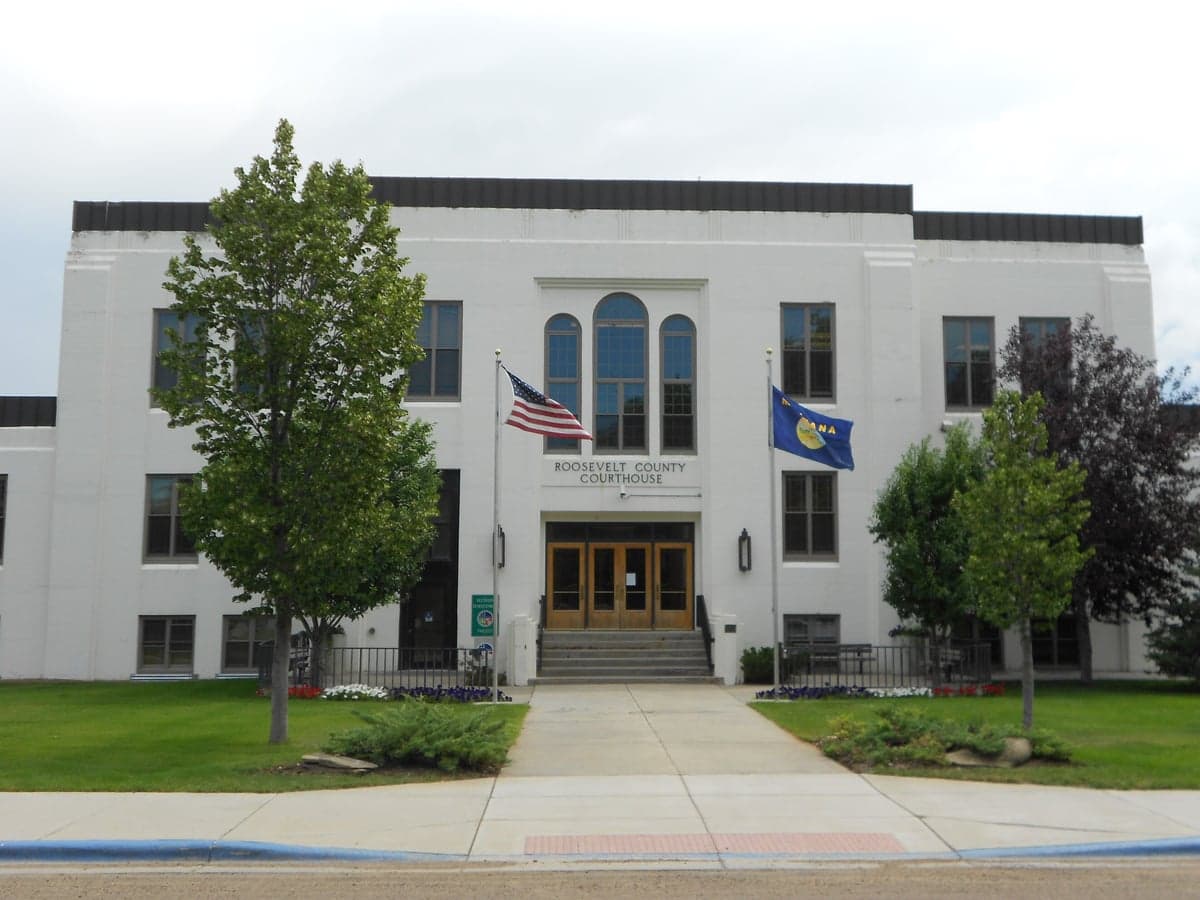
Photo: Wikipedia
Political ClimatePolitical Climate in Roosevelt County
Showing district-level results — no local-only data available.
Local Political AnalysisPolitical Analysis of Roosevelt County
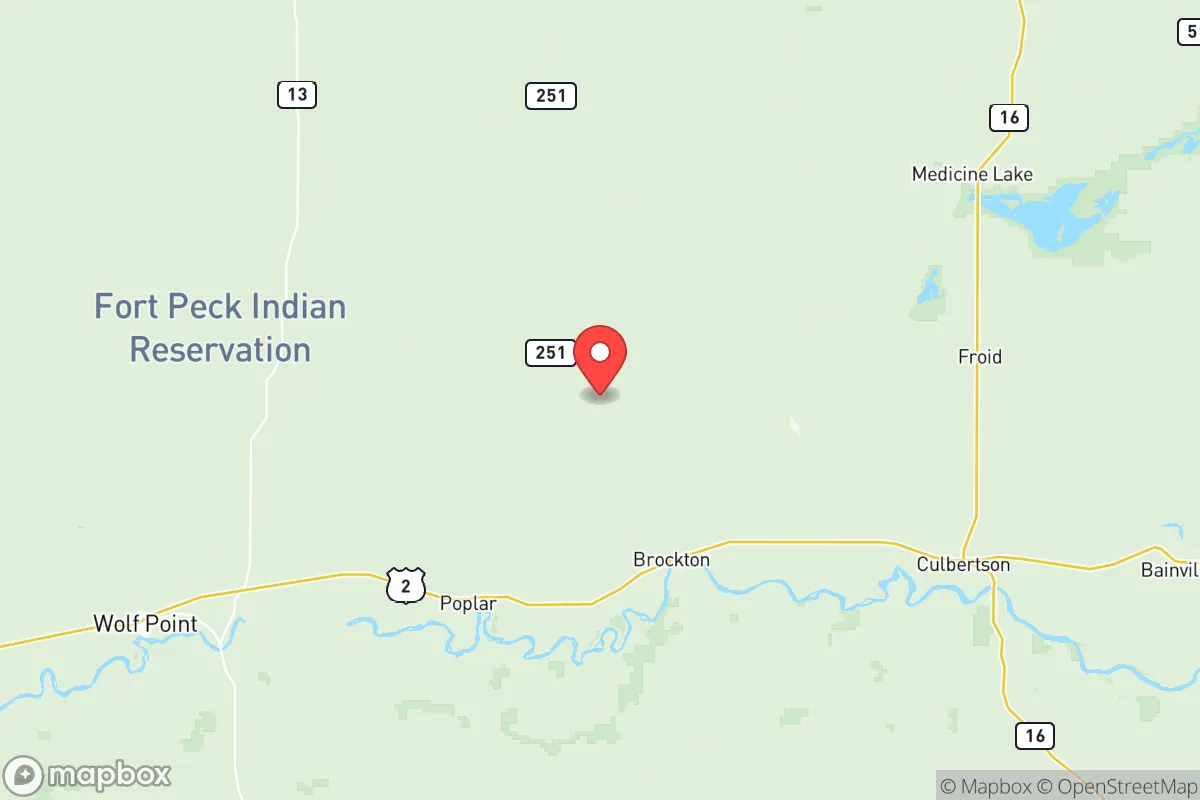
Roosevelt County, Montana, is a reliably Republican stronghold with a Cook PVI of R+15, making it significantly more conservative than the state of Montana as a whole, which sits at R+10. This isn't a new development; the county has voted for the GOP presidential candidate in every election since 2000, often by margins exceeding 30 points. However, the political landscape isn't monolithic. The county seat, Wolf Point, and the smaller town of Culbertson, with their larger Native American populations (primarily Assiniboine and Sioux), tend to be more competitive, occasionally swinging toward Democratic candidates in local races. In contrast, the more rural, agricultural areas around Froid and Bainville are deeply red, often delivering 80%+ of the vote to Republican candidates. The overall trajectory is a slow but steady rightward shift, mirroring the broader trend in rural Montana, though the Democratic strongholds in Wolf Point and on the Fort Peck Indian Reservation provide a persistent, if minority, counterweight.
How it compares
Compared to the rest of Montana, Roosevelt County is a political outlier in its intensity. While the state as a whole has a Republican lean, it still features competitive statewide races and a handful of Democratic-leaning counties like Missoula and Silver Bow. Roosevelt County, by contrast, is a deep red island in a sea of red, but with a notable blue pocket. The R+15 PVI means that a Republican candidate can expect to perform about 5 points better here than they would in an average Montana county. This is largely driven by the county's rural, agricultural economy and its relatively low population density outside of the reservation. The Democratic vote, concentrated in Wolf Point and on the reservation, is often enough to sway local county commission races but rarely enough to flip the county in a presidential or statewide election. For example, in the 2020 presidential election, Donald Trump won Roosevelt County with 62% of the vote, while he won the state with 57%. That 5-point gap is a consistent feature of the county's political identity.
What this means for residents
For conservative residents, especially those in the agricultural communities around Froid and Bainville, the political climate feels natural and affirming. Local government, school boards, and county commissions are dominated by Republicans, and conservative values are the default in public discourse. For liberal residents, particularly in Wolf Point and on the reservation, the experience is more complex. They are a clear minority in county-wide elections, but they hold significant influence in local municipal races and tribal politics. The Fort Peck Indian Reservation has its own distinct political dynamics, often focused on tribal sovereignty, resource management, and federal funding, which can diverge sharply from the concerns of the surrounding rural communities. This creates a political reality where two very different worlds coexist within the same county lines, with limited cross-pollination. A liberal resident in Wolf Point might feel politically isolated in the county at large but find a strong, supportive community within the town and on the reservation.
A key cultural distinction is the role of the Fort Peck Indian Reservation, which covers a significant portion of the county. This creates a unique political dynamic where issues of tribal sovereignty, land use, and federal Indian policy are often more salient than the standard left-right divides. For example, debates over oil and gas development on the reservation can split both the Republican and Democratic coalitions, with some tribal members prioritizing economic development and others environmental protection. This means that while the county's overall political lean is clear, the day-to-day political reality is more nuanced than a simple red-blue map suggests. The long-term trend is likely a continuation of the current dynamic: a deeply red rural base, a persistent blue minority in Wolf Point and on the reservation, and a slow, steady rightward shift in the county's overall voting patterns.

State Political ClimatePolitical Climate in Montana
State Political AnalysisPolitical Environment in the State
Montana has shifted decisively to the right over the past two decades, moving from a competitive purple state to a solidly Republican stronghold with a Cook PVI of R+10. The dominant coalition is a mix of rural conservatives, libertarian-leaning ranchers, and a growing number of out-of-state transplants drawn by low taxes and loose regulations, while the Democratic base is increasingly concentrated in a handful of college towns and the state’s largest city, Billings. Over the last 10-20 years, the GOP has swept every statewide office, captured supermajorities in the legislature, and turned what was once a bellwether into a reliably red state — though the path to that dominance has been anything but uniform across the landscape.
Urban vs. rural divide
The political map of Montana is a textbook study in urban-rural polarization. The Democratic strongholds are shrinking islands: Missoula (home to the University of Montana) and Bozeman (Montana State University) vote reliably blue, with Missoula County giving Biden 65% in 2020 and Gallatin County (Bozeman) flipping from red to purple as tech workers and outdoor enthusiasts poured in. Billings, the state’s largest city, is more conservative than its size suggests — Yellowstone County went for Trump by 16 points — but still hosts a small Democratic core. Meanwhile, the vast rural expanse runs deep red: counties like Liberty, Garfield, and Petroleum routinely deliver 80-90% Republican margins. The real story is the suburban fringe: places like Kalispell and Whitefish in Flathead County have seen explosive growth, with Kalispell trending hard right while Whitefish retains a liberal enclave vibe. The divide isn’t just geographic — it’s cultural, with the rural east and north feeling increasingly alienated from the booming, transplant-heavy western valleys.
Policy environment
Montana’s policy environment is defined by a low-tax, low-regulation posture that appeals strongly to conservative relocators. There is no state sales tax — a major draw — and income tax is a flat 5.9% after recent reforms. Property taxes are moderate but vary wildly by county, with rising assessments in Bozeman and Missoula sparking local backlash. The regulatory climate is business-friendly: no state-level minimum wage above the federal floor (though it’s $9.95 via ballot initiative), and occupational licensing has been steadily trimmed. Education policy is a flashpoint: the state has a robust school choice movement, with a new education savings account (ESA) program passed in 2023 that lets families use public funds for private or homeschool expenses. Healthcare is mixed — Montana expanded Medicaid under the ACA, a decision that remains politically contested, but the state also has some of the loosest telemedicine and direct-primary-care laws in the nation. Election laws have tightened: voter ID requirements are strict, same-day registration was eliminated in 2021, and mail-in voting was restricted to those with an approved excuse, though absentee ballots remain widely used.
Recent policy direction
The last three legislative sessions have pushed Montana sharply toward a model of maximal individual liberty on several fronts, though with notable exceptions. On gun and self-defense law, Montana is a constitutional carry state with no permit required for concealed carry, and in 2023 it passed a law prohibiting enforcement of federal gun regulations that don’t have a state equivalent — a direct challenge to federal authority. Parental and education rights saw a major win with the ESA program, plus a ban on teaching “divisive concepts” in public schools and a requirement that school boards adopt policies allowing parents to review curriculum. Speech is broadly protected, with no state hate speech law and a 2021 bill prohibiting social media platforms from deplatforming candidates. Medical and bodily autonomy is a split: abortion remains legal up to 20 weeks (protected by a 1999 state Supreme Court ruling), but a 2023 law banned gender-affirming care for minors, and the legislature has repeatedly tried to restrict abortion access. Property rights are strong — Montana has a “right to farm” law shielding agricultural operations from nuisance suits, and a 2023 bill expanded landowners’ ability to use deadly force against trespassers. Taxation is trending downward: the 2023 session cut the top income tax rate from 6.75% to 5.9% and expanded the earned income tax credit. Voting and ballot access have tightened, as noted, with new restrictions on mail-in ballots and a ban on ballot harvesting.
Civil unrest & political movements
Montana has seen its share of political flashpoints, though large-scale civil unrest is rare. The most visible movement is the anti-government/sovereign citizen strain, which flares up periodically in rural counties — in 2021, a standoff in the tiny town of Roundup over a land-use dispute drew armed militia groups from across the region. The Yellowstone Club and Bozeman growth has fueled a backlash from both left and right: left-leaning activists protest luxury development and housing costs, while conservative ranchers fight zoning changes and “California transplants.” Immigration politics are muted — Montana has a tiny foreign-born population (about 2%) — but the state passed a 2023 law requiring local law enforcement to cooperate with ICE, and there are no sanctuary cities. Election integrity controversies have been intense: the 2020 election saw Trump win by 16 points, but a GOP-led audit in 2021 found no evidence of widespread fraud, though it recommended tighter laws. The most visible flashpoint for a new resident would be the culture war over public lands: debates over federal land management, logging, and mining rights are constant, with libertarian “county supremacy” movements pushing for local control of federal lands, especially in places like Lincoln County and the Hi-Line.
Projection
Over the next 5-10 years, Montana’s political trajectory points further right, but with a twist. The in-migration wave — driven by remote workers, retirees, and conservative refugees from blue states — is reshaping the electorate: newcomers tend to be wealthier, more educated, and more culturally conservative than the old ranching base, which is actually moderating some rural areas while pushing suburbs like Bozeman and Kalispell even redder. The Democratic Party is at risk of becoming irrelevant outside Missoula and a few tribal districts, as the state’s growing Hispanic population (still small) and Native American vote (about 6% of the population) aren’t enough to offset the influx. Expect continued tax cuts, further restrictions on abortion (possibly a trigger law if Roe is fully overturned), and more battles over public lands and water rights as climate change strains resources. The wild card is the libertarian streak: many new arrivals are pro-gun, anti-tax, and skeptical of government, but they also want good schools and infrastructure, which could create tension with the old-school “leave us alone” ethos. A new resident moving in now should expect a state that is reliably red, increasingly wealthy, and deeply divided between the booming western valleys and the struggling rural east — but with a political culture that prizes individual freedom above almost everything else.
For a new resident, the bottom line is this: Montana offers a policy environment that strongly favors personal liberty on guns, property, and taxes, but with trade-offs in public services and a growing cultural divide between the transplant-heavy growth corridors and the traditional rural communities. Conservatives will find a welcoming legislative climate and a like-minded social scene in most places outside Missoula and Bozeman. Liberals will find a small but resilient community in those same college towns, but should expect to be in the minority on most state-level issues. The key practical takeaway is to choose your location carefully — the political reality in Whitefish is very different from that in Miles City, and the gap is only widening.
* Values derived from national, state, county, city and local statistics and may differ in a specific area. Last updated: 2026-07-12T04:23:55.000Z
Narrative content on this page is AI-generated and may contain mistakes. Verify any details that matter before acting on them.
ReloMaps may earn a commission from affiliate links at no extra cost to you.

