
Photo: Wikipedia
Strategic Assessment of Park County
Strong survivability profile. Good buffer from population centers, with manageable environmental and tactical risks.
What does the Strategic Assessment tell us?
Our Strategic Assessment grades tactical survivability of an area. Major population centers, military targets, fallout zones, natural disasters, and border exposure all drive risk — lower exposure means a more defensible position in a crisis.
This is heavily inspired by Joel Skousen's Strategic Relocation book. Highly recommended you checkout the book ($)What does this tell us?
Our Strategic Assessment grades tactical survivability of an area. Major population centers, military targets, fallout zones, natural disasters, and border exposure all drive risk — lower exposure means a more defensible position in a crisis.
This is heavily inspired by Joel Skousen's Strategic Relocation book. Highly recommended you checkout the book ($)Strategic Pillars

Key Distances
Strategic Assessment Analysis
Park County, Montana offers a compelling strategic position for relocation-minded readers prioritizing resilience and self-sufficiency, balancing relative isolation with practical access to essential services and supply routes. The county’s low population density, high elevation, and distance from major metropolitan targets create a baseline of geographic security that is difficult to find elsewhere in the lower 48. For those thinking seriously about disaster readiness, Park County presents a mix of genuine advantages and specific, manageable risks that require clear-eyed assessment.
Geographic position and natural advantages for long-term security
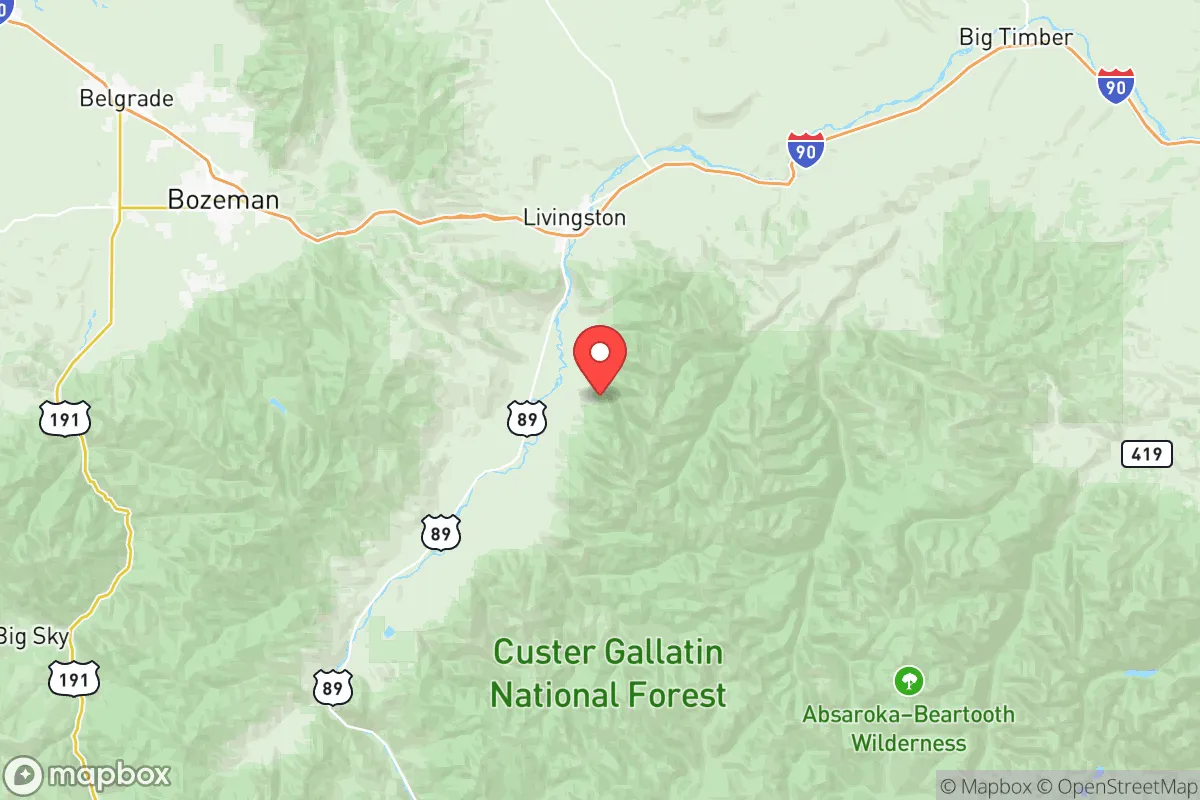
Park County sits in south-central Montana, straddling the Yellowstone River valley and the northern edge of the Absaroka-Beartooth Wilderness. Its county seat, Livingston, lies at roughly 4,500 feet elevation, while the surrounding mountains rise to over 10,000 feet. This elevation provides a natural buffer against many lowland hazards: flooding is confined to the Yellowstone River corridor, and the area experiences fewer than 20 severe thunderstorm days per year. The county’s position roughly 100 miles from Billings and 250 miles from Butte places it outside the immediate fallout zones of any major population centers or industrial targets. The nearest military installation of strategic significance is Malmstrom Air Force Base near Great Falls, approximately 180 miles northwest — far enough to avoid direct blast effects but within a plausible fallout plume under certain wind scenarios. The Yellowstone River itself is a perennial water source, fed by mountain snowmelt, and the county sits atop the Livingston aquifer, a deep groundwater system that provides reliable well water across much of the valley floor. For a relocator, the combination of elevation, distance from primary targets, and abundant surface water forms the foundation of a defensible long-term position.
Risks, exposures, and proximity to fallout-relevant landmarks
No location is without risk, and Park County’s strategic picture includes several exposures that a serious relocator must weigh. The most significant man-made risk comes from the Yellowstone National Park geothermal system, which extends into the county’s southern reaches. While a catastrophic caldera eruption is a low-probability event on human timescales, hydrothermal explosions and increased seismic activity are real, if infrequent, hazards. The Hebgen Lake area, just west of the county line, experienced a deadly 7.3-magnitude earthquake in 1959, and the region remains seismically active. On the industrial side, the ExxonMobil refinery in Billings is the nearest major hazardous facility, approximately 100 miles east-northeast. Prevailing winds in Park County are from the west-southwest, which means a release from Billings would generally blow away from the county, but a shift during a weather event could carry particulates into the Yellowstone Valley. The BNSF Railway mainline runs through Livingston and along the Yellowstone River, carrying freight including hazardous materials; a derailment or spill near the river could threaten downstream water intakes. For a relocator, the practical takeaway is that Park County faces moderate, localized risks — none of which are catastrophic in probability, but all of which benefit from advance planning, particularly around water storage and alternative access routes.
Practical resilience for a relocator: food, water, energy, and defensibility
For the reader serious about self-sufficiency, Park County offers a mixed but workable profile. Water is the strongest asset: the Yellowstone River flows year-round, and shallow groundwater is accessible across most of the valley. A properly sited well with a hand pump or solar-powered backup provides a reliable off-grid supply. The county’s growing season is short — roughly 90 to 110 frost-free days — but cold-hardy crops like potatoes, carrots, kale, and grains can be grown in the valley bottom. The Livingston Farmers Market and local producers like Chico Hot Springs demonstrate that small-scale agriculture is viable, though large-scale food production would require significant land and infrastructure. Energy is a relative weakness: the county is served by NorthWestern Energy, which relies on a mix of hydro, coal, and natural gas. Grid reliability is generally good, but winter storms can cause outages. Solar potential is moderate — the area receives about 260 sunny days per year, but winter days are short and snow cover can reduce panel output. Wood heating is common and practical, with ample public and private forestland for sustainable harvest. Defensibility is where Park County shines: the terrain is naturally compartmentalized, with the valley offering long sightlines and the mountains providing choke points. The county’s population of roughly 17,000 means that a small, prepared group can know their neighbors and build mutual-aid networks. The Livingston Police Department and Park County Sheriff’s Office are professional but small; in a prolonged crisis, communities would largely rely on themselves. For a relocator, the key is to secure a property with its own water source, southern exposure for passive solar, and access to multiple exit routes — the most practical being U.S. Highway 89 south toward Yellowstone or north to Interstate 90.
Overall, Park County represents a strong strategic choice for the resilience-minded relocator who values geographic buffer, natural resources, and community scale over proximity to urban amenities. Its distance from primary targets, reliable water, and defensible terrain outweigh the moderate risks from seismic activity and industrial corridors. The county is not a bunker — it requires active preparation, land stewardship, and social integration — but for a single individual or family willing to invest in those areas, it offers one of the more balanced security profiles in the Rocky Mountain region. The smart play is to secure a property with water and southern exposure, build relationships with local producers and neighbors, and treat the area as a base for long-term self-reliance rather than a retreat from the world.

* Values derived from national, state, county, city and local statistics and may differ in a specific area. Last updated: 2026-07-03T02:35:25.000Z
Narrative content on this page is AI-generated and may contain mistakes. Verify any details that matter before acting on them.
ReloMaps may earn a commission from affiliate links at no extra cost to you.

