
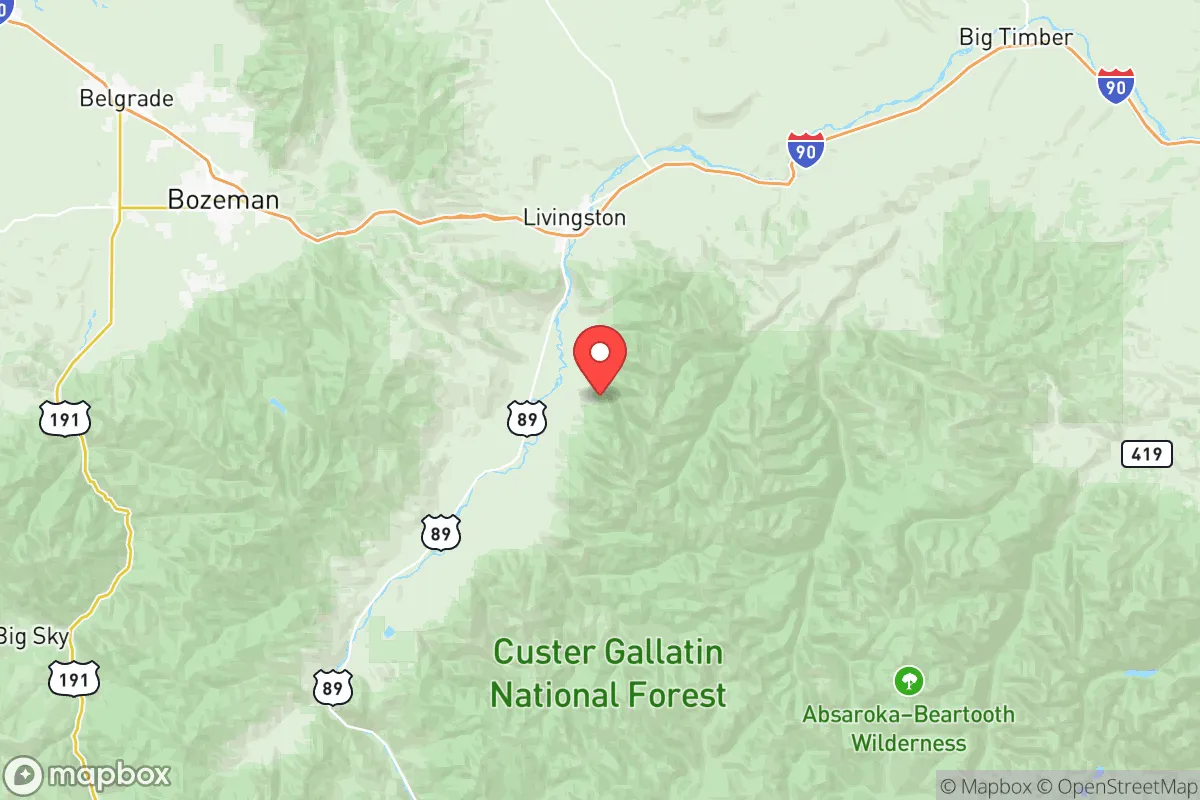
Photo: Wikipedia
Personal Sovereignty in Park County
Viable for self-reliance. Generally workable, though some barriers may limit total independence.
What does Personal Sovereignty tell us?
Personal Sovereignty measures your capacity for self-reliance and independence with minimal government friction. Higher scores mean fewer barriers between you and the way you want to live... but it assumes you have the space you need and good neighbors.
What does this tell us?
Personal Sovereignty measures your capacity for self-reliance and independence with minimal government friction. Higher scores mean fewer barriers between you and the way you want to live... but it assumes you have the space you need and good neighbors.
State Policy
Energy independence: Net exporter (120% of energy produced in-state)
Personal Liberty
Homesteading

Personal Liberty Analysis
Park County, Montana, offers one of the strongest personal sovereignty environments in the lower 48, combining a deeply ingrained Western independence culture with some of the lightest state-level regulatory and tax burdens in the nation. The county’s autonomy profile is shaped by its geography—from the tourist-heavy gateway of Livingston to the remote, high-elevation ranchlands around Pray and Emigrant—creating distinct zones where the practical experience of freedom varies significantly. For a relocation reader prioritizing self-reliance, Park County presents a high-sovereignty baseline with specific, actionable trade-offs between access to services and the ability to live entirely unbothered.
Tax burden and regulatory posture: How Montana’s light-touch approach plays out in Park County
Montana’s state-level tax and regulatory posture is among the most favorable in the country for personal sovereignty, and Park County largely reflects that. There is no state sales tax, meaning every dollar earned or spent in Livingston, Clyde Park, or Gardiner stays in your pocket—a direct boost to financial autonomy. Property taxes are moderate, with the state’s effective rate hovering around 0.83% of assessed value, though Park County’s rates can be slightly higher in the Livingston school district due to local levies. The regulatory environment is notably light: Montana has no statewide building code for single-family homes in unincorporated areas, and Park County’s zoning is minimal outside of Livingston’s city limits. In places like Emigrant and Pray, you can build a home, a shop, or a barn without the permitting gauntlet common in Front Range or Pacific Northwest counties. However, the county does enforce subdivision regulations under the Montana Subdivision and Platting Act, so splitting land for multiple dwellings requires a review—a modest check on unfettered development that preserves the rural character most sovereignty-minded residents value.
Self-defense and gun law specifics: Constitutional carry and the practical reality in Park County
Montana is a constitutional carry state, and Park County’s gun culture is as robust as any in the Rockies. No permit is required to carry a concealed firearm for any law-abiding adult 18 or older, and the county sheriff’s office in Livingston issues permits for those who want reciprocity with other states—a straightforward, shall-issue process. State law preempts local firearm ordinances, so Livingston, Gardiner, and Clyde Park cannot enact their own restrictions; the legal baseline is uniform across the county. Stand-your-ground and castle-doctrine laws are fully in effect, with no duty to retreat in any place you are lawfully present. For practical self-defense, the county’s remote areas—particularly the Paradise Valley corridor between Livingston and Gardiner—mean that law enforcement response times can exceed 30 minutes in winter or during tourist season. Residents in Pray, Emigrant, and the Shields River Valley near Clyde Park routinely treat personal firearms as a primary layer of security, not a political statement. The only notable limitation is that Montana prohibits firearms in certain government buildings and K-12 schools, but these restrictions are narrow and well-defined.
Self-reliance and homesteading viability: Lot sizes, zoning, and off-grid feasibility across Park County
Homesteading viability in Park County varies dramatically by location, driven by water access and zoning rather than state-level restrictions. In the Shields River Valley around Clyde Park, 5-acre parcels are common, and 20+ acre tracts are available for under $200,000—a realistic entry point for a self-reliant household. Off-grid living is legal and practiced: Montana has no state law requiring grid connection, and Park County’s health department permits alternative wastewater systems (composting toilets, greywater) on a case-by-case basis, though a septic permit is still required for any dwelling. Solar is viable, with the county averaging over 300 sunny days per year, and no permitting hurdles for rooftop or ground-mount arrays outside city limits. The critical constraint is water: in the Paradise Valley near Emigrant and Pray, groundwater rights are often fully appropriated, meaning new wells can be expensive and uncertain. In contrast, the Livingston area has more reliable municipal water, but that comes with hookup fees and monthly bills that reduce autonomy. Zoning is minimal: unincorporated areas have no minimum lot size for single-family homes, though subdivision triggers county review. For a serious homesteader, the Clyde Park and Wilsall areas offer the best balance of affordable land, water access, and regulatory freedom, while the Gardiner gateway to Yellowstone is more constrained by tourism-driven land prices and seasonal service limitations.
Personal liberties: Parental rights, medical autonomy, speech, and property in Park County
Montana’s legal framework strongly supports personal liberties across the board, and Park County’s culture reinforces them. Parental rights are explicitly protected under state law, with a 2021 statute affirming that parents have the fundamental right to direct their children’s education, healthcare, and upbringing—no mask mandates, no vaccine passports, and no curriculum overrides from Helena. The county’s school districts, particularly in Clyde Park and Gardiner, are small and community-controlled, meaning local parents have direct influence over school boards. Medical autonomy is similarly robust: Montana has no state-level vaccine mandate for adults, no restrictions on ivermectin or hydroxychloroquine prescriptions, and a 2023 law prohibiting discrimination against unvaccinated individuals. The practical limitation is access—Livingston has a critical-access hospital and a handful of primary care providers, but for specialized care, residents drive 90 minutes to Bozeman or 2.5 hours to Billings. Speech and assembly are protected under the Montana Constitution, which has its own free-speech clause that courts have interpreted more broadly than the First Amendment. Property rights are strong: Montana’s “private property rights” act requires compensation for any regulation that reduces property value by 30% or more, a powerful check against overreach. In practice, Park County’s planning department is pragmatic—residents in Pray and Emigrant report that building permits are rubber-stamped as long as they meet basic health and safety codes.
Overall, Park County ranks among the top 10% of U.S. counties for personal sovereignty, with a legal and cultural environment that consistently prioritizes individual choice over collective mandates. The trade-off is clear: the same light-touch governance that enables off-grid living and constitutional carry also means limited emergency services, slow internet in the Shields River Valley, and a hands-off approach to land-use conflicts between neighbors. For a reader who values freedom over convenience and is willing to drive for healthcare and groceries, Park County delivers a sovereignty package that few places can match—especially when compared to the regulatory density of Bozeman’s Gallatin County just over the pass or the urban constraints of Missoula or Helena.

* Values derived from national, state, county, city and local statistics and may differ in a specific area. Last updated: 2026-07-03T02:35:25.000Z
Narrative content on this page is AI-generated and may contain mistakes. Verify any details that matter before acting on them.
ReloMaps may earn a commission from affiliate links at no extra cost to you.

