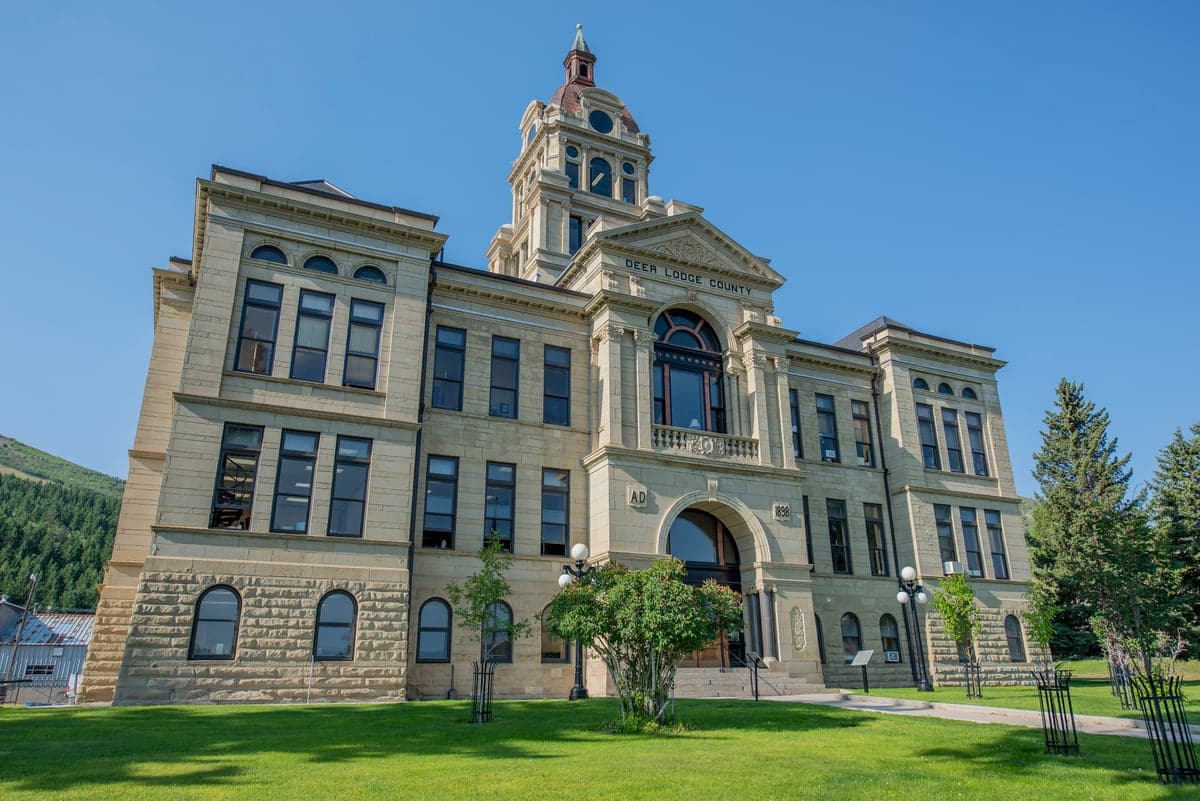
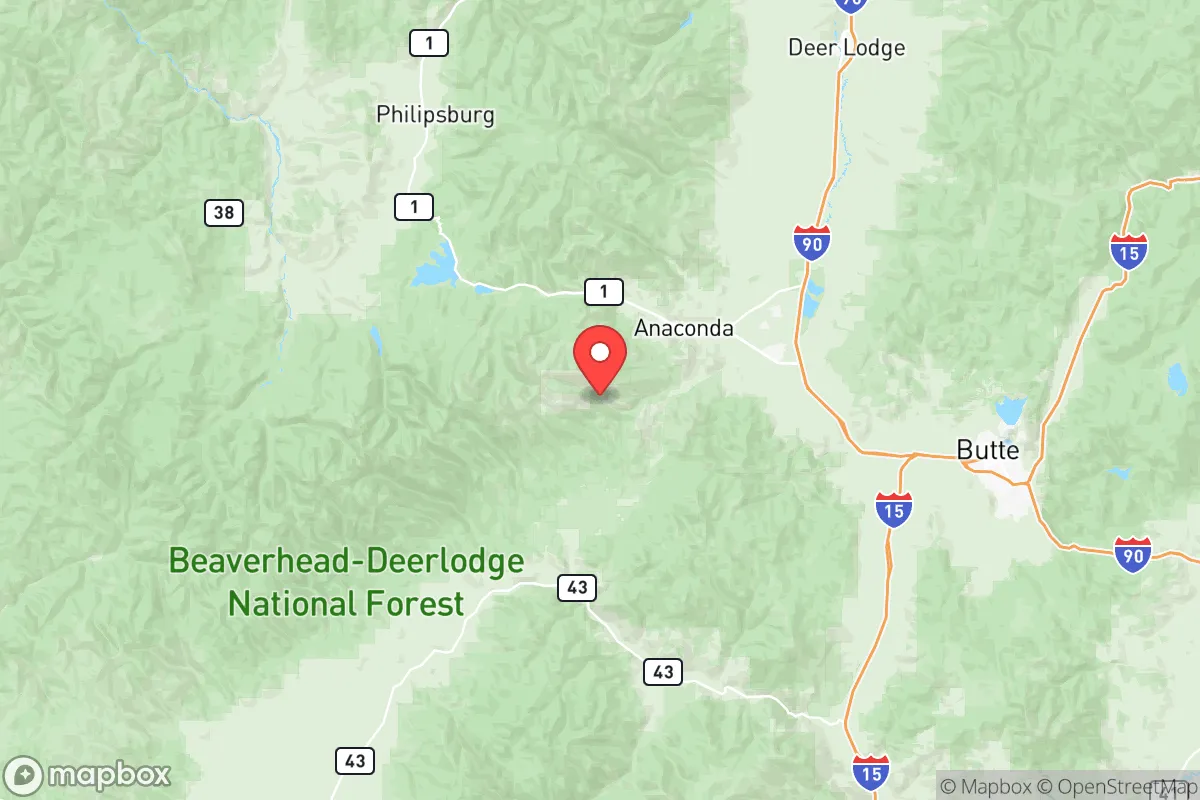
Photo: Wikipedia
Political ClimatePolitical Climate in Deer Lodge County
Showing district-level results — no local-only data available.
Local Political AnalysisPolitical Analysis of Deer Lodge County
Deer Lodge County, anchored by the city of Anaconda, leans Republican with a Cook PVI of R+5, but it's a noticeably softer shade of red than the rest of Montana, which sits at R+10. That five-point gap tells the real story: this county has a genuine Democratic tradition that hasn't fully faded, even as the state has lurched rightward over the last two decades. The political reality here isn't a monolith — it's a place where a union Democrat can still win a local race, where the old smelter town ethos bumps up against newer conservative arrivals, and where the precinct-level results show a county that's genuinely contested in a way most of rural Montana simply isn't anymore.
How it compares to the rest of Montana
The simplest way to put it: Deer Lodge County is to Montana what a swing precinct is to a safe state. While the state as a whole votes R+10, this county's R+5 means it's about 15 points more Democratic than the statewide baseline — a massive gap in practical terms. Look at the 2020 presidential race: Anaconda's city precincts, particularly around the old downtown and the neighborhoods near the Washoe Park area, voted for Joe Biden, while the rural precincts north of town toward the Deer Lodge Valley and the areas around the Pintler Mountains went heavily for Donald Trump. The swing precincts are in the middle-ring neighborhoods of Anaconda itself — places like the blocks around the Anaconda High School and the residential areas near the golf course — where margins are often within a few percentage points. Compare that to the rest of Montana, where even Missoula County's Democratic stronghold is surrounded by deep-red rural counties; here, the red isn't as deep, and the blue holds more ground.
What this means for residents
For conservative residents, living in Deer Lodge County means you're still in a Republican-leaning area, but you'll encounter more genuine political disagreement than you would in, say, neighboring Granite County or Powell County. You can't assume everyone at the coffee shop in Anaconda agrees with you — the union legacy runs deep, and the local Democratic Party still fields candidates for county commission and the state legislature. For liberal residents, the picture is more encouraging than in most of rural Montana: you can win local elections here, especially if you run as a moderate who respects the area's labor history. The Anaconda City Council often has Democratic majorities, and the county's state House seat has flipped between parties in recent cycles. That said, both sides should expect the county to continue trending rightward slowly, as retirees from out of state and remote workers from Bozeman and Missoula move in, drawn by the relatively cheap land and the proximity to the Pintler Wilderness.
Culturally, Deer Lodge County stands apart from the rest of Montana in a few noticeable ways. The old Anaconda Smelter Stack — the tallest brick structure in the world — is a constant physical reminder of the labor movement that built this town, and that history still shapes local politics in a way that feels almost anachronistic in 2026 Montana. The county is also more skeptical of the extractive industries that dominate the state's politics; while the rest of Montana cheers mining and logging, Deer Lodge County has a strong environmentalist streak, born from the decades of pollution the smelter left behind. Policy-wise, this means the county often votes against state-level preemption on local land use and environmental regulations, and it's one of the few rural counties where a Democrat can win a county commission seat by talking about clean water and public lands without apologizing for it. It's a blue-collar blue dot in a red state, and it wears that identity with a complicated pride.

State Political ClimatePolitical Climate in Montana
State Political AnalysisPolitical Environment in the State
Montana is a solidly Republican state with a Cook PVI of R+10, but that number masks a more complicated reality than a simple red-state label. Over the past 20 years, the state has shifted rightward in presidential elections — George W. Bush won it by 20 points in 2004, while Donald Trump carried it by 16 in 2020 and by a similar margin in 2024 — but the influx of out-of-state transplants, particularly in the western mountain counties, has introduced a growing libertarian-leaning and independent streak that sometimes puts local politics at odds with the national GOP brand. The dominant coalition is a mix of traditional ranchers and farmers, resource-extraction workers, and a newer wave of remote workers and retirees who moved here for the wide-open spaces and lower taxes, not necessarily for the culture-war agenda.
Urban vs. rural divide
The political map of Montana breaks down along a clear geographic fault line. The state's largest population center, the Billings metro area in Yellowstone County, is reliably Republican but not overwhelmingly so — Yellowstone County voted +18 for Trump in 2020, making it a GOP stronghold but with enough Democratic-leaning voters in the city proper to keep local races competitive. The Missoula area, home to the University of Montana, is the state's most reliably blue region; Missoula County went +22 for Biden in 2020 and has been a Democratic anchor for decades. Bozeman and Gallatin County, meanwhile, represent the most politically dynamic part of the state — once a swing area, it has trended rightward as explosive growth has brought in more conservative-leaning newcomers, though the city of Bozeman itself remains a purple-to-blue island surrounded by a red county. The Flathead Valley, anchored by Kalispell and Whitefish, is a study in contrasts: Kalispell is deeply conservative, while Whitefish has a noticeable liberal and artsy enclave, making Flathead County a bellwether that often votes Republican but with a significant minority that keeps local politics interesting. The eastern plains — places like Miles City, Glendive, and Sidney — are as red as any place in America, often voting 80%+ Republican, driven by agriculture and energy interests. Helena, the state capital, leans Democratic due to the concentration of state government workers, while Butte has a strong union and working-class Democratic tradition that is slowly fading as the mining economy changes.
Policy environment
Montana's policy environment is defined by a low-tax, limited-government philosophy that appeals to both traditional conservatives and libertarian-leaning newcomers. The state has no sales tax, a flat income tax rate of 5.9% (reduced from 6.75% in 2024), and property taxes that are moderate by national standards but vary significantly by county. The regulatory posture is generally business-friendly, particularly for agriculture, mining, and energy development, though the state has seen a push in recent years to streamline permitting for housing construction. Education policy is a mixed bag: Montana has a robust system of public schools, but the state has also expanded school choice options, including charter schools and education savings accounts for special-needs students. Healthcare policy is dominated by the state's Medicaid expansion, which was implemented under the Affordable Care Act and has been reauthorized multiple times with bipartisan support — a fact that surprises many newcomers who expect a more conservative approach. Election laws have been tightened in recent years: the state now requires a photo ID to vote, has restricted ballot collection (banning "ballot harvesting"), and implemented voter list maintenance procedures. Montana also has a unique system of citizen-initiated ballot measures that has produced some of the most interesting policy outcomes in the country, including the legalization of medical marijuana in 2004 and recreational marijuana in 2022.
Recent policy direction
The last five years have seen Montana move decisively in a conservative direction on most fronts, but with notable exceptions that reflect the state's independent streak. On gun rights, Montana is one of the most permissive states in the country: it has constitutional carry (no permit needed for concealed carry), preemption laws that prevent local governments from enacting stricter regulations, and a "Second Amendment Preservation Act" that purports to nullify federal gun laws — though this has been challenged in court. On education and parental rights, the state passed a "Parents' Bill of Rights" in 2023 that requires schools to notify parents about curriculum changes and allows them to opt their children out of certain materials. On medical and bodily autonomy, Montana is an outlier among red states: the state Supreme Court has repeatedly upheld a constitutional right to abortion under the state's privacy clause, and a 2024 ballot measure to enshrine abortion rights in the state constitution passed with 55% of the vote, making Montana one of the few states where abortion access has actually expanded since Dobbs. Property rights are strongly protected, with the state having a robust "right to farm" law and relatively few zoning restrictions outside of incorporated cities. On taxation, the trend has been toward lower rates: the 2024 income tax cut was paired with a significant expansion of the property tax rebate program. Voting access has been tightened but not dramatically so — Montana still allows same-day voter registration, which is relatively rare among Republican-controlled states.
Civil unrest & political movements
Montana has a history of political activism that ranges from the libertarian to the populist, but large-scale civil unrest is rare. The most visible flashpoints in recent years have centered on public land management and federal land ownership — the state is roughly 30% federally owned, and conflicts over grazing rights, timber harvests, and recreational access periodically flare up, particularly in the national forests around Missoula and the Rocky Mountain Front. The militia movement has a presence in Montana, with groups like the Montana Militia and the Three Percenters maintaining a visible but relatively small footprint, mostly in the rural eastern counties and the Flathead Valley. Immigration politics are less heated here than in border states, but the issue has gained traction as the state's agricultural sector has become more dependent on H-2A visa workers and as the population has grown more diverse. There have been no serious secession or nullification movements in Montana in recent years, though the "constitutional sheriff" movement has some influence in rural counties. The most notable political flashpoint in the last decade was the 2021 special election for Montana's at-large congressional seat, which saw a contentious Republican primary that highlighted the tension between the party's establishment and its more populist, Trump-aligned wing. Protests have been relatively small and focused on specific issues — the 2020 Black Lives Matter protests in Missoula and Bozeman drew a few hundred participants each, while counter-protests were similarly modest. The overall atmosphere is one of political engagement without the kind of street-level tension seen in more polarized states.
Projection
Over the next 5-10 years, Montana's political trajectory is likely to continue its gradual rightward shift, but with important caveats. The state's population growth — roughly 10% between 2020 and 2025 — is being driven disproportionately by in-migration from California, Washington, Oregon, and Colorado, and these newcomers tend to be more moderate than the national average for either party. Many are fiscally conservative but socially moderate or libertarian, which could push the state's Republican Party toward a more pragmatic, less culture-war-focused posture. The western counties — Gallatin, Flathead, Missoula, and Ravalli — will continue to be the political battlegrounds, with the balance of power shifting as new subdivisions and housing developments change the electorate. The Democratic Party's base is shrinking in rural areas but growing in the urban centers, particularly Missoula and Bozeman, which could make statewide races more competitive over time. The wild card is the state's growing Native American population — Montana has seven Indian reservations, and Native voters have become increasingly organized and influential, particularly in races for the state legislature and the Public Service Commission. A relocator moving to Montana now should expect to find a state that is solidly Republican but not monolithically so, where local politics can vary dramatically depending on which county you're in, and where the most contentious debates are likely to be about land use, water rights, and the pace of growth rather than the national culture war issues that dominate other states.
For a new resident, the bottom line is that Montana offers a political environment that is broadly conservative on economics and regulation, but with a strong libertarian streak that produces some surprising outcomes — like the protection of abortion rights and the legalization of recreational marijuana. You'll find that your neighbors are more likely to want to talk about hunting, fishing, and property taxes than about national politics, and that the state's small population means that individual voices can have an outsized impact on local governance. If you're moving here for the politics, you'll find plenty to like or dislike depending on your perspective, but most people find that the state's political climate is less intense and more pragmatic than what they left behind.
* Values derived from national, state, county, city and local statistics and may differ in a specific area. Last updated: 2026-06-28T08:05:25.000Z
Narrative content on this page is AI-generated and may contain mistakes. Verify any details that matter before acting on them.
ReloMaps may earn a commission from affiliate links at no extra cost to you.

