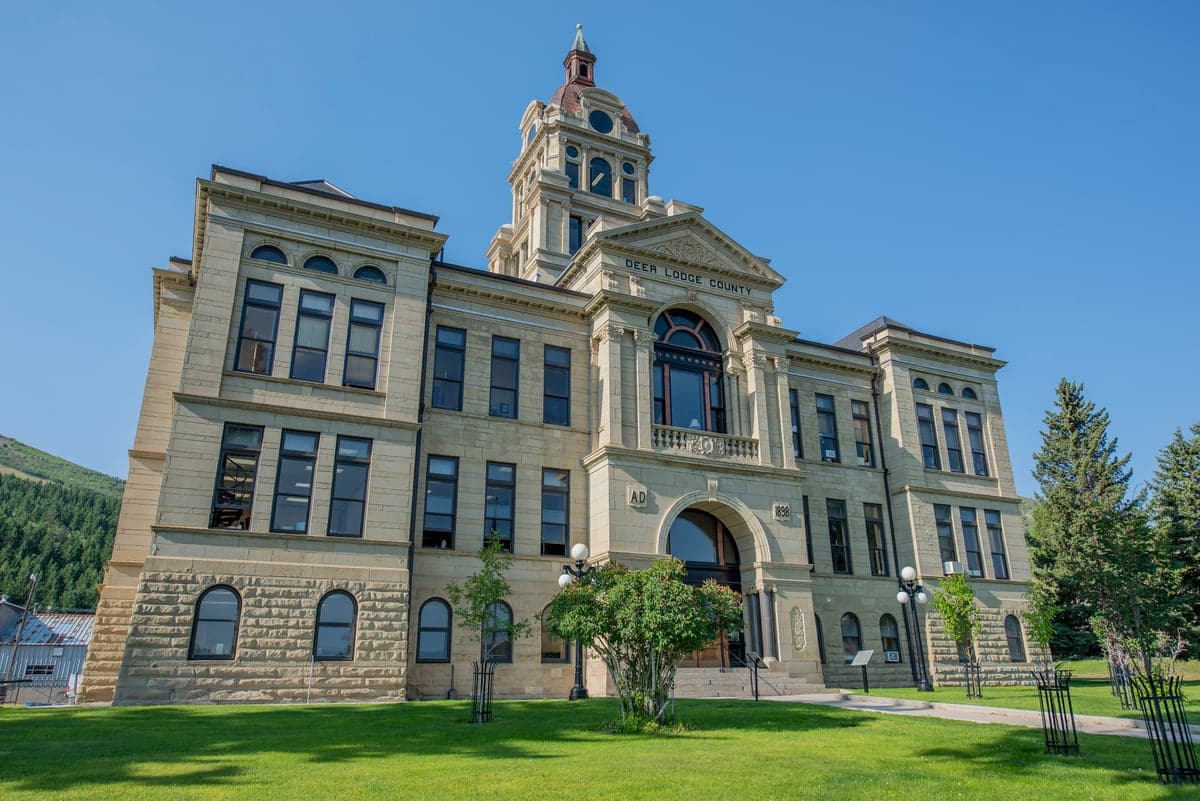
Photo: Wikipedia
Personal Sovereignty in Deer Lodge County
Viable for self-reliance. Generally workable, though some barriers may limit total independence.
What does Personal Sovereignty tell us?
Personal Sovereignty measures your capacity for self-reliance and independence with minimal government friction. Higher scores mean fewer barriers between you and the way you want to live... but it assumes you have the space you need and good neighbors.
What does this tell us?
Personal Sovereignty measures your capacity for self-reliance and independence with minimal government friction. Higher scores mean fewer barriers between you and the way you want to live... but it assumes you have the space you need and good neighbors.
State Policy
Energy independence: Net exporter (120% of energy produced in-state)
Personal Liberty
Homesteading

Personal Liberty Analysis
Deer Lodge County, Montana, offers a notably high degree of personal sovereignty, anchored by Montana’s strong constitutional protections for individual rights and a local culture that prizes self-reliance. The county’s regulatory environment is light-touch compared to urban centers, with county-level governance in Anaconda and the smaller communities of Warm Springs, Galen, and Georgetown generally deferring to state preemption on firearms and property rights. For individuals and families seeking to maximize personal autonomy—from tax burden to self-defense law to off-grid living—Deer Lodge County presents a landscape where state-level freedoms are largely unimpeded by local ordinances, though practical considerations like zoning in the Anaconda-Deer Lodge County consolidated government area require attention.
Tax burden and regulatory posture in Deer Lodge County
Montana’s tax structure is favorable for those prioritizing financial sovereignty, and Deer Lodge County reflects this with no state sales tax and a relatively low property tax burden. The county’s mill levy rate is moderate by Montana standards, with residential property taxes typically running around 0.8% to 1.0% of assessed value—lower than many states but slightly above Montana’s rural average due to the consolidated city-county government in Anaconda. The regulatory posture is permissive: there is no county-wide building code outside of Anaconda’s limited urban zone, and the county planning department imposes minimal restrictions on land use in unincorporated areas like Warm Springs and Georgetown. Montana’s right-to-work laws and absence of a state income tax on most retirement income further reduce the fiscal footprint on residents. However, the county’s reliance on property taxes to fund schools and roads means that large landholders in areas like Lost Creek or Racetrack should expect annual assessments that, while not burdensome, are not negligible.
Self-defense and gun law specifics in Deer Lodge County
Montana is a constitutional carry state, and Deer Lodge County fully embraces this with no additional county-level firearm restrictions. Residents and visitors may carry concealed or openly without a permit, and the county sheriff’s office in Anaconda does not impose waiting periods, background checks beyond federal requirements, or magazine capacity limits. The state’s Castle Doctrine and Stand Your Ground laws apply uniformly, providing broad legal protection for the use of deadly force in self-defense within one’s home, vehicle, or place of business. In practice, this means that a homeowner in Georgetown or a rancher near Warm Springs faces no local ordinances that would complicate a self-defense claim. The county’s gun culture is deeply ingrained; shooting ranges and hunting access are plentiful, and the sheriff’s office is known for a pro-Second Amendment stance. For those moving from restrictive states, Deer Lodge County offers one of the most straightforward legal environments for firearm ownership and carry in the continental U.S.
Self-reliance and homesteading viability in Deer Lodge County
Homesteading and off-grid living are viable across much of Deer Lodge County, but feasibility varies by location due to zoning and utility access. In unincorporated areas like Lost Creek and Racetrack, minimum lot sizes are typically 5 to 10 acres for rural residential use, and there are no county-level prohibitions on rainwater collection, composting toilets, or solar panel installation. The county’s consolidated government in Anaconda does enforce building permits and septic system regulations within the city limits and a two-mile extraterritorial jurisdiction, but outside that zone—such as in Georgetown or the Pintler Scenic Area—residents can build without inspections, provided they meet state health requirements for well and septic. Off-grid energy is practical: the area receives over 200 sunny days per year, and net metering is available through NorthWestern Energy, though interconnection fees apply. For those seeking true self-reliance, the county’s abundant water resources and relatively lax land-use rules make it one of Montana’s more accommodating areas for independent living, though access to propane and firewood delivery in remote spots like Warm Springs Creek should be confirmed before purchase.
Personal liberties in Deer Lodge County
Montana’s legal framework strongly supports parental rights, medical autonomy, and property rights, and Deer Lodge County’s local governance generally aligns with these principles. Parental rights in education are protected by state law, with no county-level mandates that override a parent’s authority to direct their child’s upbringing, including homeschooling and medical decisions. Medical autonomy is broad: Montana does not have a state vaccine mandate for adults, and the county health department in Anaconda does not enforce mask or quarantine orders beyond state recommendations. Property rights are robust, with no county-wide rent control, no inclusionary zoning, and minimal interference with land use outside of Anaconda’s urban core. Speech and assembly are fully protected, and the county’s small population means that local government interactions are often direct and personal—residents in Georgetown or Warm Springs can typically attend county commission meetings and expect their concerns to be heard without bureaucratic friction. The only notable limitation is the county’s consolidated government structure, which gives Anaconda more regulatory reach than a typical county seat, but this primarily affects those within the city limits rather than the broader county.
Overall, Deer Lodge County ranks among Montana’s more sovereignty-friendly areas, offering a combination of low taxes, strong self-defense laws, and permissive land-use rules that appeal to those prioritizing personal freedom. Compared to counties in the Bitterroot or Flathead Valleys, Deer Lodge County has fewer zoning restrictions and a lower cost of entry for land, though it lacks the same level of off-grid infrastructure. For the individual or family seeking a place where state-level constitutional protections are matched by a local culture of non-interference, Deer Lodge County—particularly the unincorporated areas of Lost Creek, Racetrack, and Georgetown—provides a solid foundation for autonomous living without the regulatory creep found in more populated Montana counties.

* Values derived from national, state, county, city and local statistics and may differ in a specific area. Last updated: 2026-06-28T08:05:25.000Z
Narrative content on this page is AI-generated and may contain mistakes. Verify any details that matter before acting on them.
ReloMaps may earn a commission from affiliate links at no extra cost to you.

