
Photo: Wikipedia
Political ClimatePolitical Climate in Jones County
Showing district-level results — no local-only data available.
Local Political AnalysisPolitical Analysis of Jones County
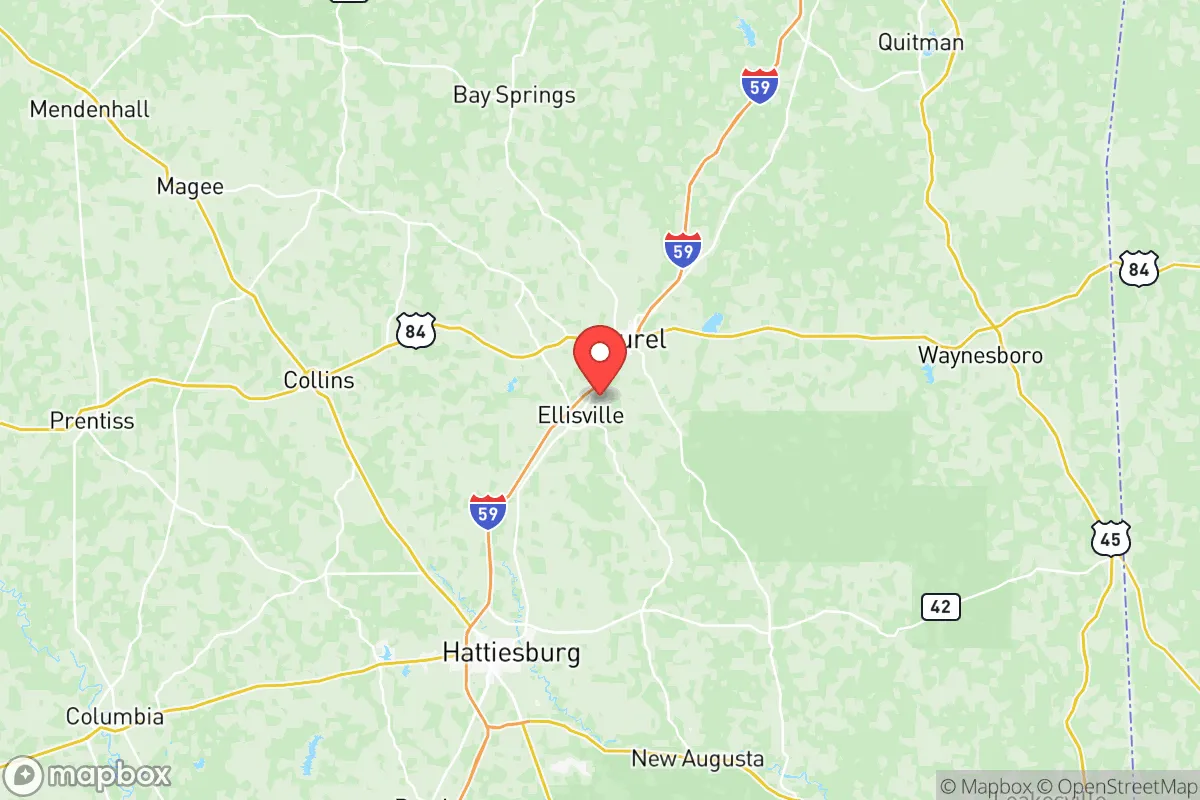
Jones County, Mississippi, is a reliably conservative area with a Cook Partisan Voting Index (PVI) of R+21, making it significantly more Republican than the state of Mississippi as a whole, which sits at R+11. This isn't a new development; the county has been a Republican stronghold for decades, but the margin has widened in recent presidential cycles as rural, working-class areas have shifted rightward. While the county as a whole is deeply red, there are subtle variations—the city of Laurel, the county seat, tends to be more competitive, with Democratic candidates occasionally winning precincts near downtown and around the historic district, while the more rural and suburban precincts in Ellisville and the areas around Sandersville and Soso are reliably Republican by wide margins.
How it compares
The ten-point gap between Jones County (R+21) and Mississippi's statewide PVI (R+11) is substantial and reflects a broader trend: Jones County is more conservative than the state average, which is itself pulled slightly leftward by the Democratic strongholds in the Delta and parts of Jackson. In practice, this means that while Mississippi as a whole votes Republican by a comfortable margin, Jones County is a core part of the GOP's base in the Pine Belt region. For example, in the 2024 presidential election, Donald Trump likely carried Jones County by a margin closer to 70-75%, compared to his roughly 58-60% statewide performance. This divergence is driven by the county's demographics—it's whiter and more rural than the state average, with a strong manufacturing and timber economy that has historically aligned with conservative economic and social policies. The county's Republican lean is also more entrenched than in neighboring counties like Forrest (home to Hattiesburg) or Lamar, which have larger college-town and suburban populations that can produce more moderate or swing voters.
What this means for residents
For conservative residents, the political climate in Jones County is deeply affirming. Local elected offices—from the Board of Supervisors to the Chancery Court judges—are overwhelmingly held by Republicans, and conservative candidates rarely face serious primary challenges. Policy debates at the county level tend to focus on economic development, infrastructure, and maintaining low taxes, with social issues playing a secondary but consistent role. For liberal or moderate residents, the reality is more nuanced. While they are a clear minority, they are not entirely isolated; Laurel's more diverse precincts and the presence of a small but active Democratic club provide some community. However, they often find their views sidelined in local governance, and national political conversations can feel one-sided. The practical effect is that progressive policy initiatives—such as expanding public transit or increasing county funding for social services—face an uphill battle, while conservative priorities like right-to-work laws and Second Amendment protections are widely supported. The county's strong Republican lean also means that national political trends, like the debate over abortion or gun control, are largely settled in favor of conservative positions, with little public pushback.
Culturally, Jones County's political identity is intertwined with its history as a center of the timber and manufacturing industries, and with a strong sense of local independence. The county is home to the Lauren Rogers Museum of Art and the annual Loblolly Festival, but its political culture is more closely tied to the values of self-reliance and limited government that are common across rural Mississippi. One notable policy distinction is the county's approach to economic development: Jones County has aggressively pursued industrial recruitment, offering tax incentives and infrastructure support to attract manufacturing and distribution centers, a strategy that aligns with its pro-business, low-regulation ethos. This has created a stable job market but also means that the county's political leadership is closely aligned with the interests of major employers like Howard Industries and Sanderson Farms. For residents, this translates into a political environment where economic growth is the primary metric of success, and where debates about social or environmental policy are often secondary to maintaining a favorable business climate. The county's deep red hue is unlikely to shift in the near future, as demographic trends—an aging, predominantly white population with strong ties to conservative media and local churches—reinforce the status quo.

State Political ClimatePolitical Climate in Mississippi
State Political AnalysisPolitical Environment in the State
Mississippi is one of the most reliably Republican states in the country, with a Cook Partisan Voting Index of R+11, meaning it votes about 11 points more Republican than the national average in presidential elections. The state hasn’t voted for a Democratic presidential candidate since Jimmy Carter in 1976, and the GOP holds every statewide office and supermajorities in both legislative chambers. Over the past 10-20 years, the shift has been less about Democrats flipping to Republicans and more about the complete collapse of the old conservative Democratic coalition that once dominated the Delta and Pine Belt, replaced by a solid, culturally conservative Republican majority anchored in the suburbs and rural areas.
Urban vs. rural divide
The political map of Mississippi is starkly divided between a handful of urban centers and the vast rural expanse. The state’s only reliably blue stronghold is the Jackson metro area (Hinds County), which has voted Democratic by wide margins for decades, driven by a large African American population and a progressive-leaning professional class. In 2024, Hinds County went about +40 for the Democratic ticket. The other notable blue pockets are the Mississippi Delta counties like Bolivar and Washington (Greenville), where Black-majority populations produce consistent Democratic wins. On the flip side, the Gulf Coast counties—Harrison (Biloxi-Gulfport), Jackson (Pascagoula), and Hancock—have trended hard red, with Harrison County voting +25 R in 2024. The suburban ring around Jackson, particularly Madison and Rankin counties, are among the most Republican in the nation; Madison County voted +38 R in 2024. The northeastern corner around Tupelo (Lee County) and the Pine Belt around Hattiesburg (Forrest County) are also solidly Republican, though Hattiesburg itself has a small liberal college-town contingent from the University of Southern Mississippi. The rural counties in the central hills and along the Tennessee border—like Pontotoc, Union, and Lafayette (Oxford)—are deeply red, though Oxford’s Ole Miss campus injects a noticeable blue streak into otherwise conservative Lafayette County.
Policy environment
Mississippi’s policy environment is among the most conservative in the nation, reflecting its R+11 lean. The state has no state income tax on wages (phased out by 2026), a 7% sales tax on most goods, and some of the lowest property taxes in the country due to a homestead exemption that caps assessments. The regulatory posture is light-touch: no state-level minimum wage above the federal $7.25, no universal background checks for gun purchases, and a right-to-work law that has kept unionization rates below 5%. Education policy is dominated by school choice: the state has a robust charter school law, a voucher-like Education Scholarship Account program for special-needs students, and a new universal school choice program passed in 2024 that lets any family use state funds for private or homeschool expenses. Healthcare is a perennial flashpoint: Mississippi has not expanded Medicaid under the Affordable Care Act, leaving roughly 75,000 working poor in a coverage gap, though the state has one of the highest rates of rural hospital closures in the country. Election laws are restrictive by national standards: voter ID is required, no-excuse absentee voting is limited to those 65 or older or with a specific disability, and early voting was only introduced in 2024 (a single Saturday before Election Day). The state also has a lifetime ban on voting for anyone convicted of certain felonies, though a 2023 law restored rights for some nonviolent offenders after a five-year waiting period.
Recent policy direction
The last three years have seen Mississippi accelerate its conservative agenda across multiple fronts. On guns, the state enacted permitless carry (constitutional carry) in 2022, allowing any adult who can legally possess a firearm to carry it openly or concealed without a license. On education, the 2024 universal school choice law (HB 1430) is the most expansive in the South, diverting per-pupil state funding to private and homeschool accounts. Parental rights were strengthened by a 2023 law requiring schools to notify parents of any curriculum involving sexual orientation or gender identity and to obtain parental consent before a student can change their name or pronouns. On abortion, Mississippi’s trigger law banning nearly all abortions took effect in 2022 after Dobbs, with no exceptions for rape or incest—only to save the mother’s life. The state also passed a 2023 law restricting gender-affirming care for minors, banning puberty blockers and hormone therapy. On voting, the 2024 early voting law was a modest expansion, but the state still has no online voter registration and requires a notarized absentee ballot application. Property rights were bolstered by a 2023 law limiting eminent domain for private economic development. On privacy and surveillance, Mississippi has no comprehensive data privacy law, but a 2024 law restricts the use of facial recognition by law enforcement without a warrant. The overall direction is toward maximizing individual liberty in gun ownership, education choice, and property rights, while tightly restricting abortion, transgender care, and ballot access.
Civil unrest & political movements
Mississippi has a quieter political landscape than many states, but flashpoints exist. The most visible recent unrest was the 2020-2021 protests in Jackson over police brutality and the removal of Confederate monuments, which saw clashes between Black Lives Matter activists and counter-protesters. The state’s immigration politics are low-key because Mississippi has a very small foreign-born population (about 2.5%), but there have been localized tensions in poultry-processing towns like Morton and Forest, where Latino populations have grown. In 2023, the legislature passed a bill requiring local law enforcement to cooperate with ICE, but no sanctuary city movement has emerged. Secession rhetoric is rare but not extinct; a 2022 poll found 42% of Mississippi Republicans supported secession, though no serious movement exists. Election integrity controversies flared after 2020, with the state GOP passing a 2021 law banning private funding of election administration (a response to Zuckerberg-funded grants in other states). The most organized political movements are on the right: the Mississippi Republican Party’s grassroots is dominated by the Mississippi Tea Party and the Mississippi Center for Public Policy, which have pushed the school choice and tax-cut agendas. On the left, the Mississippi Poor People’s Campaign and the NAACP’s state chapter are active, but they have little legislative influence. A new resident would notice the absence of visible political yard signs or bumper stickers outside of election season—politics here is less performative than in swing states.
Projection
Over the next 5-10 years, Mississippi’s political trajectory is likely to stay deeply red, but with subtle shifts. The state’s population is aging and slowly declining (down about 0.2% per year), with out-migration of younger, college-educated residents to Texas, Tennessee, and Florida. In-migration is modest and mostly from other Southern states, bringing people who are already conservative. The growing Latino population in the poultry and construction sectors is still too small to shift the partisan balance, and they tend to vote Republican at higher rates than Latinos nationally. The biggest wildcard is the Black population (about 38% of the state), which remains overwhelmingly Democratic but has low turnout in non-presidential years. If national Democrats continue to lose ground with rural and working-class voters, Mississippi could become even more Republican, potentially reaching R+14 or R+15 by 2032. However, the Jackson metro’s decline—the city lost 6% of its population between 2020 and 2024—could weaken the state’s only blue anchor. The suburbs of Madison and Rankin will continue to grow and harden their Republican lean. A relocator moving in now should expect a state where conservative policy will continue to expand: more school choice, further tax cuts, and tighter restrictions on abortion and transgender rights. The only plausible leftward shift would come from a national Democratic wave that boosts Black turnout, but that’s a cyclical event, not a structural change.
For a new resident, the bottom line is straightforward: Mississippi offers a low-tax, low-regulation environment where conservative values dominate policy and culture. If you’re a conservative family, you’ll find a state that aligns with your views on guns, education, and taxes, and where your vote carries weight in primaries. If you’re a liberal, you’ll be in a clear minority, especially outside of Jackson, Oxford, or the Gulf Coast’s small progressive pockets. The state’s political stability means no dramatic swings, but also little chance of policy change on issues like Medicaid expansion or abortion access. Your daily life will be shaped more by local county politics than state-level debates—the real action is in school board and supervisor races, where conservative majorities are the norm. If you value predictability and a government that stays out of your way on economic matters, Mississippi delivers; if you want a politically diverse environment or progressive social policy, you’ll need to look elsewhere.
* Values derived from national, state, county, city and local statistics and may differ in a specific area. Last updated: 2026-06-16T05:10:42.000Z
Narrative content on this page is AI-generated and may contain mistakes. Verify any details that matter before acting on them.
ReloMaps may earn a commission from affiliate links at no extra cost to you.

