
Photo: Wikipedia
Demographics of Jones County
Affluence Level in Jones County
A below-average socioeconomic profile. Incomes, home values, and educational attainment trail the U.S., with higher poverty and unemployment.
People of Jones County
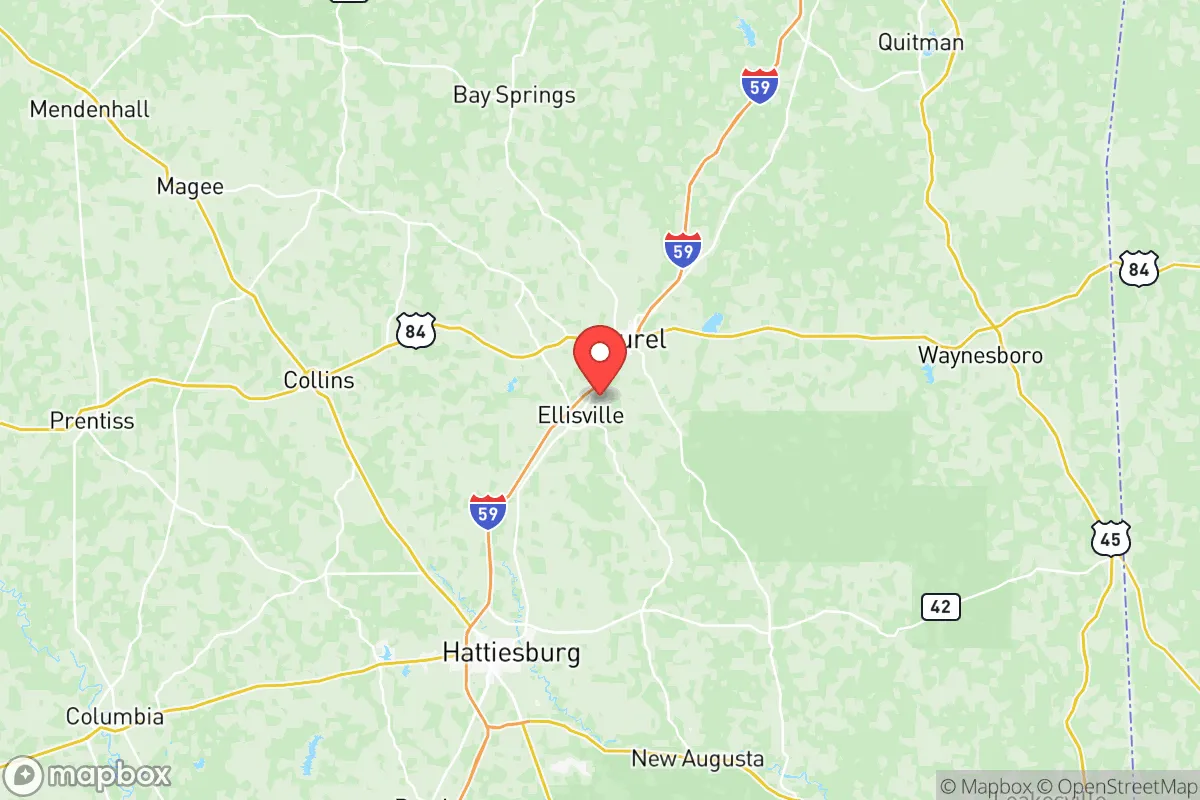
Today, the people of Jones County, Mississippi, number 66,839 and are characterized by a strong sense of local identity, a predominantly native-born population (only 2.2% foreign-born), and a demographic makeup that is roughly two-thirds White (63.1%) and just over a quarter Black (28.5%). The county is notably less diverse than the national average, with a small but growing Hispanic community (6.1%) and minimal Asian (0.3%) or Indian (0.1%) populations. This is a place where family roots run deep, where the Civil War-era legacy of the "Free State of Jones" still echoes in local lore, and where the population is older and less college-educated (20.0%) than the state average, reflecting a rural-to-small-town character centered on the cities of Laurel and Ellisville.
Settlement & growth (pre-1960)
Long before European settlement, the area that is now Jones County was part of the traditional homeland of the Choctaw people. The Choctaw used the region's pine forests and rivers for hunting and seasonal camps, but they did not establish large permanent villages within the county's boundaries. The first European incursion came via the French and Spanish colonial periods, but no permanent settlements took hold until after the United States acquired the territory in the 1798 Mississippi Territory and forcibly removed the Choctaw via the Treaty of Dancing Rabbit Creek in 1830.
The first major wave of American settlers arrived in the 1830s and 1840s, primarily Scots-Irish and English yeoman farmers from the Carolinas, Georgia, and Tennessee. These were small-scale subsistence farmers, not plantation owners, drawn by cheap, hilly land unsuitable for large-scale cotton agriculture. They founded the county seat of Ellisville (named for a local landowner) in 1832 and the town of Laurel in 1882. The county's population remained overwhelmingly White and rural through the antebellum period, with enslaved Black people making up only about 12% of the population in 1860—far lower than the Mississippi Delta. This demographic fact underpinned the county's famous Civil War-era resistance: Jones County effectively seceded from the Confederacy in 1863, forming the "Free State of Jones" under Newton Knight, a unionist uprising rooted in the region's anti-plantation, small-farmer culture.
After the Civil War and Reconstruction, the county's economy and population were transformed by the timber boom. From the 1880s through the 1920s, the vast pine forests attracted a new wave of settlers: Black and White laborers from across the Deep South, drawn by jobs in sawmills and turpentine camps. The town of Laurel exploded in population, becoming a major lumber hub. This period also saw the arrival of a small number of European immigrants—mostly Italian and Lebanese merchants—who settled in Laurel and Ellisville, though their numbers were never large. By 1900, the Black population had risen to roughly 30%, as freedmen and their descendants moved into the county for timber work. The Great Migration (1910–1970) saw many Black residents leave Jones County for industrial jobs in the North, but the county's Black population remained substantial, concentrated in Laurel's historically Black neighborhoods like East Laurel and in rural communities like Sandersville.
The post-World War II era (1945–1960) brought modest suburbanization around Laurel, fueled by the growth of the Masonite Corporation (a hardboard manufacturer) and other wood-products industries. White families began moving to new subdivisions on the outskirts of Laurel and Ellisville, while the county's overall population remained stable at around 45,000. The Civil Rights Movement of the 1960s saw significant local activism, including a 1965 march in Laurel led by Dr. Martin Luther King Jr., but the county's racial demographics changed little during this period.
Modern era (post-1965)
The 1965 Hart-Cellar Act, which opened immigration to non-European countries, had a minimal direct impact on Jones County. The foreign-born population today is just 2.2%, far below the national average, and the county did not experience the large-scale immigration from Latin America or Asia seen in many other parts of the South. Instead, the most significant demographic shift since 1965 has been domestic: the slow, steady outmigration of younger, college-educated residents to larger cities like Hattiesburg, Jackson, and the Gulf Coast, combined with the in-migration of a small number of retirees and remote workers seeking a lower cost of living.
The Hispanic population, while still small at 6.1%, has grown noticeably since the 1990s, driven by labor demand in poultry processing (at plants in nearby Wayne County) and in construction. These families have settled primarily in Laurel and Ellisville, where a small but visible Hispanic commercial corridor has emerged along parts of Highway 84. The Asian population (0.3%) and Indian population (0.1%) remain negligible, consisting mostly of a handful of medical professionals at South Central Regional Medical Center in Laurel and a few small business owners. The Black population has held steady at around 28.5%, with many families remaining in the same neighborhoods and rural communities their ancestors settled during the timber era. Suburbanization has continued at a slow pace, with new subdivisions appearing along the Highway 15 corridor between Laurel and Ellisville, but the county has not experienced the explosive growth seen in Mississippi's Gulf Coast or DeSoto County.
The future
Jones County's population is projected to remain relatively stable or decline slightly over the next 10–20 years, as the county's older demographic (median age around 40) and low birth rates offset any in-migration. The county is becoming slightly more diverse, driven by the gradual growth of the Hispanic population, which could reach 8–10% by 2040, and by a small but steady influx of Black families returning from Northern cities to retire or care for aging relatives. However, the White population will likely continue to decline as a share, from 63.1% toward 58–60%, due to outmigration of young adults and lower birth rates among White families.
New residential development is concentrating in the Laurel area, particularly along the Highway 84 corridor west of town, where new subdivisions and apartment complexes are attracting a mix of young families and remote workers. The historic downtowns of Laurel and Ellisville are seeing modest reinvestment, with the "Free State of Jones" tourism brand drawing some visitors and new residents interested in the area's unique history. The county's cultural identity remains deeply rooted in its rural, working-class, and independent-minded character, but it is slowly evolving as the Hispanic community becomes more established and as a small number of newcomers from other parts of the country arrive.
For someone moving in now, Jones County offers a low-cost, slow-paced lifestyle in a community that values self-reliance and local history. The population is stable, not booming, and the demographic changes are gradual rather than disruptive. New residents will find a place where the "Free State of Jones" legacy is still a point of pride, where church and family remain central, and where the biggest challenge is not diversity but economic opportunity—the county's poverty rate hovers around 20%, and the college-educated share is just 20.0%. It is a place for those seeking affordability and authenticity, not for those expecting rapid growth or cosmopolitan diversity.

* Values derived from national, state, county, city and local statistics and may differ in a specific area. Last updated: 2026-06-16T05:10:42.000Z
Narrative content on this page is AI-generated and may contain mistakes. Verify any details that matter before acting on them.
ReloMaps may earn a commission from affiliate links at no extra cost to you.

