
Photo: Wikipedia
Personal Sovereignty in Jones County
Viable for self-reliance. Generally workable, though some barriers may limit total independence.
What does Personal Sovereignty tell us?
Personal Sovereignty measures your capacity for self-reliance and independence with minimal government friction. Higher scores mean fewer barriers between you and the way you want to live... but it assumes you have the space you need and good neighbors.
What does this tell us?
Personal Sovereignty measures your capacity for self-reliance and independence with minimal government friction. Higher scores mean fewer barriers between you and the way you want to live... but it assumes you have the space you need and good neighbors.
State Policy
Energy independence: Importer (50% of energy produced in-state)
Personal Liberty
Homesteading

Personal Liberty Analysis
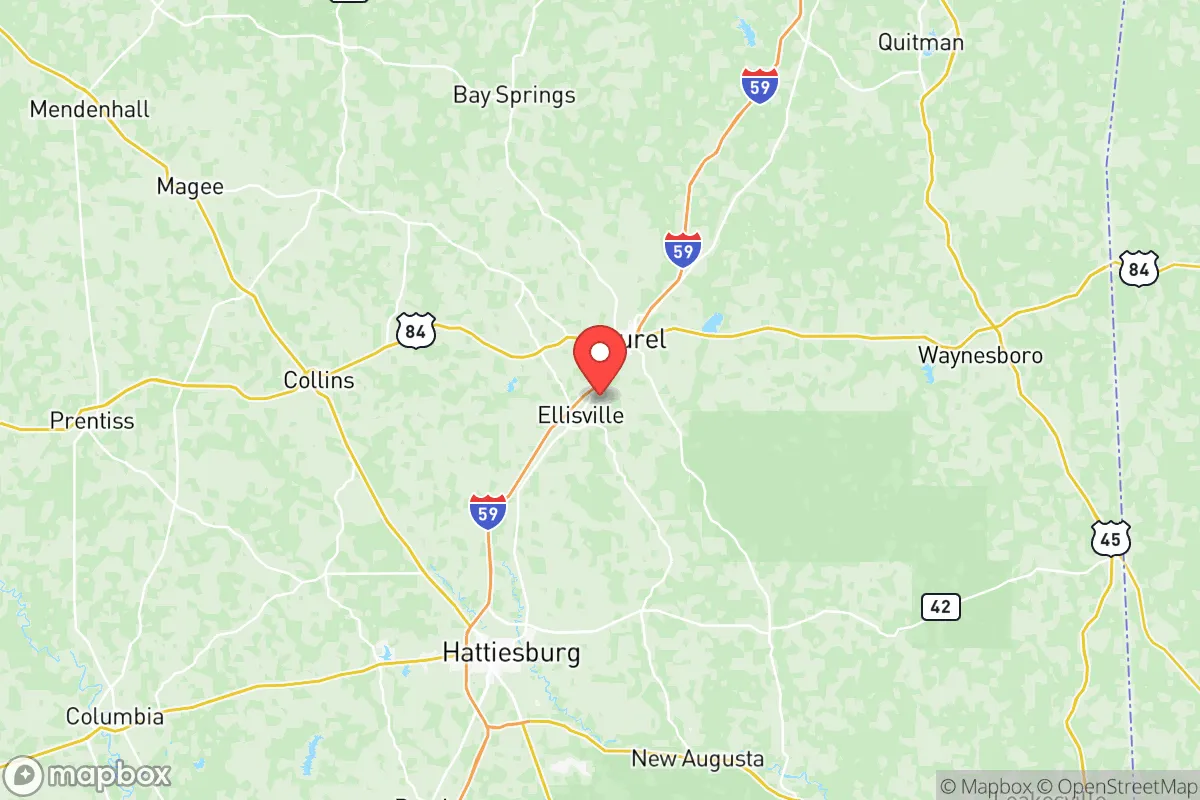
Jones County, Mississippi, offers a notably high degree of personal sovereignty, grounded in Mississippi’s strong state-level protections for gun rights, parental authority, and property use, combined with a local regulatory environment that is generally light-touch. The county seat of Laurel and the smaller communities of Ellisville, Sandersville, and Soso each present slightly different flavors of autonomy, but the overarching ethos is one of self-reliance and minimal government interference. For individuals and families who prioritize making their own decisions on self-defense, education, and land use, Jones County ranks among the more freedom-oriented areas in the Pine Belt region.
Tax burden and regulatory posture: How light is the local government footprint?
Mississippi’s state-level tax burden is among the lowest in the nation, and Jones County’s local government largely follows suit. The state has a flat income tax rate of 4.0% (phasing down to 3.99% in 2026), and the average combined state and local sales tax rate in Jones County is approximately 7.0%—with Laurel at 7.0% and Ellisville at 7.0% as well. Property taxes are exceptionally low: the county’s millage rate for residential property hovers around 100 mills, translating to roughly $1,000 annually on a $100,000 home. There is no county-level inventory tax on business personal property, and the regulatory posture for small businesses is permissive. Zoning is minimal outside of Laurel’s city limits; in unincorporated areas like Glade or the rural stretches near Sandersville, there are virtually no building codes or land-use restrictions beyond basic septic and well permits. The county does not impose a local business license fee for most home-based enterprises, and the permitting process for new construction is straightforward—typically a single visit to the chancery clerk’s office. This creates an environment where starting a side business, building a workshop, or operating a small farm incurs very little bureaucratic friction.
Self-defense and gun law specifics: What can you legally do in Jones County?
Mississippi is a constitutional carry state, meaning any adult who can legally possess a firearm may carry it openly or concealed without a permit. Jones County fully respects this: there are no local ordinances restricting carry in parks, public buildings (beyond state-mandated courthouse security), or on public streets. The county sheriff’s office in Laurel and Ellisville is known for a pro-Second Amendment stance, and stand-your-ground laws apply with no duty to retreat in any place where the individual has a legal right to be. For those who want a permit for reciprocity with other states, the Jones County Sheriff’s Office issues enhanced carry permits with a 30-day turnaround. Private firearm sales between individuals require no background check or paperwork, and there are no local magazine capacity or ammunition restrictions. The gun culture is deeply embedded: shooting ranges are common in rural areas like Soso and Sandersville, and hunting on private land is unrestricted with landowner permission. For self-defense in the home, Mississippi’s Castle Doctrine provides a legal presumption that a homeowner who uses deadly force against an intruder acted reasonably.
Self-reliance and homesteading viability: Lot sizes, zoning, and off-grid feasibility
Jones County is a strong candidate for homesteading and off-grid living, particularly outside the city limits of Laurel and Ellisville. In unincorporated areas, minimum lot sizes for residential use are typically 1 to 5 acres, with no county-wide minimum for agricultural parcels. Zoning is virtually nonexistent in rural precincts—you can keep chickens, goats, or a few head of cattle on a standard 2-acre lot without a permit. Off-grid feasibility is high: rainwater catchment is legal and common, composting toilets are permitted with a simple septic variance, and solar panel installation requires no county building permit. The county does not enforce any aesthetic or setback covenants on private land, so building a workshop, greenhouse, or tiny home is straightforward. In the community of Glade, many residents rely on well water and septic systems, and the county health department’s inspection process for new wells is a single $50 fee. For those seeking a more intentional community, the area around Sandersville offers large tracts of timberland (20+ acres) at prices under $2,000 per acre, with no subdivision regulations. The only notable restriction: within Laurel’s city limits, the historic district near downtown has design review for exterior modifications, but this does not affect agricultural or off-grid uses on the outskirts.
Personal liberties: Parental rights, medical autonomy, speech, and property
Mississippi law provides robust protections for parental rights, including the right to direct a child’s education, medical care, and religious upbringing. Jones County has a thriving homeschool community, with no state-mandated curriculum, testing, or registration requirements—parents simply file a certificate of enrollment with the local school district. Medical autonomy is similarly broad: there are no state or local vaccine mandates for adults, and the county health department does not enforce any mask or quarantine orders. Religious and political speech is fully protected, and the county does not regulate signs, leafleting, or public gatherings beyond standard traffic safety. Property rights are strongly defended: the county does not impose rent control, short-term rental bans, or tree preservation ordinances on private land. Eminent domain is rarely exercised, and the county’s comprehensive plan (last updated 2020) explicitly prioritizes private property rights over government land-use planning. For those concerned about surveillance, Jones County has no red-light cameras, no automated license plate readers on county roads, and the sheriff’s office does not participate in federal data-sharing programs for non-criminal traffic stops.
Overall, Jones County offers one of the more sovereignty-friendly environments in Mississippi’s Pine Belt, comparable to neighboring Covington or Wayne counties but with slightly better infrastructure access. The combination of constitutional carry, minimal zoning, low taxes, and strong parental rights creates a legal framework where individuals and families can live largely as they see fit—provided they respect the quiet, rural character of the area. For a reader weighing relocation based on personal freedom, Jones County stands out as a place where government footprint is small, self-reliance is the norm, and the law consistently sides with the individual over the state.

* Values derived from national, state, county, city and local statistics and may differ in a specific area. Last updated: 2026-06-16T05:10:42.000Z
Narrative content on this page is AI-generated and may contain mistakes. Verify any details that matter before acting on them.
ReloMaps may earn a commission from affiliate links at no extra cost to you.

