 Popular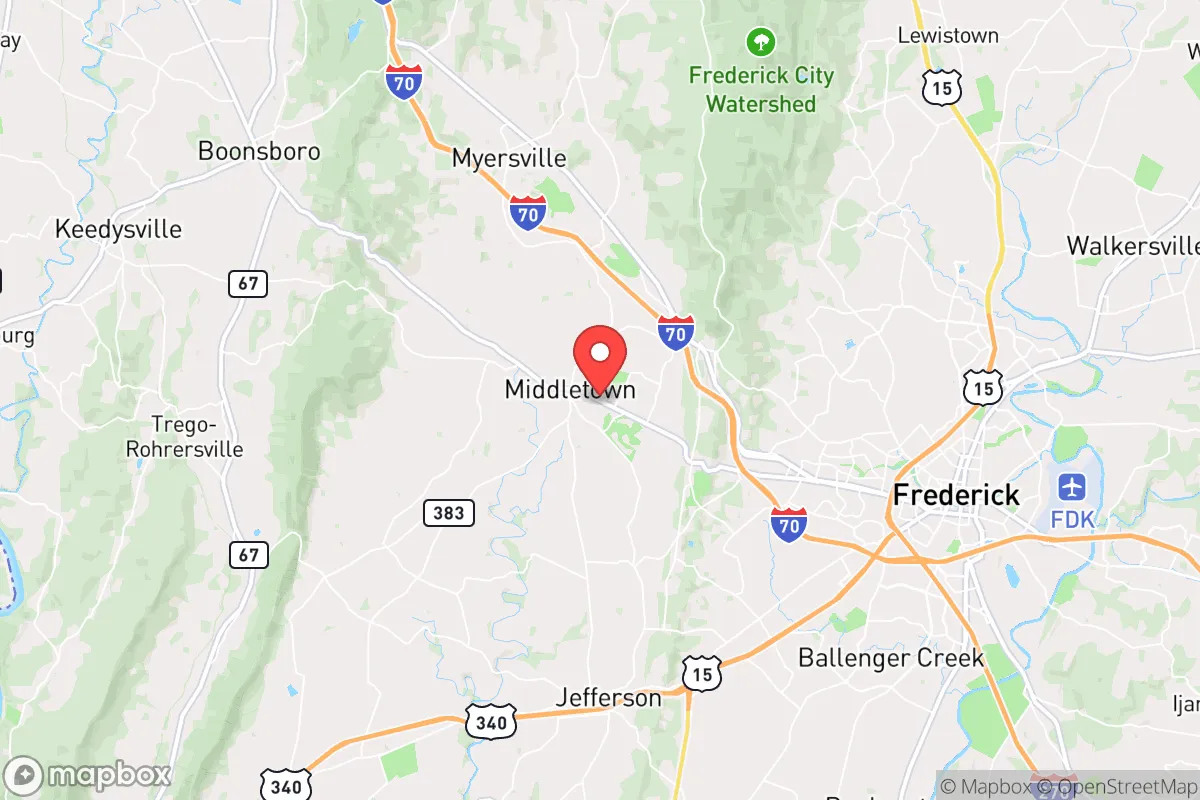
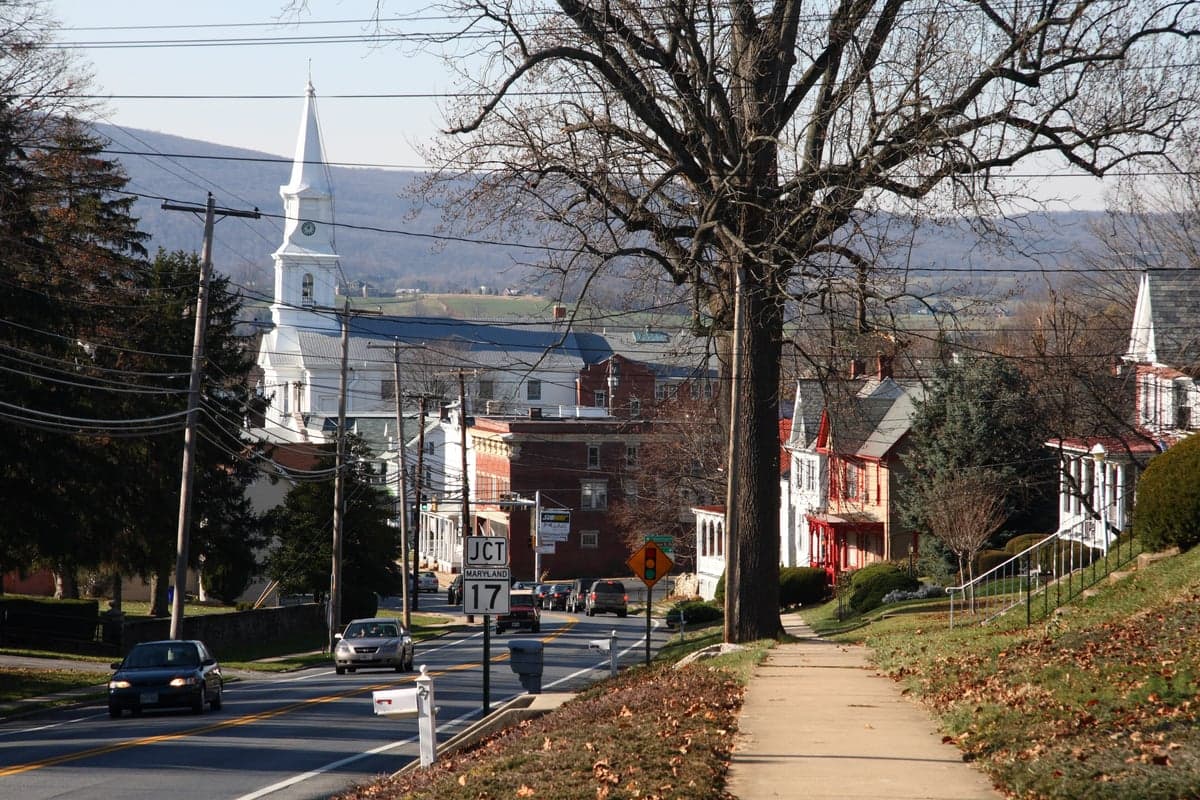
Photo: Wikipedia
Political ClimatePolitical Climate in Middletown, MD
District shown is the primary district for this city’s centroid. Cities may span multiple districts.
Local Political AnalysisPolitical Analysis of Middletown, MD
Middletown, Maryland, sits in a political sweet spot that surprises a lot of people. While the state as a whole leans heavily Democratic with a Cook PVI of D+17, Middletown itself is a much more moderate D+3, meaning it's a genuine swing area where both parties have a real shot at winning local races. Over the past decade, the town has shifted leftward, but not nearly as fast as the rest of Frederick County or the state, and a lot of that has to do with the deep-rooted agricultural and small-town conservative traditions that still hold strong here. You'll find plenty of Trump signs in yards alongside Harris-Walz signs, and that's not something you see in most Maryland towns.
How it compares
The gap between Middletown's D+3 and Maryland's D+17 is massive in practical terms. Drive 15 minutes east into Frederick city and you're in a D+15 environment where progressive policies dominate local council discussions. Head west toward Boonsboro or Hagerstown and you'll hit R+10 to R+15 territory. Middletown is the buffer zone. In the 2024 presidential election, Frederick County as a whole went for Biden by about 10 points, but Middletown precincts were within 2-3 points of a tie. The town's state legislative district (District 4) is one of the few genuinely competitive seats in the state, flipping between parties every few cycles. That's unheard of in most of Maryland, where gerrymandering has locked in safe seats for both parties.
What this means for residents
For conservative residents, living in a D+3 town means your vote actually matters. You're not shouting into the void like you would be in Baltimore City or Montgomery County. Local school board races, town council seats, and even the county commissioner elections are regularly decided by margins under 5%. For liberal residents, it means you can't take anything for granted. You have to show up, knock on doors, and actually persuade your neighbors, because the automatic Democratic majority that exists statewide doesn't exist here. The practical result is that Middletown's local government tends to be more pragmatic and less ideological than what you'd see in Annapolis. Zoning decisions, tax rates, and school funding debates are hashed out with both sides having real leverage, which forces compromise.
Culturally, this political balance means Middletown has managed to keep its small-town character while still evolving. You won't find the kind of culture-war battles that dominate school boards in more polarized districts. The town's annual events, like the Middletown Volunteer Fire Company carnival and the Heritage Day festival, draw everyone regardless of party affiliation. The biggest policy distinction you'll notice is in housing and development: the town has been slower to approve large-scale subdivisions than Frederick city, partly because the more conservative council members push back on density, while the liberal members push for affordable housing. The result is a slower, more deliberate growth pattern that frustrates developers but keeps the town's historic feel intact. If you're moving here from deep-blue or deep-red territory, you'll find the political climate refreshingly grounded in local issues rather than national talking points.

State Political ClimatePolitical Climate in Maryland
State Political AnalysisPolitical Environment in the State
Maryland is one of the most reliably Democratic states in the country, with a Cook Partisan Voting Index of D+17, meaning it votes about 17 points more Democratic than the national average in presidential elections. The state hasn't voted for a Republican presidential candidate since George H.W. Bush in 1988, and Democrats control the governorship, both chambers of the General Assembly, and both U.S. Senate seats. Over the last 10-20 years, the Democratic lean has actually deepened as the Washington, D.C. suburbs have grown and diversified, while the rural parts of the state have become more Republican — a classic urban-rural sorting that has pushed the state further left overall.
Urban vs. rural divide
The political map of Maryland is a tale of two worlds. The entire western shore of the Chesapeake Bay, from the D.C. suburbs north through Baltimore, is deep blue. Montgomery County and Prince George's County alone account for nearly a third of the state's votes and routinely deliver 75-85% Democratic margins. Baltimore City is similarly lopsided. The eastern shore and western Maryland are the reddest parts of the state — Garrett County in the far west voted 70% for Trump in 2020, and Allegany County (Cumberland) is reliably Republican. The key swing counties that used to be competitive — Anne Arundel County (Annapolis) and Baltimore County — have been trending blue over the last decade as suburban voters shift left. Frederick County, once a conservative stronghold, is now a purple-to-blue county as D.C. commuters push in from the south. The only real Republican holdout of note is Carroll County (Westminster), which remains solidly red and is a notable outlier in the central part of the state.
Policy environment
Maryland's policy environment is consistently progressive. The state has a graduated income tax with rates from 2% to 5.75%, and local counties add their own "piggyback" tax on top — combined rates can exceed 8% in high-tax jurisdictions like Montgomery County. Property taxes are moderate but vary widely by county. Sales tax is 6% and applies to most goods but not groceries. The regulatory posture is business-friendly in some sectors (biotech, cybersecurity) but heavy on labor and environmental rules. Education spending per pupil is among the highest in the nation, driven by the Blueprint for Maryland's Future law, which pours billions into K-12. Healthcare is heavily regulated, with a state-based insurance exchange and strict oversight of hospital rates. Election laws are among the most accessible in the country: same-day registration, no-excuse mail voting, early voting, and automatic voter registration at the DMV. There is no voter ID law requiring a photo — a signed affidavit suffices at the polls.
Recent policy direction
Recent legislation shows Maryland moving further left on most fronts. On gun and self-defense law, the state passed the Gun Safety Act of 2023, which bans carrying firearms in a long list of "sensitive places" including hospitals, public transit, and any private property without explicit permission — effectively a response to the Bruen decision. Maryland also has a strict handgun permit system and a ban on "assault weapons" that has survived court challenges. On parental and education rights, the state has moved toward LGBTQ-inclusive curriculum mandates and has not adopted any "parents' bill of rights" laws seen in red states. On speech and privacy, Maryland passed the Online Data Privacy Act in 2024, one of the stronger state privacy laws, but has also expanded surveillance powers in some areas. On medical and bodily autonomy, Maryland has codified abortion access into state law, expanded Medicaid coverage for gender-affirming care, and passed shield laws protecting providers who serve out-of-state patients. On property rights, the state has strong environmental regulations that can limit development, particularly in the Chesapeake Bay watershed. On taxation, the trend is toward higher taxes on high earners — a proposed "millionaire's tax" surcharge was debated in 2024. On voting and ballot access, the state continues to expand mail voting and early voting, with no signs of tightening.
Civil unrest & political movements
Maryland has a history of visible political activism, particularly around the D.C. suburbs and Baltimore. The 2015 Baltimore protests after the death of Freddie Gray were a major flashpoint, leading to a National Guard deployment and lasting changes in policing policy. More recently, the state has seen organized activism around abortion rights, with large rallies in Annapolis, and around gun rights, with Second Amendment groups regularly testifying against new restrictions. Immigration politics are a live issue: Maryland has a "Trust Act" limiting local police cooperation with federal immigration enforcement, and several counties including Montgomery and Prince George's have explicit sanctuary policies. There has been periodic talk of secession from the western and eastern shore counties — in 2021, a bill to allow counties to secede was introduced but went nowhere. Election integrity controversies have been relatively muted compared to swing states, though some Republican activists have raised concerns about the state's mail voting system. A new resident would notice the prevalence of political yard signs and bumper stickers, especially in the purple suburbs, and the strong presence of both progressive and conservative advocacy groups at the state capitol.
Projection
Over the next 5-10 years, Maryland is likely to become even more Democratic. The D.C. suburbs continue to grow and diversify, with Montgomery and Prince George's counties adding population while rural counties stagnate or decline. The in-migration from the D.C. area is overwhelmingly Democratic-leaning professionals. The Republican Party in Maryland is increasingly confined to the rural west and eastern shore, with little chance of winning statewide office unless a moderate breaks through in a wave year. The state's tax and regulatory environment will likely continue to trend left, with new spending programs and higher taxes on the wealthy. For a conservative relocator, the practical reality is that you will be living in a state where your vote for president and Senate is almost certainly going to the Democratic column, but where local elections in places like Carroll County or Garrett County can still be competitive. For a liberal relocator, Maryland offers a policy environment that is largely aligned with your values, with strong protections for reproductive rights, voting access, and social services.
The bottom line for a new resident: If you're conservative, you can find like-minded communities in Carroll County, the eastern shore, or western Maryland, but you will be living under a state government that is consistently progressive on taxes, guns, education, and social policy. If you're liberal, you'll find the state broadly aligned with your views, especially in the D.C. suburbs and Baltimore. Either way, expect high taxes, strong regulations, and a political culture that is shaped more by the D.C. metro area than by the rest of the state. The divide between the blue urban corridor and the red rural periphery is real and likely to widen, so choose your county carefully — it will make a bigger difference to your daily life than the state's overall lean.
* Values derived from national, state, county, city and local statistics and may differ in a specific area. Last updated: 2026-10-10T16:28:18.000Z
Narrative content on this page is AI-generated and may contain mistakes. Verify any details that matter before acting on them.
ReloMaps may earn a commission from affiliate links at no extra cost to you.

