 Popular
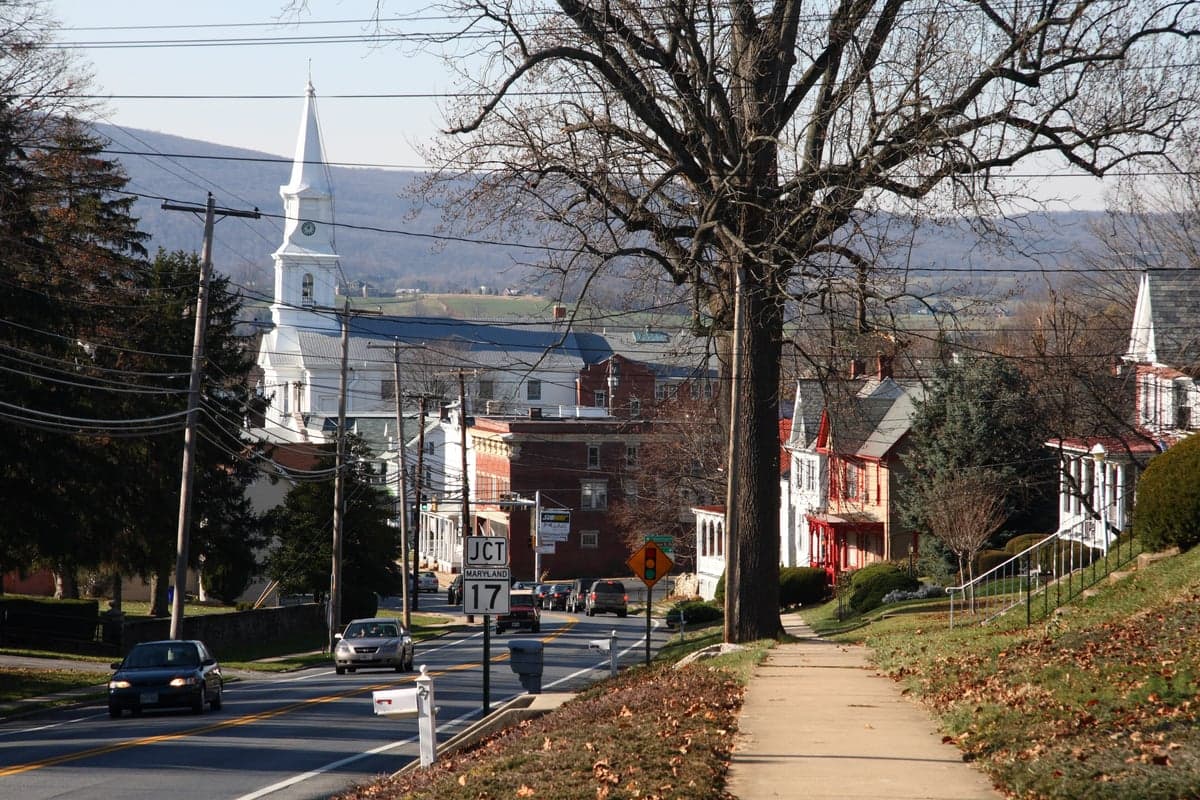
Photo: Wikipedia
Demographics of Middletown, MD
Affluence Level in Middletown, MD
An upper-middle-class area. Household wealth, education levels, and homeownership run ahead of national benchmarks.
People of Middletown, MD
Today, Middletown, Maryland is a small, tight-knit community of 5,108 residents that blends historic small-town character with modern suburban convenience. The population is predominantly White (84.0%), with notable and growing East/Southeast Asian (5.1%) and Indian subcontinent (4.0%) communities, while the foreign-born share remains low at just 1.4%. With 62.1% of adults holding a college degree, the city attracts educated professionals and families who value its walkable historic core, strong school system, and proximity to Frederick and Washington, D.C. The people of Middletown today are defined by a quiet, family-oriented civic pride and a demographic profile that is slowly diversifying from its deep German and English roots.
How the city was settled and grew
Middletown was laid out in 1767 along the Monocacy Road, a major colonial thoroughfare, and drew its earliest settlers primarily from German and English farming families seeking fertile land in the Middletown Valley. The town's original population clustered around the central square and along Main Street, in what is now known as the Historic District, where many 18th- and 19th-century stone and brick homes still stand. During the 19th century, the arrival of the railroad and the town's role as a regional market center attracted additional waves of German and Irish laborers, who settled in modest homes along Jefferson Street and Fountain Street. The population remained overwhelmingly White and Protestant through the early 1900s, with growth driven by local agriculture, milling, and small-scale commerce rather than heavy industry.
Modern era (post-1965)
After the 1965 Hart-Cellar Act and the broader suburbanization of the Washington-Baltimore corridor, Middletown began to see gradual demographic change. The construction of Interstate 70 in the 1970s made the town accessible to commuters, and new subdivisions such as Worthington Manor and Greenbrier attracted White middle-class families from Frederick and Montgomery counties seeking larger lots and lower taxes. The East/Southeast Asian population, now 5.1%, began arriving in the 1990s and 2000s, largely as professionals drawn to the area's schools and housing values, and they settled primarily in newer developments like Worthington Manor and the Middletown Commons area. The Indian subcontinent community, now 4.0%, followed a similar pattern, with many families moving directly into these same subdivisions rather than clustering in a single ethnic enclave. The Hispanic (2.8%) and Black (1.1%) populations remain small, reflecting the town's limited rental housing stock and higher home prices, which have historically filtered for higher-income buyers.
The future
Middletown's population is projected to grow slowly but steadily, with the town's comprehensive plan anticipating additional single-family development on its eastern and southern edges. The East/Southeast Asian and Indian subcontinent shares are likely to increase modestly as educated professionals continue to be drawn by the Frederick County Public Schools system and the town's commuter-friendly location. However, the foreign-born share (1.4%) is expected to remain low relative to national averages, as the town lacks the rental housing and entry-level jobs that attract larger immigrant populations. The cultural identity of Middletown is evolving from a historically homogeneous German-American farming community into a more diverse, college-educated suburb, though the pace of change is gradual and the town retains a distinctly traditional, family-oriented character.
For someone moving in now, Middletown offers a stable, safe, and increasingly diverse community where newcomers are welcomed but expected to participate in local traditions like the annual Old Tyme Christmas and the Middletown Volunteer Fire Company events. The population is becoming slightly more diverse in terms of Asian and Indian subcontinent representation, but the overall demographic trajectory is one of slow, managed growth rather than rapid transformation. It is a place for families and professionals who value excellent schools, historic charm, and a quiet lifestyle within commuting distance of major employment centers.

* Values derived from national, state, county, city and local statistics and may differ in a specific area. Last updated: 2026-10-10T16:28:18.000Z
Narrative content on this page is AI-generated and may contain mistakes. Verify any details that matter before acting on them.
ReloMaps may earn a commission from affiliate links at no extra cost to you.

