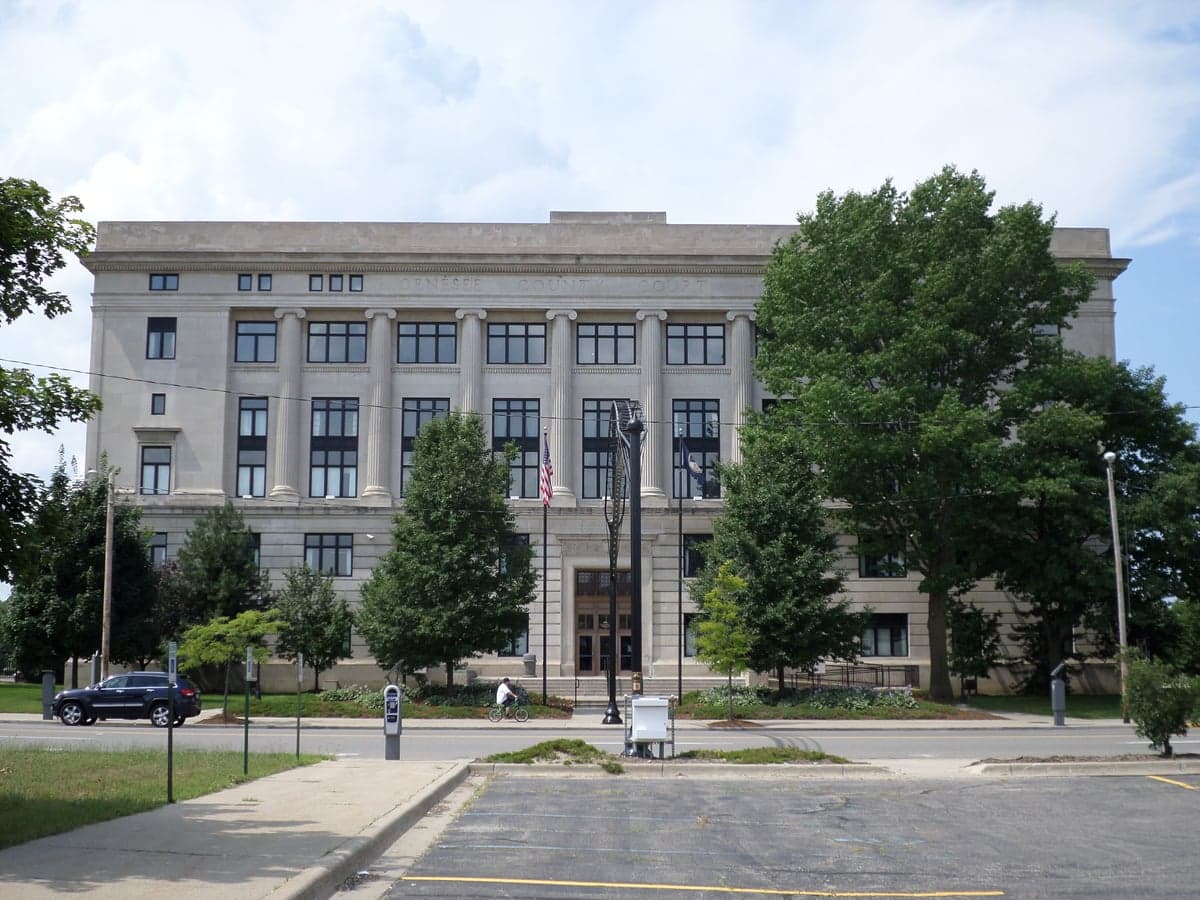
Photo: Wikipedia
Political ClimatePolitical Climate in Genesee County
Showing district-level results — no local-only data available.
Local Political AnalysisPolitical Analysis of Genesee County
Genesee County, anchored by Flint, has shifted from a reliably blue stronghold to a genuine battleground, now carrying a Cook PVI of R+1. That means the county as a whole votes about one point more Republican than the national average, a stark contrast to the state of Michigan’s overall EVEN rating. This rightward drift is most visible in the county’s outer suburbs and rural townships, while the city of Flint itself remains deeply Democratic. The real story, though, is how the swing precincts in places like Grand Blanc Township and Fenton are deciding local and state races.
How it compares
Michigan as a state is a pure toss-up at EVEN, but Genesee County’s R+1 rating hides a deeply fractured political map. Flint’s core precincts routinely deliver 70-80% of the vote to Democrats, powered by union households and a large African American population. Drive 15 minutes west to Fenton or Linden, and you’ll find precincts that go 60% Republican, driven by suburban families and small-business owners. The real action is in the swing townships: Grand Blanc Township, Burton, and Vienna Township have precincts that flip between parties every election cycle. In 2020, these areas broke slightly for Trump, but in 2022, they swung back toward Democrats in the governor’s race. This volatility means no candidate can take Genesee County for granted, and both parties pour serious money into local TV ads and door-knocking here.
What this means for residents
For conservative residents, the R+1 lean means their votes carry real weight in county commission races and state House districts, especially in the southern and western parts of the county. Republican candidates routinely win countywide offices like sheriff and prosecutor, even as Flint’s mayor and city council remain Democratic. For liberal residents, the county’s trajectory is a warning: the old union-driven Democratic machine has weakened, and winning countywide now requires turning out voters in Flint while also competing in the suburbs. Practical effects include a county government that often deadlocks on big spending items, like road repairs or economic development incentives, because the commission is split nearly 50-50. Property taxes in the county remain moderate compared to neighboring Oakland County, but bond proposals for schools and infrastructure often fail by narrow margins, reflecting the partisan divide.
Culturally, Genesee County feels like two different places. Flint’s urban core has a gritty, working-class identity with a strong labor history and a vibrant arts scene centered around the Flint Institute of Arts and the Flint Farmers’ Market. The outer townships and small cities like Davison and Swartz Creek lean more rural and conservative, with a focus on hunting, church life, and local sports. One notable policy distinction: Genesee County has a relatively high number of charter schools and school-of-choice programs, which both parties support but for different reasons—conservatives see it as competition, liberals see it as a lifeline for underfunded Flint schools. The county’s political future likely hinges on whether the swing townships continue trending right or whether a new wave of younger, more diverse voters moving into Grand Blanc and Fenton pushes the county back toward the center. For now, it’s a place where your neighbor might have a Trump flag in the front yard and a Biden sign in the back, and nobody’s surprised.

State Political ClimatePolitical Climate in Michigan
State Political AnalysisPolitical Environment in the State
Michigan is the ultimate swing state, with a Cook PVI of EVEN that perfectly captures its knife-edge balance. Over the last 20 years, it’s gone from reliably blue in presidential races (voting for Democrats from 1992 to 2012) to a true battleground that flipped for Trump in 2016, then flipped back for Biden in 2020 by just 154,000 votes out of 5.5 million cast. The state is now defined by a three-way tug-of-war: the heavily Democratic, union-heavy southeast (Detroit, Ann Arbor), the reliably Republican western and northern Lower Peninsula (Grand Rapids, Traverse City), and a handful of suburban counties that decide everything — especially Macomb, Oakland, and Kent. What that means for a relocator is that your experience of Michigan’s politics will depend almost entirely on which of these three Michigans you land in.
Urban vs. rural divide
The political map of Michigan is a study in contrasts. Wayne County (Detroit) and Washtenaw County (Ann Arbor) are the Democratic engine, delivering margins of 60-70% for the party. Detroit alone accounts for about 15% of the state’s vote, and its turnout is critical. On the other side, the rural Upper Peninsula and the “Thumb” region (Huron, Sanilac counties) vote Republican by 2-to-1 margins. The real action is in the suburban ring. Macomb County, just north of Detroit, is the iconic bellwether — it went for Obama twice, then Trump by 12 points in 2016, then Biden by 8 points in 2020. Oakland County, the wealthy, educated suburban powerhouse, has been trending blue for a decade and now votes Democratic by double digits. Kent County (Grand Rapids), historically a Republican stronghold, flipped to Biden in 2020 and is now a true swing county. The takeaway: if you move to the Detroit suburbs, you’re in the epicenter of the state’s political fight. If you move to Traverse City or the Upper Peninsula, you’re in solidly red territory, but with a growing blue-leaning tourist and second-home population.
Policy environment
Michigan’s policy landscape has shifted dramatically since Democrats took full control of state government in 2023 for the first time in 40 years. The state has a flat income tax of 4.25% (reduced from 4.35% in 2023 via a trigger law), and sales tax is 6%. Property taxes are relatively high, with an average effective rate around 1.5%, but the Headlee Amendment and Proposal A keep annual increases capped at 5% or inflation, whichever is lower — a major protection for long-term homeowners. The regulatory environment is mixed: Michigan is a right-to-work state, but Democrats repealed that law in 2023, meaning unions can again require dues as a condition of employment. Education policy is a flashpoint: the state has a universal school choice program (allowing cross-district enrollment) but no voucher system. In 2023, Democrats passed a $24 billion school aid budget with significant increases for at-risk and special education. Healthcare is dominated by the expansion of Medicaid under the Healthy Michigan Plan, which covers about 1.2 million residents. Election laws are relatively open: no-excuse absentee voting was approved by voters in 2018, and same-day voter registration is available. Michigan also has an independent redistricting commission, created by a 2018 ballot initiative, which has produced some of the most competitive congressional maps in the country.
Recent policy direction
The 2023-2024 legislative session was a whirlwind of Democratic priorities. On gun policy, Michigan passed universal background checks and a “red flag” law (extreme risk protection orders), both signed by Governor Gretchen Whitmer in 2023. Self-defense law remains relatively strong: the state has a “stand your ground” law (enacted in 2006) and shall-issue concealed carry permits. On parental and education rights, the state banned the teaching of “certain concepts related to race and sex” in K-12 schools in 2023, though the law is narrower than similar bans in Florida or Texas. Medical and bodily autonomy saw a major shift: in 2022, voters passed Proposal 3, enshrining abortion rights in the state constitution, and in 2023, Democrats repealed a 1931 law criminalizing abortion. Property rights are generally strong, with no statewide rent control and relatively permissive zoning in most areas, though some cities (Ann Arbor, Grand Rapids) have adopted inclusionary zoning. Taxation saw a notable change: the retirement tax was eliminated in 2023, saving seniors an average of $1,000 per year. Voting and ballot access expanded with the 2018 passage of Proposal 3, which includes automatic voter registration, no-excuse absentee voting, and straight-ticket voting. The overall direction is clearly leftward on social and labor issues, but the state remains moderate on fiscal matters — the income tax cut was preserved, and the budget has been balanced every year.
Civil unrest & political movements
Michigan has been a flashpoint for political activism on both sides. The 2020 lockdown protests at the state capitol in Lansing, where armed demonstrators entered the building, drew national attention and remain a vivid memory for residents. The “Wolverine Watchmen” militia group was charged in a plot to kidnap Governor Whitmer in 2020, and several members have been convicted. On the left, the “Uncommitted” movement in the 2024 Democratic primary — a protest vote against Biden’s Israel policy — drew over 100,000 votes in Michigan, driven largely by the state’s large Arab American population in Dearborn and Hamtramck. Immigration politics are a live issue: Michigan has no sanctuary state law, but several cities (Detroit, Ann Arbor, Kalamazoo) have declared themselves sanctuary cities. Election integrity remains a hot topic: the 2020 election in Michigan was subject to numerous audits and lawsuits, with no evidence of widespread fraud, but the controversy led to the creation of a new Bureau of Elections oversight unit. A new resident will notice the political polarization most visibly in yard signs, bumper stickers, and the intensity of local Facebook groups — but actual civil unrest is rare outside of organized protests in Lansing or Detroit.
Projection
Over the next 5-10 years, Michigan is likely to remain a swing state, but the demographic trends favor Democrats. The state is aging and losing population in rural areas, while the Detroit suburbs, Grand Rapids, and Ann Arbor are growing. The 2020 census showed Michigan growing by only 2% — the slowest in the Midwest — but the growth is concentrated in blue-leaning counties. In-migration from other states is modest, but the state is attracting some remote workers from the coasts, particularly to Traverse City and the Lake Michigan shoreline. The Republican Party is rebuilding after a series of losses, and the state’s independent redistricting commission means that neither party can gerrymander its way to a permanent majority. The most likely scenario is continued close elections, with the state flipping between parties every 2-4 years. For a conservative relocator, that means your vote will matter more here than in a deep red state — but you’ll also have to live with policy swings every time control changes hands. For a liberal relocator, the state offers a chance to be part of a durable coalition, but one that requires constant turnout to hold.
Bottom line for a new resident: Michigan is not a place where you can ignore politics — it’s a state where your vote genuinely counts, and where the policy environment can change dramatically with each election cycle. If you’re moving here, expect to be part of a competitive, high-stakes political environment. Your experience will vary hugely depending on whether you settle in the Democratic stronghold of Ann Arbor, the swing suburbs of Macomb County, or the conservative countryside of the Upper Peninsula. The state offers a mix of fiscal moderation and social liberalism that is rare in the Midwest, but it comes with the trade-off of constant political tension. If you want stability, look elsewhere. If you want to be where the action is, Michigan delivers.
* Values derived from national, state, county, city and local statistics and may differ in a specific area. Last updated: 2026-07-14T10:18:19.000Z
Narrative content on this page is AI-generated and may contain mistakes. Verify any details that matter before acting on them.
ReloMaps may earn a commission from affiliate links at no extra cost to you.

