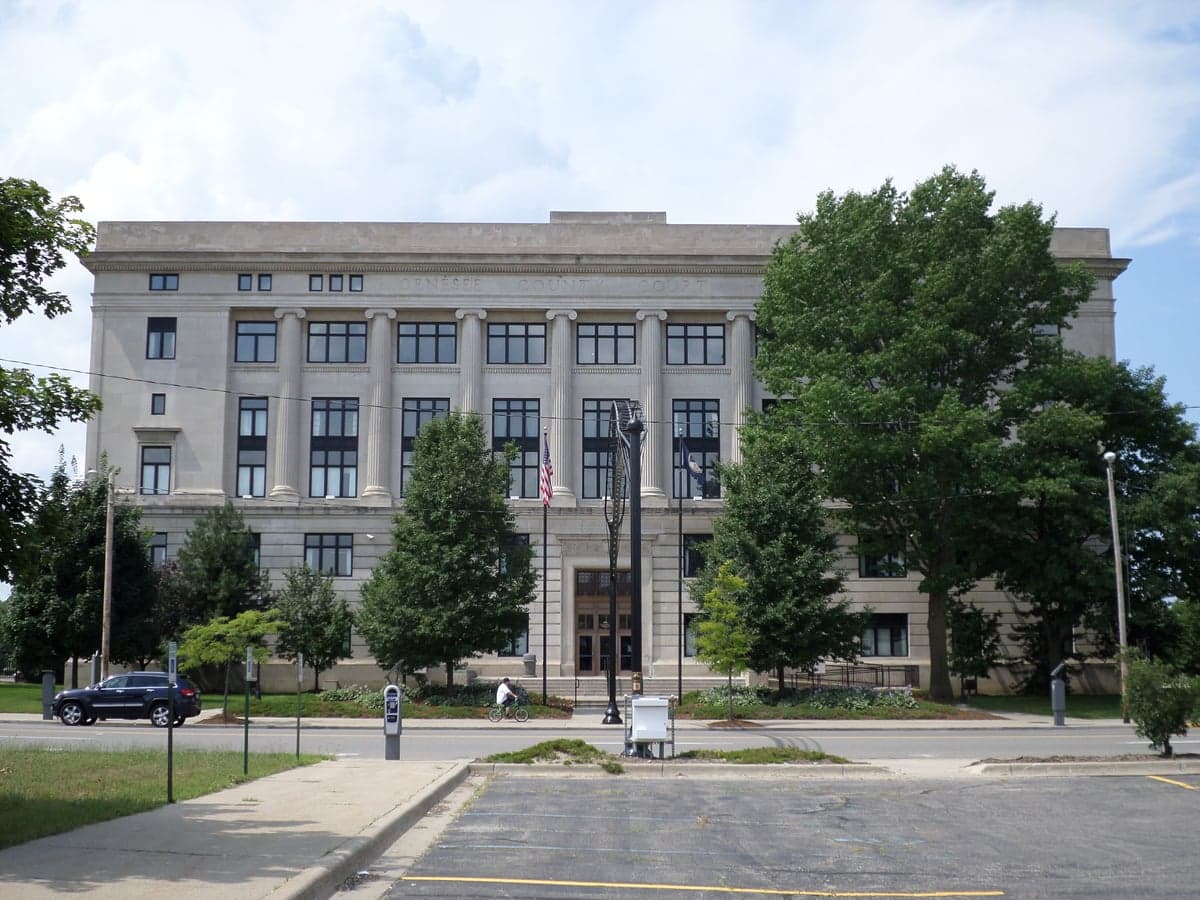
Photo: Wikipedia
Demographics of Genesee County
Affluence Level in Genesee County
A below-average socioeconomic profile. Incomes, home values, and educational attainment trail the U.S., with higher poverty and unemployment.
People of Genesee County
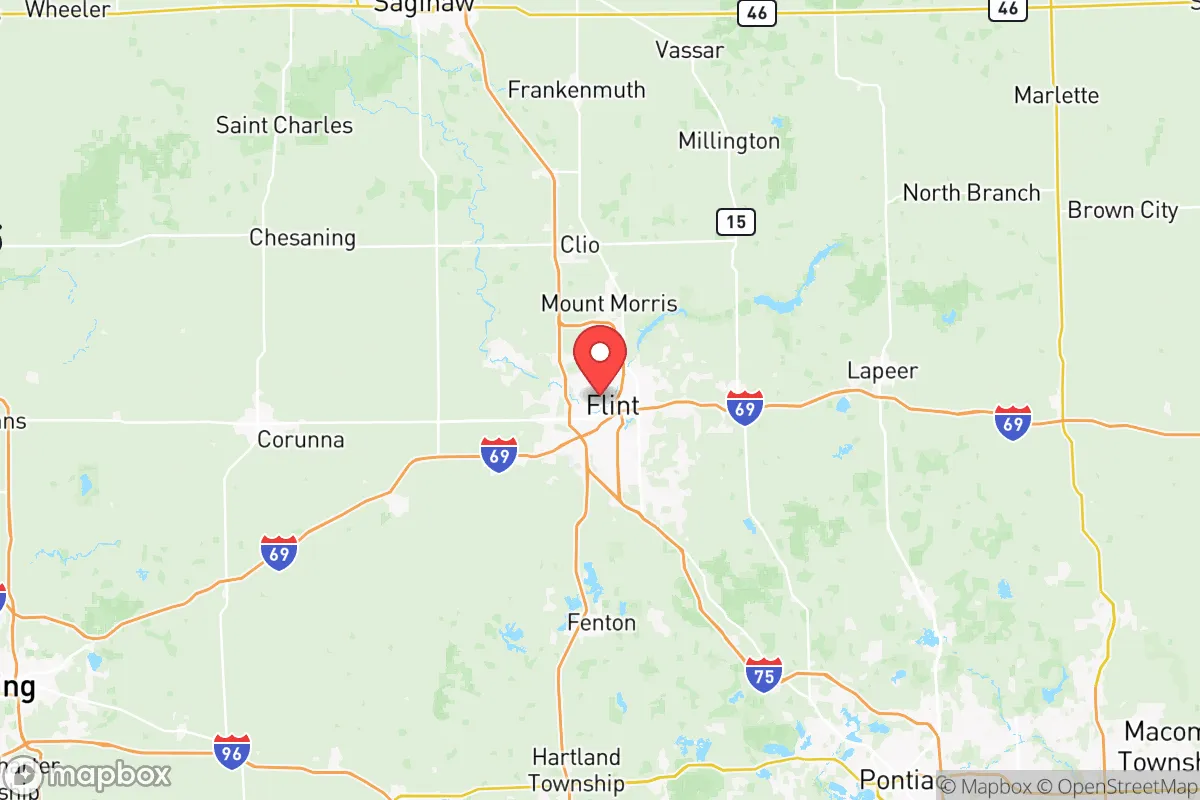
Genesee County, Michigan, is home to roughly 404,000 residents, a population shaped by a century of automotive manufacturing and the rise and restructuring of the American auto industry. The county’s identity is anchored by the city of Flint, its historic industrial core, but its character is increasingly defined by a suburban ring of communities like Grand Blanc, Fenton, and Davison. With a population that is 70.6% White, 19.2% Black, and 4.1% Hispanic, Genesee County reflects a legacy of industrial migration and a more recent, modest diversification, though it remains one of the least foreign-born counties in the nation at just 1.0%.
Settlement & growth (pre-1960)
The original inhabitants of the Genesee County area were primarily the Anishinaabe peoples, including the Ojibwe (Chippewa) and Odawa (Ottawa) nations, who used the Flint River as a travel and trade corridor. European-American settlement began in earnest after the 1819 Treaty of Saginaw, which ceded the land to the United States. The first permanent white settlers arrived in the 1820s and 1830s, establishing small farming communities along the river. Flint was formally founded in 1830 as a fur-trading post and quickly became a county seat and a center for the lumber industry, processing timber from the vast Michigan forests.
The defining demographic event for Genesee County was the rise of the automobile industry. In 1904, the Buick Motor Company was founded in Flint, and by the 1910s, General Motors had consolidated its operations there. This created an enormous demand for labor, pulling in waves of domestic migrants. The first major wave came from rural Michigan and the broader Midwest—farmers and small-town residents seeking steady factory wages. These early migrants were overwhelmingly of Northern European descent, primarily English, German, Irish, and Scots-Irish, settling in Flint’s central neighborhoods and in the growing industrial suburbs of Flint Township and Burton.
The Great Migration of African Americans from the South to the industrial North began in earnest during World War I and accelerated through the 1940s and 1950s. Black families from Alabama, Mississippi, and Tennessee moved to Flint specifically for GM jobs, establishing a strong community in the city’s north and east sides, particularly in the Flint neighborhoods of Civic Park and the area around University of Michigan–Flint. By 1960, Flint’s Black population had grown to roughly 17% of the city’s total, a dramatic shift from the near-zero share in 1900. Simultaneously, a smaller but notable wave of white Appalachian migrants—from Kentucky, Tennessee, and West Virginia—also arrived for factory work, settling in working-class neighborhoods across Flint and in Mount Morris Township.
Modern era (post-1965)
The post-1965 era in Genesee County is defined not by new immigration but by domestic migration and suburbanization. The 1965 Hart-Cellar Act had a negligible impact here; the county’s foreign-born population remains at just 1.0%, far below the national average. Instead, the major demographic story is the movement of white residents from Flint to the surrounding suburbs, a process that accelerated after the 1967 Flint race riots and the subsequent white flight of the 1970s and 1980s. Families moved to Grand Blanc, Fenton, and Davison, creating a suburban ring that is now overwhelmingly white and more affluent than the city itself.
The decline of General Motors, beginning in the 1980s and culminating in the 2009 bankruptcy, triggered a population exodus. Flint’s population fell from a peak of 196,940 in 1960 to roughly 80,000 today. This loss was concentrated among working-class white and Black families who left for other states or other parts of Michigan. The 2014 Flint water crisis further accelerated the departure of residents, particularly from the city’s core. Today, the Black population is heavily concentrated in Flint (where it is the majority at roughly 54% of the city’s residents) and in older inner-ring suburbs like Beecher and Mount Morris Township. The white population is concentrated in the outer suburbs: Grand Blanc Township (over 80% white), Fenton (over 90% white), and Davison (over 90% white).
Hispanic residents, now 4.1% of the county, have grown modestly, primarily through domestic migration from other parts of Michigan and the Southwest. They are dispersed across the county, with small clusters in Flint and in Burton. The East/Southeast Asian population (0.6%) and Indian subcontinent population (0.3%) are very small, largely consisting of professionals employed by the remaining GM technical centers and by McLaren Flint Hospital, with most living in Grand Blanc and Fenton. The county’s Arab population, though not separately tracked in the provided data, is also minimal, a contrast to the large Arab communities in nearby Dearborn.
The future
Genesee County’s population is projected to continue a slow decline, mirroring the broader trend in Michigan’s industrial counties. The county lost roughly 10% of its population between 2010 and 2020, and the 2024 estimate of 404,087 suggests further erosion. The future is one of modest diversification, driven primarily by the growth of the Hispanic population, which is expected to rise from 4.1% to perhaps 6-7% by 2040 through both domestic migration and higher birth rates. The Black population share is likely to remain stable or grow slightly, as Flint’s population loss slows and suburban Black communities in Grand Blanc and Burton continue to expand.
The most significant demographic shift will be the continued aging of the white suburban population. Grand Blanc and Fenton are seeing an influx of retirees and empty-nesters, while younger families are increasingly priced out of those communities and moving to more affordable areas like Linden or Clio. The county’s cultural identity is slowly evolving from a blue-collar, GM-centric identity to a more diversified economy centered on healthcare (McLaren Flint, Hurley Medical Center) and education (Kettering University, UM-Flint). The foreign-born population is expected to remain very low, as the county lacks the job growth and immigrant networks that drive international migration to larger metro areas.
For someone moving to Genesee County now, the region offers a clear choice: the urban, majority-Black, and economically challenged city of Flint, or the predominantly white, more affluent, and growing suburbs of Grand Blanc, Fenton, and Davison. The county is becoming a place where the suburban ring is stable and family-oriented, while the urban core continues to struggle with population loss and the legacy of deindustrialization. It is not a region of rapid demographic change or new immigrant enclaves, but rather a mature, post-industrial community where the key decision for a new resident is whether to live in the city or the suburbs.

* Values derived from national, state, county, city and local statistics and may differ in a specific area. Last updated: 2026-07-14T10:18:19.000Z
Narrative content on this page is AI-generated and may contain mistakes. Verify any details that matter before acting on them.
ReloMaps may earn a commission from affiliate links at no extra cost to you.

