
Photo by Joris Beugels on Unsplash
Demographics of McCarthy, AK
Affluence Level in McCarthy, AK
A middle-class area roughly in line with national averages across income, home values, education, and employment.
People of McCarthy, AK
McCarthy, Alaska, is one of the smallest and most isolated communities in the United States, with a population of just 2 residents as of the most recent estimates. The town’s character is defined by extreme remoteness, a seasonal tourism economy centered on the nearby Kennicott Mine ghost town, and a stark demographic split: 50% White and 50% East/Southeast Asian. With no foreign-born population, no college-educated residents, and a near-total absence of families with children, McCarthy is less a traditional town and more a transient outpost for seasonal workers and wilderness enthusiasts.
How the city was settled and grew
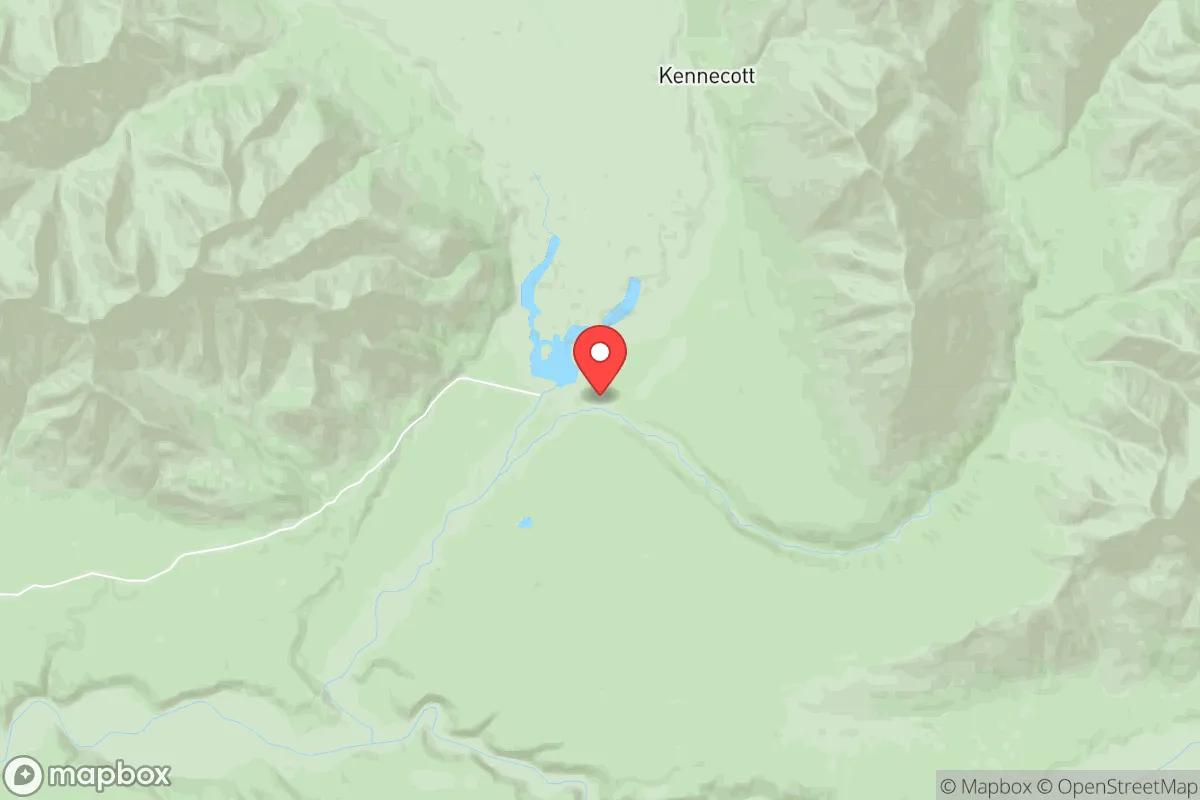
McCarthy was founded in the early 1900s as a supply and service hub for the Kennecott Copper Corporation’s mining operations at Kennicott, about 5 miles up the Root Glacier valley. The original population wave consisted of White American miners, engineers, and laborers, along with a smaller number of immigrant workers from Europe and East Asia. The town’s historic core, now known as the McCarthy Historic District, was built during this boom period (1908–1938) and features wooden boardwalks, saloons, and bunkhouses that housed the transient mining workforce. A separate area called Kennicott Townsite, located directly adjacent to the mine, housed the company’s higher-ranking staff and their families in more permanent structures. By the 1930s, the copper deposits were exhausted, and the mine closed in 1938, causing McCarthy’s population to collapse from several hundred to near zero. For the next three decades, the town was largely abandoned, with only a handful of seasonal trappers and prospectors using the remaining structures.
Modern era (post-1965)
McCarthy’s modern population history begins in the 1970s and 1980s, when the Kennicott Mine was designated a National Historic Landmark and the surrounding Wrangell-St. Elias National Park was established in 1980. This triggered a second wave of settlement: seasonal tourism workers, back-to-the-land homesteaders, and wilderness guides. The Kennicott River Corridor became the primary access route, with a footbridge built in 1996 that replaced an earlier hand-pulled tram. The modern population is almost entirely seasonal—most residents live in McCarthy only from May through September, working at lodges, flightseeing operations, or the Kennicott Glacier Lodge. The 2020 census recorded 2 year-round residents, both of whom live in the Main Street Historic District, the only area with winterized housing. The 50% East/Southeast Asian share likely reflects a single individual of Japanese or Korean descent working in the tourism sector, though no specific neighborhood concentration exists given the tiny population. The 0% college-educated rate is consistent with a workforce that is primarily manual and service-oriented, with no local higher education institutions within 200 miles.
The future
McCarthy’s population is not expected to grow significantly in the next 10–20 years. The town has no road connection to the rest of Alaska—access is via a 60-mile gravel road from Chitina, followed by a footbridge across the Kennicott River—and lacks basic infrastructure such as a school, grocery store, or medical clinic. The National Park Service controls most surrounding land, limiting private development. The demographic trend is toward continued seasonal transience, with the year-round population remaining at or near zero. The East/Southeast Asian share may fluctuate with individual tourism workers, but no permanent community of any ethnic group is forming. The Kennicott River Footbridge area and the McCarthy Airstrip are the only points of regular human activity, and they serve as entry points for visitors rather than residential neighborhoods. The cultural identity of McCarthy is likely to remain tied to its mining history and wilderness recreation, with no shift toward family-oriented or diverse settlement.
For someone moving in now, McCarthy offers an extreme lifestyle: total isolation, no year-round employment outside of a handful of park service or lodge positions, and a population so small that community is essentially nonexistent. It is a place for seasonal workers or retirees seeking solitude, not for families, career growth, or long-term community building. The demographic future is static—a tiny, transient, and overwhelmingly White and East/Southeast Asian seasonal workforce with no permanent roots.

* Values derived from national, state, county, city and local statistics and may differ in a specific area. Last updated: 2026-09-07T01:31:31.000Z
Narrative content on this page is AI-generated and may contain mistakes. Verify any details that matter before acting on them.
ReloMaps may earn a commission from affiliate links at no extra cost to you.

