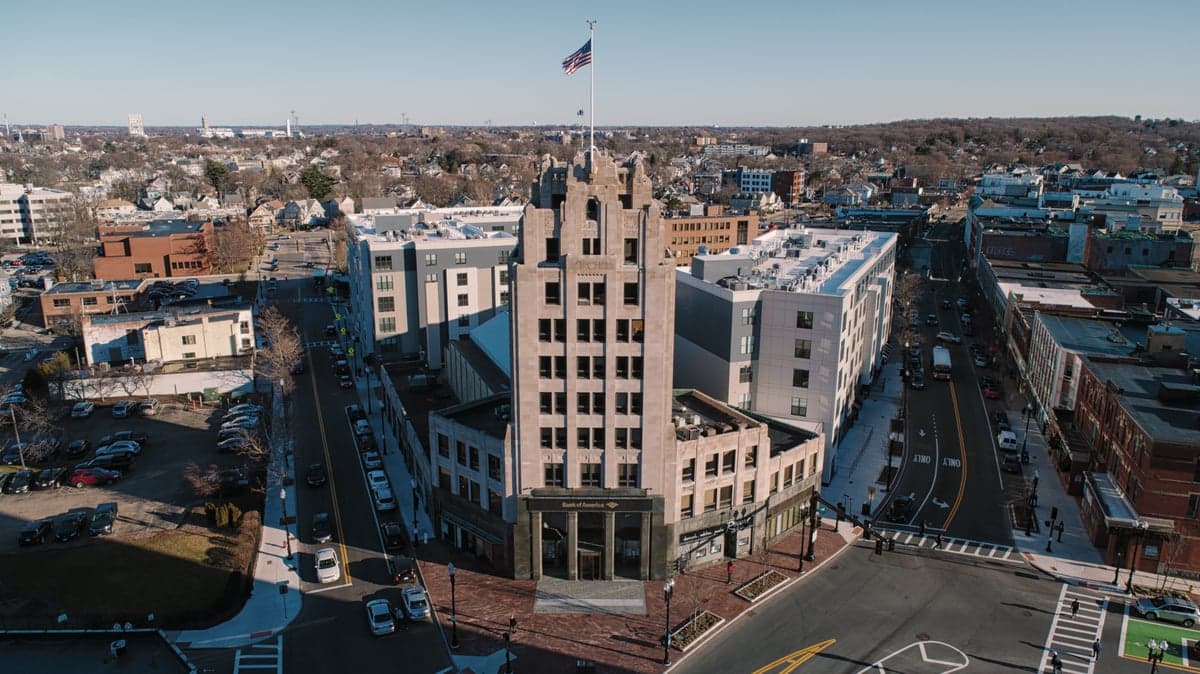
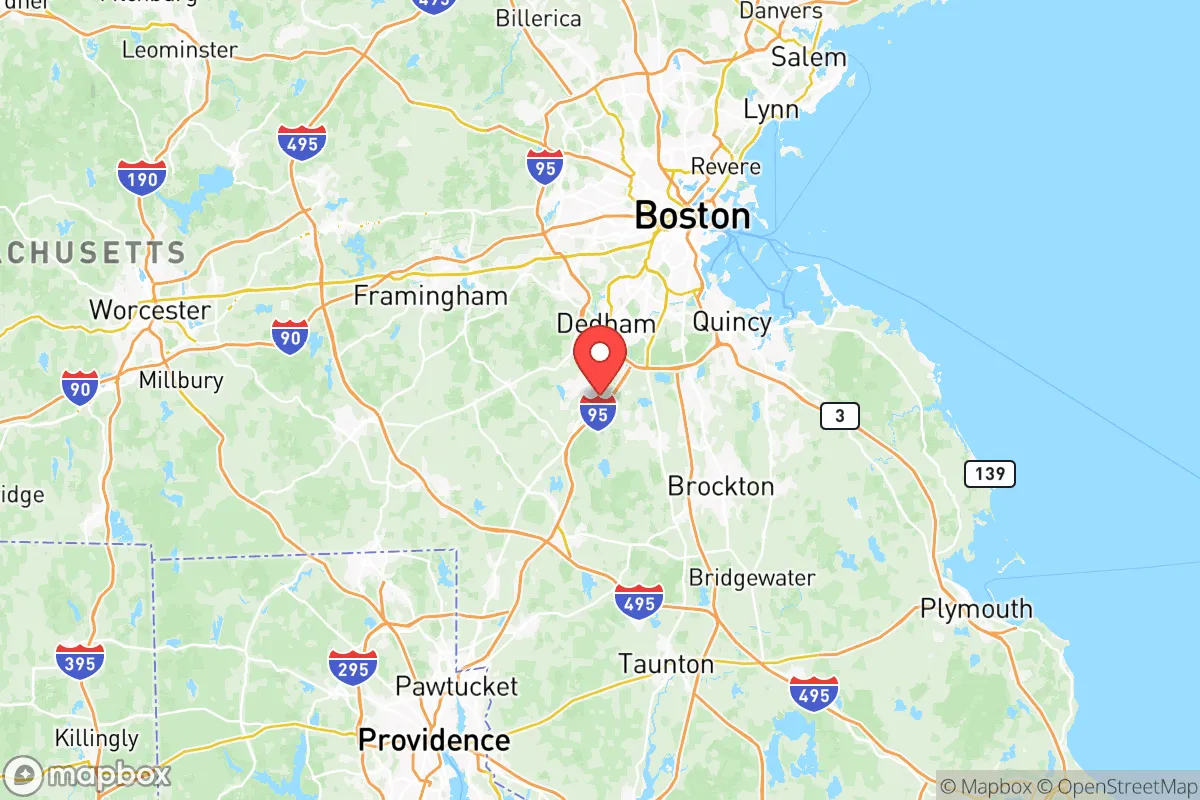
Photo: Wikipedia
Political ClimatePolitical Climate in Norfolk County
Showing district-level results — no local-only data available.
Local Political AnalysisPolitical Analysis of Norfolk County
Norfolk County, Massachusetts, is a solidly Democratic stronghold with a Cook Partisan Voting Index (PVI) of D+15, matching the state's overall D+15 rating. This means the county leans about 15 points more Democratic than the national average, and in practice, it's a place where Democrats consistently win county-wide races by comfortable margins. However, the political reality is more nuanced than a single number suggests, with significant variation between the older, more conservative towns and the rapidly diversifying suburbs closer to Boston.
How it compares
While Norfolk County's D+15 PVI is identical to Massachusetts as a whole, the county's internal dynamics are distinct. The state's deep-blue reputation is largely driven by Boston and its immediate inner suburbs, but Norfolk County contains a fascinating mix. Towns like Brookline and Newton (the latter partially in Middlesex County) are among the most liberal in the state, routinely delivering 80%+ of the vote to Democratic presidential candidates. In contrast, towns in the southern and western parts of the county, such as Norfolk and Wrentham, are more moderate and have a visible Republican minority. In the 2024 presidential election, for example, Norfolk town voted about 54% for the Democratic candidate, while Brookline voted over 85%. The swing precincts are often found in towns like Franklin and Medfield, where results can be closer to the county average, and where local races—like select board or school committee—are genuinely competitive. This variation is a key difference from the more uniformly liberal Suffolk County (Boston) or the more conservative Plymouth County to the south.
What this means for residents
For a liberal resident, living in Norfolk County means your vote is rarely the deciding factor in a presidential or statewide election, but you have outsized influence in local Democratic primaries, which often determine the actual outcome. For a conservative resident, the reality is that you are in a clear minority in most county-wide elections, but your voice is still heard in town-level races, especially in the more moderate towns. You'll find active Republican town committees in places like Walpole and Sharon, and conservative candidates can win seats on school boards and planning boards, particularly when running on local issues like taxes or school curriculum. The practical effect is that while the county's electoral votes and state legislative seats are safely Democratic, the day-to-day governance in many towns is more pragmatic and less ideologically driven than the county's PVI might suggest.
Culturally and policy-wise, Norfolk County reflects the broader Massachusetts trend of high property taxes, strong public schools, and a robust social safety net, but with a distinct suburban character. The county is home to some of the best public school systems in the state, like those in Wellesley and Dover, which drives up housing costs and attracts families who prioritize education. The political culture here is less about fiery ideological battles and more about managing growth, preserving open space, and funding schools. You'll see this in the frequent town meeting debates over zoning changes, MBTA Communities Act compliance, and local affordable housing initiatives. The county's Democratic lean is stable and likely to persist, but the real political action is in the micro-level decisions that shape daily life, where both liberal and conservative residents find common ground—and occasional friction—over the future of their communities.

State Political ClimatePolitical Climate in Massachusetts
State Political AnalysisPolitical Environment in the State
Massachusetts is one of the most reliably Democratic states in the country, with a Cook Partisan Voting Index of D+15, meaning it votes about 15 points more Democratic than the national average in presidential elections. The state hasn't voted for a Republican presidential candidate since Ronald Reagan in 1984, and the Democratic Party holds every statewide office, a supermajority in both legislative chambers, and all 11 U.S. House seats. However, the political reality is more nuanced than the raw numbers suggest — the state has a strong tradition of moderate, fiscally conservative Republicans in local offices, and the deep-blue label masks a significant urban-rural split that has widened over the past decade.
Urban vs. rural divide
The political map of Massachusetts is defined by the contrast between its dense, liberal eastern core and its more conservative western and central regions. Greater Boston — including Boston, Cambridge, Somerville, and Newton — is the engine of the state's Democratic dominance, routinely delivering 75-85% of the vote for Democratic candidates. These cities are home to the state's largest concentrations of college students, tech workers, and academic professionals, and they drive progressive policy on everything from housing to climate. In contrast, the western part of the state, including Pittsfield and the Berkshires, leans Democratic but with a more moderate, working-class flavor. The real Republican strongholds are in the central and southeastern parts of the state. Plymouth County and the South Shore have trended right in recent cycles, and towns like Wrentham and Franklin regularly vote Republican in local races. The 2022 gubernatorial election saw Republican Geoff Diehl win several rural towns in Worcester County and the Cape, though he lost the state by 30 points. The divide is not just geographic but cultural — the urban core is increasingly secular and progressive, while the exurbs and small towns retain a Catholic-influenced, socially moderate conservatism that is distinct from the national GOP brand.
Policy environment
Massachusetts has a high-tax, high-service policy environment that reflects its Democratic supermajority. The state has a flat income tax rate of 5%, but a 2022 ballot measure added a 4% surtax on income over $1 million, making the effective top rate 9%. Property taxes are moderate compared to the national average but vary widely by town — Boston has a rate of about $10.60 per $1,000 of assessed value, while rural towns like Buckland can exceed $18. Sales tax is 6.25%, with no tax on most groceries or clothing under $175. The regulatory environment is business-friendly in some respects — the state has a strong biotech and life sciences sector, supported by tax incentives — but housing and energy regulations are among the most stringent in the country. Education policy is a major priority: Massachusetts consistently ranks first in the nation for K-12 outcomes, and the state spends over $18,000 per pupil annually. Healthcare is near-universal, with the state's 2006 reform serving as the model for the Affordable Care Act. Election laws are among the most accessible in the country: no-excuse mail-in voting, same-day registration, and early voting are all permanent fixtures. For a conservative relocator, the tax burden and regulatory density are the most immediate practical concerns, while the education and healthcare systems are clear strengths.
Recent policy direction
Over the past five years, Massachusetts has moved decisively left on a range of issues. The 2022 "millionaire's tax" was the most significant fiscal change, funding transportation and education projects. On gun policy, the state passed one of the nation's strictest assault weapons bans in 2024, expanding the definition of banned firearms and requiring safe storage. Self-defense laws are restrictive — Massachusetts is a "may-issue" state for concealed carry, and permits are difficult to obtain in urban areas like Boston and Cambridge. On education, the state passed a 2023 law requiring all public schools to adopt policies on transgender student participation in sports and bathroom access, aligning with the state's non-discrimination framework. Parental rights have been a flashpoint: a 2024 bill that would have required parental notification for name or pronoun changes in schools failed, but the issue remains active. On privacy, the state has a strong data protection law (the Massachusetts Data Privacy Law) but no comprehensive biometric surveillance ban. Medical and bodily autonomy is broadly protected — abortion is legal up to 24 weeks and codified in state law, and gender-affirming care for minors is protected. Property rights are constrained by strong zoning regulations and rent control in Boston and Cambridge, though a 2024 law allowed communities to opt into rent stabilization. Voting access has expanded steadily, with automatic voter registration and no-excuse mail-in voting now permanent. For a conservative, the direction is clearly toward more regulation and higher taxes, though the state's fiscal discipline — it has a AAA bond rating — provides some stability.
Civil unrest & political movements
Massachusetts has a long history of political activism, but large-scale civil unrest has been relatively rare in recent years. The 2020 Black Lives Matter protests in Boston drew tens of thousands of participants and were largely peaceful, though there were isolated incidents of property damage. The state's sanctuary law, passed in 2017, limits local law enforcement cooperation with federal immigration authorities, and Boston has been a focal point for immigration advocacy. On the right, the Massachusetts Fiscal Alliance and the Massachusetts Republican Party have organized around tax and spending issues, but the state's conservative movement is small and fragmented. There have been no serious secession or nullification movements — the state's political culture is firmly within the mainstream. Election integrity has not been a major controversy; the state's vote-by-mail system was implemented without significant fraud allegations, and audits have consistently confirmed results. The most visible flashpoint for a new resident would likely be the tension between the state's progressive urban centers and its more conservative rural towns, particularly around school curriculum and housing policy. Protests are common on the Boston Common and at the State House, but they are typically small and issue-specific — climate, abortion, and labor rights draw the largest crowds.
Projection
Over the next 5-10 years, Massachusetts is likely to become more Democratic and more progressive, driven by demographic trends and in-migration. The state's population is aging and growing slowly, but the areas that are growing — Boston, Cambridge, and the inner suburbs — are the most liberal. The exurbs and rural towns that lean Republican are losing population or growing slowly, which will further concentrate political power in the urban core. The Democratic supermajority is unlikely to be seriously challenged; the state's Republican Party has struggled to field competitive candidates for statewide office since Charlie Baker's retirement. Policy will likely continue in the same direction: higher taxes on the wealthy, stricter gun laws, expanded voting access, and stronger tenant protections. The biggest wild card is housing — if the state fails to address its severe housing shortage, it could drive out moderate and conservative families who might otherwise stay, accelerating the leftward shift. For a conservative relocator, the realistic expectation is that the state will be less politically hospitable in a decade than it is today, though the quality of life — schools, healthcare, infrastructure — will remain high.
For a new resident, the bottom line is that Massachusetts offers a high-quality, high-cost environment with a political culture that is firmly Democratic and increasingly progressive. Conservatives can find community in the state's exurbs and small towns, but they should expect to be in the minority on most statewide issues. The practical trade-offs are clear: excellent schools and healthcare, strong job markets in biotech and education, and a stable, well-run state government, but also high taxes, restrictive regulations, and a political climate that is unlikely to shift rightward anytime soon. If you value top-tier public services and can absorb the cost, Massachusetts delivers — just don't expect the politics to change.
* Values derived from national, state, county, city and local statistics and may differ in a specific area. Last updated: 2026-06-17T16:55:08.000Z
Narrative content on this page is AI-generated and may contain mistakes. Verify any details that matter before acting on them.
ReloMaps may earn a commission from affiliate links at no extra cost to you.

