Photo: Wikipedia
Demographics of Hampshire County
Affluence Level in Hampshire County
A middle-class area roughly in line with national averages across income, home values, education, and employment.
People of Hampshire County
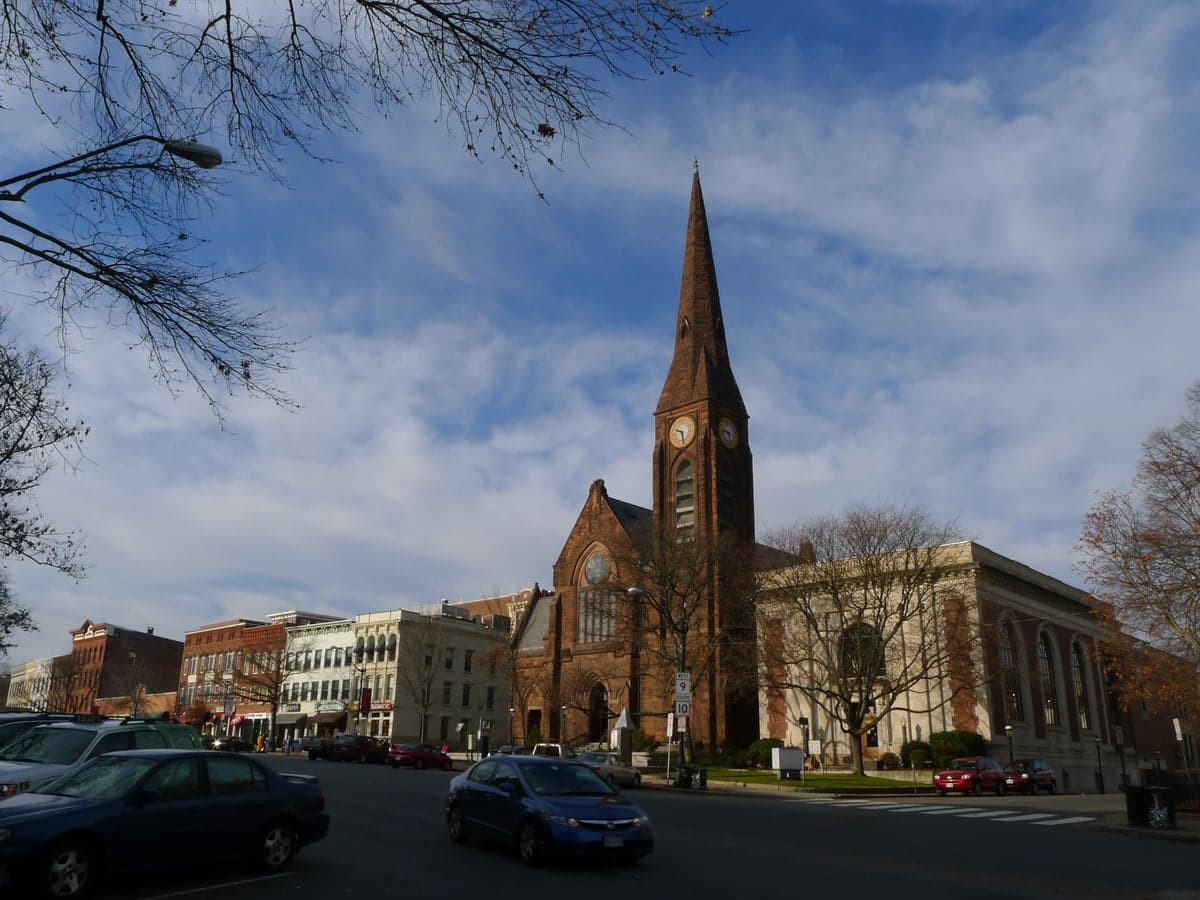
The people of Hampshire County, Massachusetts today number 156,595, forming a predominantly white (81.3%) and highly educated (51.1% college-educated) population that is notably less diverse than the state average. The county’s character is defined by its five college towns—Amherst, Northampton, South Hadley, and the village of Haydenville within Williamsburg—which anchor a progressive, intellectual culture, while the surrounding rural towns like Belchertown, Ware, and Pelham retain a more traditional, working-class New England identity. This creates a distinctive urban-rural divide within a single county, where the presence of Amherst College, Smith College, Hampshire College, and Mount Holyoke College shapes both the economy and the social fabric, while the foreign-born share sits at just 3.7%, well below the national average.
Settlement & growth (pre-1960)
The original inhabitants of what is now Hampshire County were the Pocumtuc and Nonotuck peoples, Algonquian-speaking tribes who lived in fortified villages along the Connecticut River. European contact began with English colonists from the Massachusetts Bay Colony, who established the first permanent settlement in 1654 at Northampton, followed by Hadley in 1659 and Hatfield in 1670. These early settlers were primarily English Puritans seeking religious freedom and agricultural land along the fertile Connecticut River floodplain. The region was part of the original Hampshire County, which then stretched from the Connecticut border to Vermont, before being subdivided into Franklin and Hampden counties in 1811.
Through the 18th and 19th centuries, Hampshire County’s population grew slowly but steadily, driven by two main forces: agriculture and industry. The Connecticut River valley’s rich soil attracted second-generation English families moving west from coastal Massachusetts, while the county’s many rivers—the Mill, the Manhan, and the Ware—powered gristmills, sawmills, and later textile mills. Towns like Ware and Easthampton became manufacturing centers, drawing Irish immigrants in the 1840s and 1850s to work in the mills, followed by French-Canadian families in the 1860s and 1870s who settled in the mill villages of Bondsville (in Palmer) and Thorndike (in Ware). A smaller wave of Polish immigrants arrived in the early 1900s, primarily in the industrial sections of Ware and Northampton, where they worked in the paper mills and button factories.
The most transformative development for Hampshire County’s population was the founding of its colleges. Amherst College opened in 1821, Mount Holyoke Female Seminary (now Mount Holyoke College) in 1837, Smith College in 1871, and Hampshire College in 1970. These institutions attracted faculty and staff from across the Northeast, many of whom were New England Yankees and, later, Jewish academics fleeing European persecution in the 1930s and 1940s. The college towns of Amherst and Northampton became islands of cosmopolitanism in a largely rural, Protestant county. By 1960, the county’s population was roughly 95% white, with the largest minority groups being Irish and French-Canadian Catholics, and a small but established African American community concentrated in Northampton’s “Florence” neighborhood, a former abolitionist stronghold.
Modern era (post-1965)
The 1965 Hart-Cellar Act had a modest impact on Hampshire County compared to urban Massachusetts. The county’s foreign-born population remains low at 3.7%, but the composition has shifted. The most significant post-1965 change has been the growth of the Asian population, now at 3.7% of the county, driven almost entirely by the colleges. East and Southeast Asian faculty and graduate students—particularly from China, South Korea, and Japan—have settled in Amherst and Northampton, often in neighborhoods near the campuses. The Indian subcontinent population, at 1.3%, is similarly college-linked, with many families working in the Five College system’s STEM departments or in the region’s growing healthcare sector at Cooley Dickinson Hospital in Northampton and Baystate Wing Hospital in Palmer.
The Hispanic population, now 7.2%, has grown primarily through domestic migration rather than immigration. Puerto Rican families began moving to the county in the 1980s and 1990s, drawn by agricultural work in the tobacco and onion fields of Hadley and Hatfield, as well as by service jobs in the college towns. A smaller number of Mexican and Central American immigrants have settled in Ware and Belchertown, working in the region’s remaining manufacturing and distribution centers. The Black population, at 2.2%, remains small and is concentrated in Northampton and Amherst, where it includes both long-standing African American families and a newer cohort of African and Caribbean immigrants working in higher education.
Domestic migration has reshaped the county in subtler ways. Since the 1970s, Hampshire County has attracted a steady stream of out-of-state transplants—particularly from New York, California, and the Washington, D.C. area—who move for college and stay for the quality of life. This has made Amherst and Northampton among the most liberal enclaves in Massachusetts, while the eastern towns of Ware, Belchertown, and Pelham have seen an influx of families from Hampden County seeking lower property taxes and more land. The county’s population grew by 8% between 2000 and 2020, but growth has been uneven: Amherst and Northampton have grown slowly due to high housing costs, while Belchertown and Ware have seen faster growth as bedroom communities for Springfield and Worcester commuters.
The future
Hampshire County is likely to become slightly more diverse over the next 10-20 years, but the pace will be slow. The college towns will continue to attract international faculty and students, gradually increasing the Asian and Indian shares, while the Hispanic population is expected to grow modestly through both domestic migration and a small number of new immigrants. The county’s white population, while still dominant at 81.3%, will continue to age and decline slightly as younger families are priced out of Amherst and Northampton and move to cheaper counties in western Massachusetts or New Hampshire.
The most significant demographic trend is the geographic sorting: the college towns are becoming denser, more diverse, and more expensive, while the rural towns are becoming whiter and older. Belchertown and Ware are seeing an influx of younger families, but these are predominantly white and often from other parts of Massachusetts. The county’s cultural identity will likely remain bifurcated—progressive and academic in the west, traditional and working-class in the east—with little sign of convergence. The foreign-born share may rise to 5-6% by 2040, still far below the national average, as the colleges continue to recruit globally.
For someone moving to Hampshire County now, the choice is essentially between two different worlds. The college towns offer a highly educated, politically progressive environment with strong public schools and cultural amenities, but at a high cost of living and with limited housing availability. The rural towns offer lower costs, more space, and a quieter lifestyle, but with fewer job opportunities and a less diverse population. The county as a whole is becoming more of a bedroom community for the broader Pioneer Valley economy, with its identity increasingly shaped by the tension between the academic elite and the rural working class—a dynamic that has defined Hampshire County since the first Puritan settlers arrived in Northampton nearly 400 years ago.

* Values derived from national, state, county, city and local statistics and may differ in a specific area. Last updated: 2026-07-10T05:46:10.000Z
Narrative content on this page is AI-generated and may contain mistakes. Verify any details that matter before acting on them.
ReloMaps may earn a commission from affiliate links at no extra cost to you.

