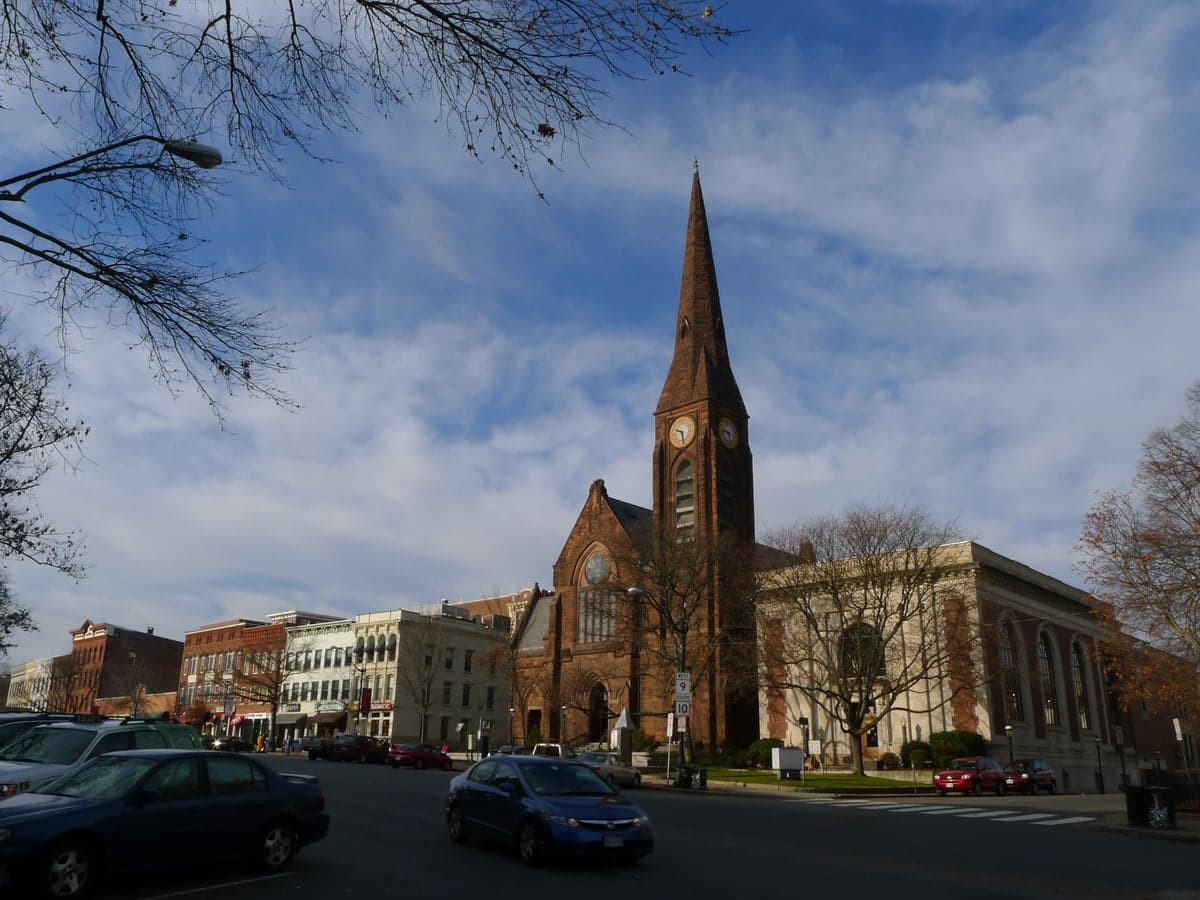
Photo: Wikipedia
Political ClimatePolitical Climate in Hampshire County
Showing district-level results — no local-only data available.
Local Political AnalysisPolitical Analysis of Hampshire County
Hampshire County, Massachusetts, is one of the most reliably Democratic areas in the state, with a Cook Partisan Voting Index (PVI) of D+13, just a shade less blue than the state’s overall D+15. That small gap matters, though: the county’s politics are shaped by a deep-rooted progressive consensus in its college towns, but tempered by more moderate and even conservative pockets in its rural hill towns. Over the past decade, the county has shifted leftward, driven by an influx of younger professionals and academics into Northampton and Amherst, while the outlying communities have held steady or moved only slightly. The result is a place where the political conversation is dominated by liberal activism, but where the actual voting patterns reveal a more nuanced landscape than the countywide PVI suggests.
How it compares
Hampshire County’s D+13 rating puts it in the same deep-blue tier as the rest of Massachusetts, but it’s worth noting that the county is actually less Democratic than Suffolk County (Boston, D+35) or Middlesex County (Cambridge, D+28). The real story is the variation within Hampshire itself. Northampton and Amherst are the engine rooms of the county’s liberalism, routinely delivering 80-85% of the vote to Democratic presidential candidates. Easthampton and Hadley are also solidly blue, but with slightly more moderate margins—think 65-70% Democratic. The swing precincts are in the county’s rural towns: Belchertown, Ware, and Pelham often vote 55-60% Democratic, but can flip to 50-50 in down-ballot races. The most conservative towns are Chesterfield and Goshen, where Republican candidates sometimes pull 45-48% of the vote, especially in state legislative races. This is not a county where Republicans are competitive at the presidential level, but local contests—like the race for the 1st Hampshire District state representative—can be genuinely contested.
What this means for residents
For liberal residents, Hampshire County is a comfortable place to live. The local government in Northampton and Amherst is heavily progressive, with strong support for rent control, public transit expansion, and climate action. Conservative residents, however, are not silenced—they just have to work harder to be heard. In the rural hill towns, Republican voters often find common cause with Democrats on issues like property taxes, school funding, and opposition to large-scale development. The practical effect is that local politics in Hampshire County are less about partisan warfare and more about coalition-building. A conservative resident in Chesterfield might disagree with the county’s overall direction but can still find allies on fiscal issues in town meetings. The county’s Democratic lean also means that state-level policies—like the Massachusetts Paid Family and Medical Leave program and the state’s strict gun laws—are widely supported, even if not universally loved.
One cultural distinction that sets Hampshire County apart from the rest of Massachusetts is its strong tradition of direct democracy and town meeting governance. In towns like Pelham and Leverett, annual town meetings are where real decisions get made—budgets, zoning, and school policies are debated face-to-face. This gives residents, regardless of party, a tangible say in how their community runs. The county’s political climate is also shaped by the presence of Smith College and UMass Amherst, which bring a steady stream of young, educated voters who push the county leftward. But the long-time residents—the farmers, small business owners, and retirees—provide a counterweight that keeps the politics grounded in local concerns. The trajectory is clear: Hampshire County will remain a Democratic stronghold, but its internal diversity means that no single political voice dominates completely. For anyone moving here, the key is understanding that your vote matters most in the town meeting, not just in the presidential election.

State Political ClimatePolitical Climate in Massachusetts
State Political AnalysisPolitical Environment in the State
Massachusetts is one of the most reliably Democratic states in the country, with a Cook Partisan Voting Index of D+15, meaning it votes about 15 points more Democratic than the national average in presidential elections. The state hasn't voted for a Republican presidential candidate since 1984, when Ronald Reagan carried it, and the Democratic grip has only tightened since the 1990s, driven by the Boston metro area's explosive growth and the exodus of moderate Republicans from the suburbs. For a conservative-leaning relocator, this means you'll be living in a state where Democrats hold every statewide office, supermajorities in both legislative chambers, and all nine U.S. House seats — but the political reality on the ground is more nuanced than the raw numbers suggest, with sharp geographic divides and a long tradition of fiscal conservatism that still lingers in the western part of the state.
Urban vs. rural divide
The political map of Massachusetts is a classic urban-rural split, but with a twist: the urban core is so dominant that it overwhelms the rest of the state. Boston and its immediate suburbs — Cambridge, Somerville, Brookline — are among the most liberal places in America, routinely voting 85-90% Democratic. The I-495 belt, which rings the outer suburbs, is where the real political action is: towns like Worcester and Lowell have shifted left over the past decade as younger, more diverse populations move in, while exurbs like Plymouth and Wrentham still lean Republican but are fading fast. Western Massachusetts — Springfield, Pittsfield, and the Berkshires — is reliably Democratic but with a more moderate, union-heavy flavor than Boston's progressive activism. The only reliably Republican strongholds are the small towns in the central and southeastern parts of the state, like Sturbridge and Carver, where Trump won by 20-30 points in 2020, but these areas are too sparsely populated to swing any statewide race. The 2022 gubernatorial election was telling: Democrat Maura Healey won by 30 points, but she lost 60 of the state's 351 cities and towns — all of them rural or exurban — while winning Boston by 80 points.
Policy environment
Massachusetts has a high-tax, high-service policy environment that is a dealbreaker for some conservatives and a selling point for others. The state income tax is a flat 5% (down from 5.15% after a 2022 ballot measure), and the sales tax is 6.25%, with no local add-ons. Property taxes are moderate by national standards — about 1.1% of assessed value — but home prices in the Boston area are among the highest in the country, so the dollar amount stings. The state has a robust regulatory apparatus: it was the first to implement a statewide health insurance mandate (the model for the Affordable Care Act), and it has some of the strictest environmental regulations in the country, including a 2021 law requiring net-zero emissions by 2050. Education policy is a mixed bag: Massachusetts consistently ranks #1 in K-12 test scores, but the state's education bureaucracy is heavy, and the 1993 Education Reform Act gave the state strong control over local school districts, which conservatives often see as overreach. Election laws are among the most liberal: no-excuse mail-in voting was made permanent in 2022, same-day registration is available, and early voting runs for two weeks. For a conservative, the policy environment means you'll pay more in taxes and deal with more regulations, but you'll get top-tier schools, reliable public services, and a safety net that works — if you can afford the cost of living.
Recent policy direction
The last five years have seen Massachusetts move decisively left on a range of issues that matter to relocators. On gun rights, the state already had some of the strictest laws in the country — a 1998 ban on "assault weapons," a 10-round magazine limit, and a licensing system that gives local police chiefs broad discretion — and in 2024, the legislature passed a major expansion that bans "ghost guns," requires microstamping for new handguns, and creates a statewide firearm license database. Self-defense law is restrictive: there is no "stand your ground" statute, and the duty to retreat is codified. On education and parental rights, the state has moved in the opposite direction from many red states: a 2021 law requires all public schools to teach LGBTQ-inclusive history and health curricula, and a 2023 law prohibits school districts from notifying parents if a child changes their gender identity or pronouns. Medical and bodily autonomy is fully protected: abortion is legal up to 24 weeks, and a 2020 law expanded access to 24 weeks for minors and removed the parental consent requirement. Property rights are constrained by strong zoning laws — the 2021 MBTA Communities Law requires cities and towns near transit to allow multi-family housing by right, overriding local zoning — and by a powerful state environmental agency that can block development. On privacy and surveillance, the state has a strong wiretap law (requires two-party consent) but no comprehensive data privacy law, though a 2024 bill is moving through the legislature. For a conservative, the direction is clear: the state is tightening gun laws, expanding LGBTQ mandates in schools, and overriding local control on housing — all trends that are likely to accelerate.
Civil unrest & political movements
Massachusetts has a long history of political activism, but it's mostly orderly and institutionalized rather than chaotic. The 2020 Black Lives Matter protests in Boston were large but peaceful, and the city's police department has a reputation for restraint. The state's sanctuary policy — a 2017 executive order by then-Governor Charlie Baker that limits state police cooperation with federal immigration enforcement — has been a flashpoint: conservative groups in towns like Wrentham and Carver have passed non-binding resolutions opposing it, but the state has not backed down. Immigration politics are tense but not explosive: the state has seen a surge of migrant arrivals since 2022, and the emergency shelter system has been overwhelmed, leading to a 2024 law that limits shelter stays to nine months and requires work authorization. Election integrity has been a minor issue: the 2020 election saw no major controversies, but conservative groups have pushed for voter ID laws, which have gone nowhere in the legislature. The most visible political movement on the right is the Massachusetts Fiscal Alliance, which runs ads against tax increases and has some influence in the western part of the state. On the left, the Progressive Massachusetts group has pushed for rent control and a "millionaire's tax" (which passed in 2022, adding a 4% surcharge on income over $1 million). A new resident would notice that political activism is mostly polite and legal — no armed protests, no courthouse standoffs — but the cultural divide between Boston and the rest of the state is real and palpable.
Projection
Over the next 5-10 years, Massachusetts is likely to become even more Democratic and more progressive, driven by two demographic trends: the continued growth of the Boston metro area, which attracts young, educated, left-leaning professionals from around the world, and the slow decline of the rural and exurban areas that still vote Republican. The state's population is projected to grow modestly, but the growth is concentrated in Suffolk, Middlesex, and Essex counties — all deep blue — while the western counties are stagnant or shrinking. In-migration from other states is actually negative: more people leave Massachusetts than move in, but those who leave tend to be older and more conservative, while those who arrive are younger and more liberal. The political implications are straightforward: the state will likely pass a public option for health insurance, expand rent control, and tighten gun laws further. The 2024 election of a Republican governor is unlikely — the state hasn't elected one since 2014, and the GOP is in disarray — but the state's fiscal conservatism may survive in the form of a strong "no new taxes" coalition that has blocked a progressive income tax for decades. For a conservative moving in now, the realistic expectation is that the state will be more progressive in a decade, but the trade-off is that the economy will remain strong, the schools will stay excellent, and the quality of life will be high — if you can afford it.
For a conservative relocator, the bottom line is that Massachusetts is a state where you will be a political minority, but not a persecuted one. The state's culture is live-and-let-live: your neighbors will likely disagree with you on politics, but they won't harass you for it, and you'll find plenty of like-minded people in the exurbs and small towns. The practical trade-offs are clear: you'll pay higher taxes and deal with more regulations, but you'll get world-class schools, reliable public services, and a stable economy. If you're moving for a job in tech, biotech, or academia, the political climate is a cost of doing business. If you're moving for lifestyle, the western part of the state — the Berkshires, the Pioneer Valley — offers a more moderate political environment and a lower cost of living. Just don't expect to change the state's politics: the Democratic supermajority is baked in for the foreseeable future, and the best you can hope for is to find your niche and enjoy the many things Massachusetts does well.
* Values derived from national, state, county, city and local statistics and may differ in a specific area. Last updated: 2026-07-10T05:46:10.000Z
Narrative content on this page is AI-generated and may contain mistakes. Verify any details that matter before acting on them.
ReloMaps may earn a commission from affiliate links at no extra cost to you.

