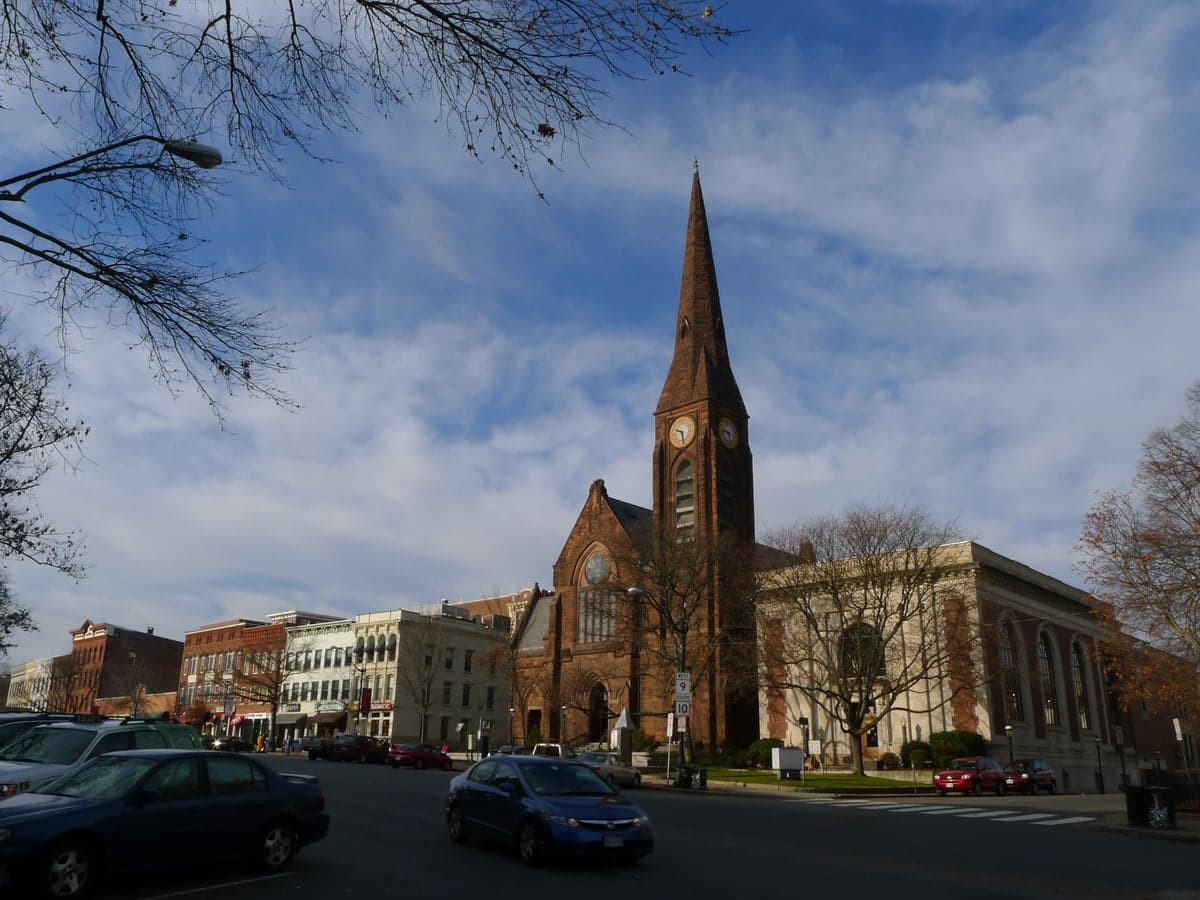
Photo: Wikipedia
Personal Sovereignty in Hampshire County
Moderate friction. Expect trade-offs in some aspect of personal liberty and independence.
What does Personal Sovereignty tell us?
Personal Sovereignty measures your capacity for self-reliance and independence with minimal government friction. Higher scores mean fewer barriers between you and the way you want to live... but it assumes you have the space you need and good neighbors.
What does this tell us?
Personal Sovereignty measures your capacity for self-reliance and independence with minimal government friction. Higher scores mean fewer barriers between you and the way you want to live... but it assumes you have the space you need and good neighbors.
State Policy
Energy independence: Importer (5% of energy produced in-state)
Personal Liberty
Homesteading

Personal Liberty Analysis
Hampshire County, Massachusetts, presents a complex environment for personal sovereignty, where individual freedoms are shaped by a dense web of state-level mandates and local municipal cultures that vary significantly from town to town. While the Commonwealth of Massachusetts imposes some of the nation's highest tax burdens and most restrictive gun laws, the county's rural western towns offer pockets of de facto autonomy, particularly in land use and daily life, that contrast sharply with the more regulated college towns like Amherst and Northampton. For a conservative-leaning individual or family weighing relocation, the key is understanding that sovereignty in Hampshire County is less about a uniform legal landscape and more about strategic town selection, with places like Cummington, Plainfield, and Chesterfield offering a markedly different experience than the bustling, progressive hub of Northampton.
Tax burden and regulatory posture in Hampshire County
Massachusetts is a high-tax state, and Hampshire County residents feel this acutely. The state's income tax is a flat 5.0% on all earned income, and the sales tax is 6.25%, with no local option to reduce it. Property taxes are the primary local revenue tool, and rates vary widely across the county. In 2025, the average effective property tax rate in Hampshire County was approximately 1.2% of assessed home value, but this masks significant disparities. Northampton, with its high property values and robust municipal services, has a rate near 1.4%, while rural towns like Cummington and Plainfield often hover around 1.1% due to lower service demands and smaller town budgets. The regulatory posture is heavily state-driven, with Massachusetts enforcing strict environmental regulations (Chapter 40B for affordable housing, Wetlands Protection Act) and building codes that apply uniformly. However, local enforcement varies: in Amherst, zoning is dense and development is tightly controlled, while in Chesterfield, a town of roughly 1,200 people, the building inspector may be a part-time position, and enforcement is more relaxed. The overall burden is high compared to states like New Hampshire or Texas, but within the county, the rural hilltowns offer a lighter touch than the college-centric communities.
Self-defense and gun law specifics in Hampshire County
Massachusetts has some of the strictest gun laws in the United States, and Hampshire County is no exception. The state requires a License to Carry (LTC) for both open and concealed carry, which is issued by the local police chief. The process is shall-issue in theory, but in practice, chiefs in towns like Amherst and Northampton have historically been more restrictive, requiring a "proper purpose" beyond self-defense, though a 2024 state law change (Chapter 135) aimed to standardize issuance. The LTC requires a 16-hour safety course, a background check, and a fee of around $100. The state also bans "assault weapons" by name, limits magazine capacity to 10 rounds, and requires all firearm transfers to go through a licensed dealer. For self-defense, the legal landscape is challenging: there is no "stand your ground" law; instead, Massachusetts imposes a "duty to retreat" if safely possible. Castle doctrine applies only to one's home. In practical terms, a resident of rural Plainfield can legally own a shotgun for home defense, but carrying a handgun for personal protection requires navigating a complex licensing system. The gun culture is present but subdued; there are fewer shooting ranges and gun shops compared to more permissive states. For a reader prioritizing self-defense rights, Hampshire County is a difficult environment, though the rural towns are more tolerant of firearms ownership than the urban centers.
Self-reliance and homesteading viability in Hampshire County
Hampshire County offers genuine opportunities for self-reliance, particularly in its western hilltowns. Zoning in towns like Cummington, Plainfield, and Chesterfield is minimal, with large minimum lot sizes—often 2 to 5 acres—that make small-scale farming and homesteading feasible. Many of these towns have "right-to-farm" bylaws that protect agricultural activities from nuisance complaints. Off-grid living is legally possible but requires navigating state building codes for septic systems and well water. Solar panels are common, and net metering is available, but going fully off-grid (no utility connection) is rare due to financing and resale challenges. The growing season is short (roughly 120-150 days), but the soil in the river valleys is fertile. Livestock, including chickens, goats, and even cattle, are common in the hilltowns, though state regulations on animal welfare and manure management apply. In contrast, Northampton and Amherst have urban zoning that restricts livestock and requires more permits for home-based businesses. For a family seeking to grow their own food, raise animals, and reduce reliance on external systems, the rural towns of Hampshire County are among the most viable in Massachusetts, though the state's high energy costs and property taxes remain a drag on true independence.
Personal liberties in Hampshire County: parental rights, medical autonomy, speech, and property
Personal liberties in Hampshire County are heavily shaped by state law, which often preempts local control. On parental rights, Massachusetts has a strong compulsory education law (ages 6-16) with rigorous homeschool reporting requirements, including annual curriculum approval by the local school district. In practice, districts in rural towns like Goshen or Williamsburg are often more accommodating than those in Amherst, which has a reputation for strict oversight. Medical autonomy is limited: Massachusetts mandates health insurance coverage, has a strict vaccine schedule for school attendance, and in 2020 passed a law requiring COVID-19 vaccines for schoolchildren (later repealed). The state also has a "right to die" law (Medical Aid in Dying), but it is tightly regulated. Free speech is protected under the First Amendment, but local ordinances in Northampton and Amherst restrict "hate speech" in public forums, and the state's anti-SLAPP law protects against frivolous lawsuits. Property rights are constrained by the state's strong environmental regulations; the Wetlands Protection Act can restrict building near any water body, and the Community Preservation Act (adopted by many towns) adds a surcharge on property taxes for open space preservation. In the hilltowns, property rights are more robust, but the state's regulatory reach is ever-present. Overall, personal liberties are more constrained than in states like New Hampshire or Texas, but the rural towns offer a buffer from the most intrusive local policies.
Compared to other regions of the United States, Hampshire County ranks low on traditional measures of personal sovereignty, such as gun rights, tax burden, and regulatory freedom. However, within the context of Massachusetts, it offers a meaningful gradient: the rural hilltowns of Cummington, Plainfield, and Chesterfield provide a degree of self-reliance and de facto autonomy that is absent in the state's urban core. For a conservative-leaning individual or family, the trade-off is clear: accept the high state-level taxes and restrictive gun laws in exchange for a community where land is affordable, neighbors are independent-minded, and the pace of life is slow. The county is not a libertarian haven, but for those willing to navigate the state's regulatory framework, it offers a viable path to a self-sufficient lifestyle that is increasingly rare in the Northeast. The key is choosing the right town—and understanding that sovereignty here is earned through careful planning, not guaranteed by law.

* Values derived from national, state, county, city and local statistics and may differ in a specific area. Last updated: 2026-07-10T05:46:10.000Z
Narrative content on this page is AI-generated and may contain mistakes. Verify any details that matter before acting on them.
ReloMaps may earn a commission from affiliate links at no extra cost to you.

