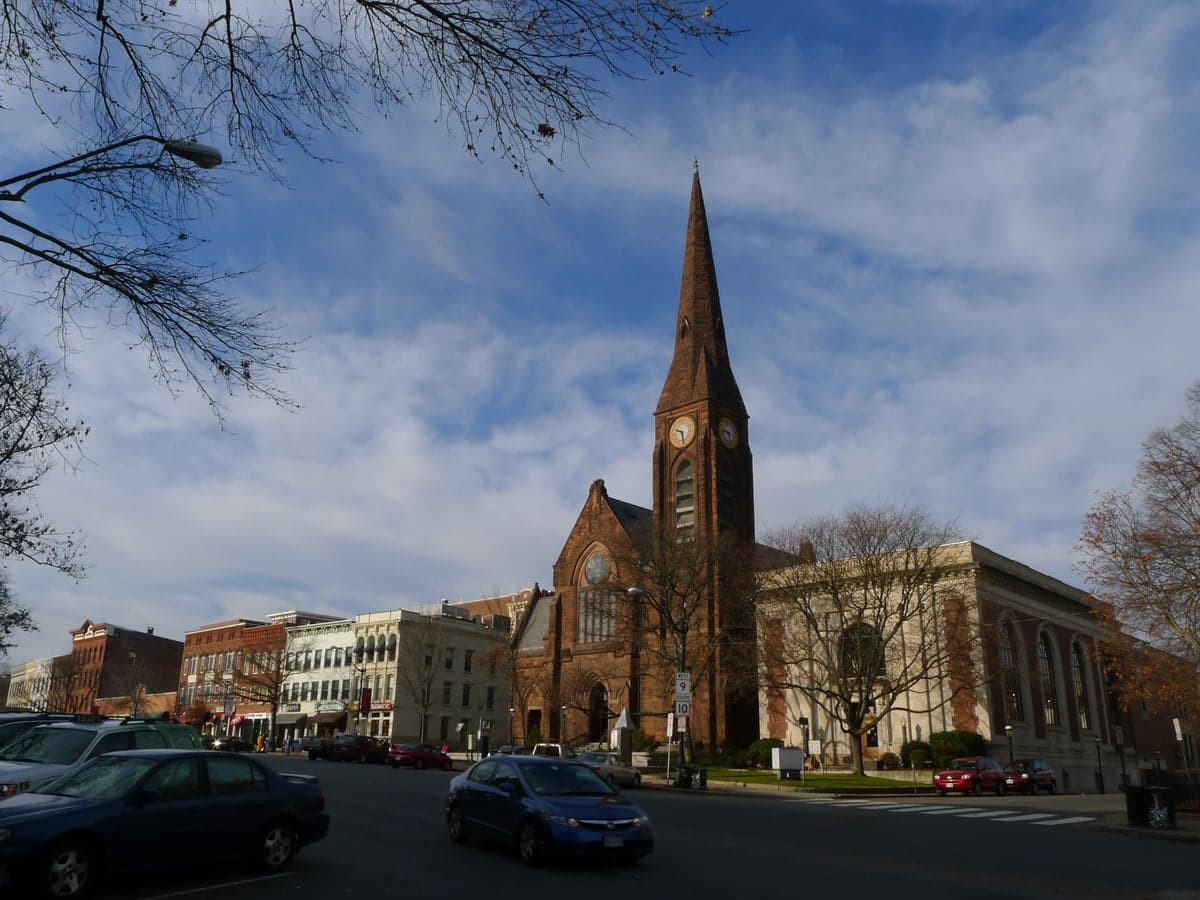
Photo: Wikipedia
Quality of Life in Hampshire County
A livable area that tracks near national norms for affordability, walkability, and neighborhood health.
What does Quality of Life tell us?
Quality of Life measures an area by evaluating factors like cost of living, nearby amenities, country club access, airport proximity, socioeconomic signals and neighborhood character. For large states, this is a general average — quality of life can vary dramatically between metro areas, suburbs, and rural communities within the same state.
What does this tell us?
Quality of Life measures an area by evaluating factors like cost of living, nearby amenities, country club access, airport proximity, socioeconomic signals and neighborhood character. For large states, this is a general average — quality of life can vary dramatically between metro areas, suburbs, and rural communities within the same state.
Cost of Living
20% above national average
83%
The Real Cost of Living in Hampshire County for 2026
| Tier | Individual | Family (4) |
|---|---|---|
| Survival | $21k | $40k |
| Comfortable | $71k | $104k |
| Luxury | $155k+ | $240k+ |
| Elite (Top 5%) | $182k+ | $282k+ |
Quality-of-Life Analysis
Hampshire County, Massachusetts, offers a quality-of-life spectrum that ranges from the vibrant, walkable college town of Northampton to the deeply rural, hilltown communities of Cummington and Plainfield, drawing everyone from academics and artists to farmers and remote workers. The county’s character is defined by its mix of the Five College consortium’s intellectual energy, the pastoral tranquility of the Pioneer Valley’s eastern edge, and the forested isolation of the Berkshire foothills. With a cost-of-living index of 120 (20% above the U.S. average), a median home value of $363,400, and a median rent of $1,332, the county provides a more affordable alternative to Boston’s metro area while still offering strong cultural and educational amenities.
Largest town(s) & population centers
The county’s largest population centers are Northampton (pop. ~28,500) and Amherst (pop. ~39,000), both of which anchor the daily life of the region. Northampton functions as the commercial and cultural hub, with a downtown dense with independent bookstores, farm-to-table restaurants, and live music venues like the Academy of Music. Its streets are pedestrian-friendly, and the city supports a robust LGBTQ+ community and a progressive political climate. Amherst, home to Amherst College and the University of Massachusetts Amherst, has a more campus-oriented rhythm, with a mix of student housing, faculty neighborhoods, and the bustling Amherst Center. Daily life in both towns revolves around the academic calendar, with farmers’ markets, public lectures, and a strong cycling culture. The average commute in the county is just 23.5 minutes, making it feasible to live in one town and work in another, though traffic on Route 9 can be congested during peak hours.
Smaller towns & rural pockets
Outside the population centers, Hampshire County’s smaller towns and rural pockets offer a markedly different pace. Easthampton, a former mill town of about 16,000, has reinvented itself as an arts destination with affordable studio spaces and the Cottage Street cultural district. Further west, Williamsburg and Goshen sit along the Mill River, with populations under 3,000 each, offering quiet, wooded residential areas and access to the D.A.R. State Forest. Cummington (pop. ~900) and Plainfield (pop. ~600) are the county’s most rural communities, located in the hilltowns along the Berkshire border. These towns feature working farms, unpaved roads, and a strong do-it-yourself ethos, with residents often commuting 30-40 minutes to Northampton or Amherst for work. Pelham, just east of Amherst, is a small, forested town of about 1,300 that feels far more remote than its proximity to the college towns suggests, with large lots and limited commercial development.
Cost & lifestyle range
The cost of living and lifestyle options vary dramatically across the county. At the upper end, Northampton and Amherst command the highest home values, often exceeding $500,000 for a single-family home in desirable neighborhoods like Northampton’s Florence or Amherst’s Cushman Village. Rents in these towns average $1,332 countywide, but can reach $1,800 for a two-bedroom in a prime location. At the lower end, Easthampton and Ware (the latter technically in Hampshire County’s eastern edge) offer more affordable housing, with median home values around $280,000-$320,000. The rural hilltowns of Cummington and Plainfield represent the most affordable entry point, with older farmhouses and fixer-uppers available for under $250,000, though buyers must factor in higher heating costs and longer commutes. Lifestyle-wise, Northampton and Amherst provide walkable, amenity-rich living with top-tier dining and cultural events, while the hilltowns offer privacy, land, and a slower pace, with residents relying on general stores in towns like Chesterfield or Westhampton for daily needs.
Hampshire County thrives for those who value a balance of intellectual stimulation and natural beauty, whether that means living in a college-town walkable neighborhood or on a rural hillside with views of the Holyoke Range. The county’s strong public schools, particularly in the Amherst-Pelham and Northampton districts, attract families, while the presence of five colleges ensures a steady influx of young professionals and retirees seeking cultural engagement. Remote workers and creatives find the lower cost of the hilltowns appealing, while academics and healthcare workers at Cooley Dickinson Hospital or Baystate Health often prefer the convenience of the larger towns. The county’s political and social climate is overwhelmingly progressive, with a strong emphasis on local food systems, environmental sustainability, and community engagement, making it a fit for those who prioritize these values over urban convenience or suburban homogeneity.

Crime in Hampshire County
Generally safer than 70% of comparable U.S. locations.
Violent CrimeViolent Crime Analysis
Property CrimeProperty Crime Analysis
Crime Analysis
Hampshire County, Massachusetts, presents a mixed safety profile that is heavily shaped by the contrasting environments of its urbanized college towns and its rural, residential communities. The county's overall violent crime rate of 284.3 incidents per 100,000 residents is notably lower than the national average but sits slightly above the Massachusetts state average, a dynamic largely driven by property crime and specific incidents in its population centers. Property crime, at 813.5 per 100,000, is also below the national figure but remains a tangible concern, particularly in areas with high student populations and transient foot traffic.
Crime in context
To understand Hampshire County's safety, it is essential to compare its rates against broader benchmarks. The national violent crime rate hovers around 380 per 100,000, making Hampshire County's 284.3 figure a meaningful improvement. However, the Massachusetts state average for violent crime is approximately 260 per 100,000, meaning the county is about 9% higher than the state norm. This elevation is not uniform across the county. The property crime rate of 813.5 per 100,000 is significantly lower than the national average of roughly 1,950 per 100,000, but it is slightly above the Massachusetts average of 780 per 100,000. These statistics indicate that while Hampshire County is not a high-crime area by national standards, it does experience crime at a rate that warrants attention, especially when compared to the safest counties in the state like Norfolk or Middlesex.
What residents experience
Daily life in Hampshire County varies dramatically by location. The city of Northampton, a vibrant cultural and commercial hub, sees a concentration of both violent and property crimes, largely due to its dense downtown, nightlife, and transient population. Incidents of assault and larceny are more common here than in the county's quieter towns. Similarly, Amherst, home to the University of Massachusetts Amherst, experiences a high volume of property crimes—particularly bicycle thefts, package thefts, and burglaries from student housing—which inflates the county's property crime numbers. Residents in these areas often report a heightened sense of vigilance regarding personal property. In contrast, the towns of Belchertown, South Hadley, and Granby consistently report far lower crime rates, with violent crime being a rare occurrence. The presence of the Northwestern District Attorney's Office, which serves Hampshire and Franklin counties, is a key factor. The office operates under a progressive prosecutorial philosophy that emphasizes restorative justice and diversion programs over incarceration. While this approach is intended to reduce recidivism, critics argue it results in lenient sentencing for repeat offenders, potentially increasing the risk to law-abiding residents in the county's more urbanized areas. This is a particular concern in Northampton and Amherst, where the combination of a transient population and a progressive justice system can lead to a perception that property crimes are not taken seriously enough.
Neighborhood-level variation is pronounced. In Northampton, the area around Main Street and the downtown core sees the highest police activity, while residential neighborhoods like Leeds and Florence are significantly safer. In Amherst, the areas immediately surrounding the UMass campus and the downtown commercial district have higher crime rates, while the outlying residential streets and the town of Hadley (which borders Amherst) offer a much lower risk profile. For families and retirees, the safest options are the smaller towns like Easthampton, which has seen revitalization but still maintains a low crime rate, and the rural communities in the eastern part of the county. The overall safety picture is one of a generally safe region where residents must be aware of the specific risks associated with the college-town environment and the potential consequences of a justice system that prioritizes rehabilitation over punishment.
* Values derived from national, state, county, city and local statistics and may differ in a specific area. Last updated: 2026-07-10T05:46:10.000Z
Narrative content on this page is AI-generated and may contain mistakes. Verify any details that matter before acting on them.
ReloMaps may earn a commission from affiliate links at no extra cost to you.

