Photo: Wikipedia
Political ClimatePolitical Climate in Charles County
Showing district-level results — no local-only data available.
Local Political AnalysisPolitical Analysis of Charles County
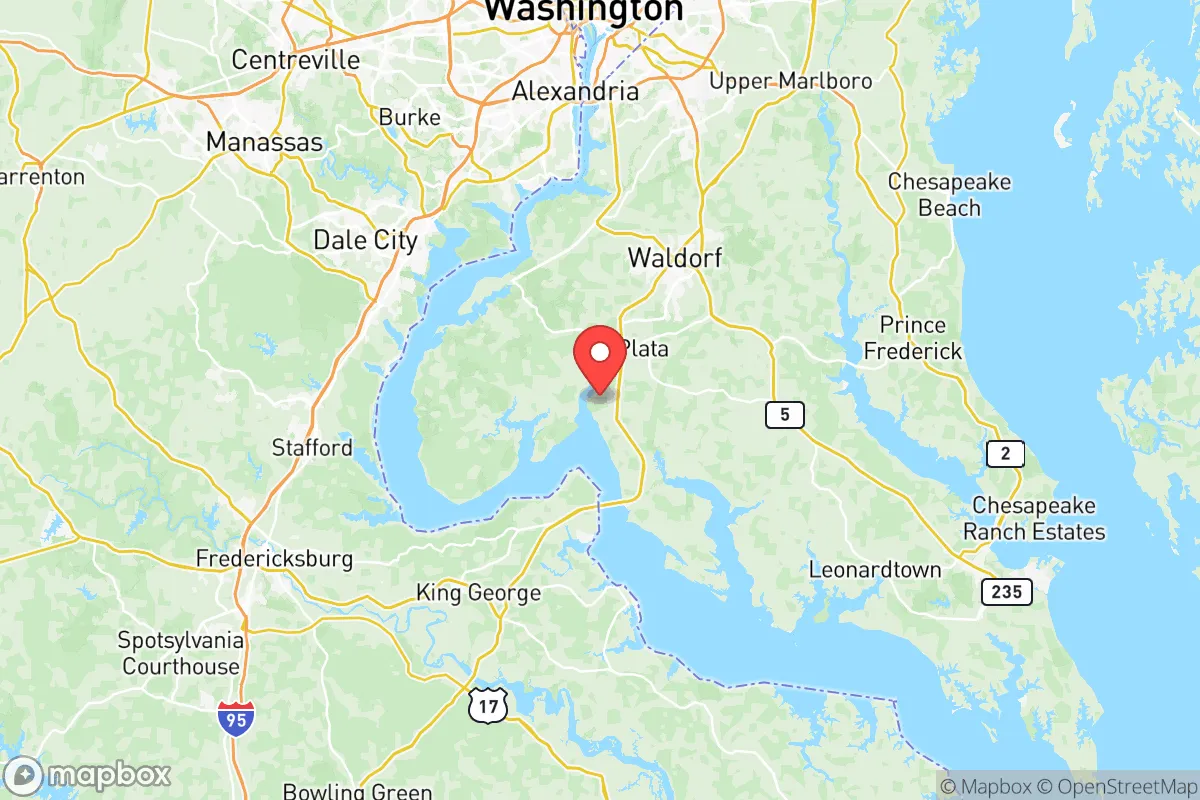
Charles County has been a reliable Democratic stronghold for decades, and that hasn't changed. With a Cook Partisan Voting Index (PVI) of D+17, the county is about as blue as the state of Maryland, which also sits at D+17, and significantly more Democratic than the national average. But the county’s politics aren't a monolith. The heavily suburban and more affluent areas around Waldorf and La Plata lean strongly Democratic, while more rural stretches near the county's southern and western fringes, particularly around places like Nanjemoy, Newburg, and Cobb Island, can still swing Republican, especially in local races. That inland-versus-riverside split is a real thing; you'll see it in precinct results every cycle. Over the last ten or fifteen years, the northern end of the county, closer to the D.C. metro area, has become more consistently blue as new commuters and families moved in, while the traditional rural vote has shrunk but remained stubbornly conservative.
How it compares
Because Charles County shares that identical D+17 PVI with Maryland as a whole, its political behavior is a near-perfect microcosm of the state’s electoral map. When Maryland votes +32 for a Democratic presidential candidate, Charles County typically lands within a couple points of that margin. The big difference is the intensity of the partisanship. Maryland’s deep-blue areas, like Montgomery County or Prince George's County (just across the Patuxent River), are D+30 or more. Charles County is more moderate by comparison. There's a noticeable Senate-versus-Governor dynamic here, too. In statewide races, Republicans can sometimes pull 40% of the Charles County vote, especially in lower-turnout gubernatorial midterms, which is higher than in the urban core counties. Local government, however, has been under unified Democratic control for as long as anyone can remember. The Board of County Commissioners has been all-Democratic since at least 2010, though the primary races between the moderate and progressive wings are often the real contests.
What this means for residents
For liberal residents, Charles County is a comfortable place to live politically. Your values are reflected in county policy on things like public school funding, affordable housing initiatives, and environmental protections along the Potomac River. You’ll find strong support for unions, especially in the public sector, and a county government that prioritizes transit-oriented development, like the ongoing projects in the Waldorf and St. Charles areas. For conservative residents, the situation is more complex. You are clearly in the minority in countywide elections, but you are not invisible. In local school board races, fiscal conservatives can win seats, especially in districts covering the more rural southern half of the county. And on statewide issues like the Second Amendment, Charles County has a vocal and organized conservative base that shows up at public hearings and drives candidate forums. It's not a place where a Republican would run for County Commissioner and expect to win outright, but it is a place where your voice carries weight in local zoning and budget debates if you organize.
One thing that really distinguishes Charles County from the rest of Maryland, especially from liberal Montgomery and Prince George's counties just north, is the culture around development and growth. There's a long-standing tension between newer suburban arrivals who want more amenities and transit options, and long-time residents—many of them families who have been here for generations—who want to protect the rural character of places like Nanjemoy or the horse farms near the county's western edge. This dynamic plays out in policy: the county has a fairly aggressive Adequate Public Facilities Ordinance (APFO) that often slows down new housing developments, which is seen as a NIMBY-friendly move by both conservative landowners and liberal slow-growth advocates. It's a weird political marriage, but it works. The county also has a notable history of African American political leadership. It is one of the few majority-Black counties in Maryland that actually votes consistently Democratic, not just in presidential years but in every primary, and that has shaped a political culture that is deeply pragmatic and community-focused, not ideological or performative.

State Political ClimatePolitical Climate in Maryland
State Political AnalysisPolitical Environment in the State
Maryland is a deeply blue state with a Cook Partisan Voting Index of D+17, meaning it leans nearly 25 points more Democratic than the national average. The state has not voted for a Republican presidential candidate since George H.W. Bush in 1988, and Democrats hold every statewide office and supermajorities in both legislative chambers. However, this partisan lean masks a stark internal divide: the state’s majority is driven by the densely populated Washington, D.C., suburbs and Baltimore, while large swaths of rural and exurban Maryland vote reliably Republican. Over the last 20 years, Democrats have consolidated power through population growth in the D.C. suburbs, while many rural counties have grown more conservative in reaction.
Urban vs. rural divide
Maryland’s political geography is a tale of two states. The liberal strongholds are Montgomery County (suburban D.C.) and Prince George’s County, both heavily populated, affluent, and diverse. Montgomery County alone casts about 12% of the state’s vote and routinely goes 75-80% Democratic. Baltimore City and Baltimore County are also reliably blue, though the city has lost population since 2020, slightly reducing its Democratic heft. On the other side, the Eastern Shore (counties like Queen Anne’s and Wicomico) and the western panhandle (Garrett and Allegany counties) are solidly red. Garrett County voted +45 for Trump in 2020 and +48 in 2024. The key swing areas are the burgeoning exurbs like Frederick County and Anne Arundel County, which are increasingly purple but trending Democratic as D.C. commuters push outward. The rural-urban split means that a resident in Hagerstown or Salisbury experiences a radically different political climate than someone in Bethesda or Columbia.
Policy environment
Maryland’s policy environment is defined by high taxes and a robust regulatory structure. The state has a progressive income tax system with rates from 2% to 5.75%, plus local add-ons that push effective rates much higher in wealthy counties. Combined state and local income taxes in Montgomery County can exceed 9%. Property taxes are moderate but vary widely. Sales tax is 6%. The state has a strict uniform ballot system, and election laws are among the most lenient in the region: automatic voter registration, no-excuse mail-in voting, and same-day registration on election day. Maryland has one of the highest effective tax burdens in the country, ranking 45th in Tax Foundation’s 2025 business climate index. The state has strong environmental regulations, a generous minimum wage ($15 in 2024, indexing to inflation), and a heavy reliance on public sector spending, which remains popular with the governing coalition.
Recent policy direction
The last five years have seen a sharp progressive shift in state law, driven by the Democratic supermajority.
Gun laws: Maryland passed some of the toughest gun laws in the nation, including a 2023 ban on carrying firearms in certain “sensitive” locations (parks, transit, bars) and a 2024 law requiring a state police background check for private long-gun sales. The state’s handgun license law (HQL) and microstamping requirements remain in place.
Education and parental rights: The 2024 “Blueprint for Maryland’s Future” enacted massive education funding increases, but also mandated new curriculum frameworks for social studies that include critical race theory elements, sparking local backlash. Parental opt-out rights for library materials were curtailed in 2025.
Healthcare and bodily autonomy: Maryland codified abortion access in state law in 2021, and a 2024 law protects providers who perform gender-affirming care for minors from out-of-state prosecution. A 2025 law removed most parental consent requirements for minors seeking reproductive health care at school-based clinics.
Privacy and surveillance: The state passed the Maryland Online Data Privacy Act in 2024, restricting data collection and requiring opt-in consent for location tracking. However, law enforcement can still access license plate reader data without a warrant in many cases.
Property and housing: A 2024 “good cause” eviction law made it harder for landlords to refuse lease renewals, and a 2025 zoning reform (the “Transit-Oriented Development” bill) allows upzoning around transit stations, overriding local zoning in some cases. Property owners face strong historic preservation commissions and environmental review delays.
Tax and budget: The state is currently debating a “wealth tax” on millionaires and capital gains, likely passing in 2026. Relocators should expect higher tax burdens over the next few years.
Civil unrest & political movements
Maryland has a history of prominent activism on both sides. The 2020 protests in Baltimore and D.C.’s Maryland suburbs over George Floyd’s death were large but mostly peaceful, though looting in Baltimore City led to a curfew. More recently, left-wing movements have focused on police reform (the 2021 Maryland Police Accountability Act) and transit equity. On the right, grassroots groups like “Moms for Liberty” have chapters in Frederick, Carroll, and Harford counties, focusing on school board elections and library content. Immigration politics are a flashpoint: Montgomery and Prince George’s counties have “sanctuary” policies limiting cooperation with ICE, while rural sheriffs openly call for stronger enforcement. A 2024 ballot initiative to repeal the sanctuary policy was defeated 60-40. The state’s election integrity controversies are muted compared to swing states, but Republican activists in Frederick and the Eastern Shore regularly question voter roll accuracy and mail-in ballot security, leading to a 2025 law limiting third-party ballot drop-off hours. The most visible political flashpoint for newcomers is probably the flagpole disputes: “thin blue line” and “Trump 2024” banners from rural homes versus “BLM” and “Love is Love” signs in the suburbs, with no actual violence but plenty of heated Nextdoor debates.
Projection
Over the next 5-10 years, Maryland will likely become even more Democratic. The D.C. suburbs continue to sprawl west into Frederick County (which voted +13 for Biden in 2020), and south into Charles County. In-migration is dominated by high-income, college-educated workers in tech, defense, and government who lean left. The state’s aging population in the redder rural counties is offset by out-migration of younger conservatives to Florida and Texas. The national trend of “political segregation” will deepen: expect Montgomery County to move toward D+35, while Garrett County becomes R+50. Projected by 2030, only six of Maryland’s 24 counties may vote Republican. What this means practically: taxes will almost certainly continue to rise (the 2025-2026 “wealth tax” is a strong signal), gun laws will tighten further, and public school curricula will become more progressive. However, conservative residents in places like Hagerstown or Easton can still find local communities that feel culturally right-of-center, even as statewide power becomes more monolithic. The state’s deep-blue status insulates it from national swings, so relocators should expect steady progressive policy momentum regardless of who wins the presidency.
Bottom line for a new resident: If you are a conservative moving to Maryland, you will have little influence on statewide elections, but you can carve out a comfortable life in the rural or exurban counties where local culture remains traditional. If you are a liberal, you will find a state government that largely aligns with your values, though you will pay heavily for it. Either way, understand that Maryland’s politics are bifurcated: the blue majority in the D.C. beltway sets the rules, and the red minority mostly adapts. The state’s high taxes and regulatory density are a given, but so are strong schools, good infrastructure, and a well-educated workforce. For most relocators, the practical trade-off is between policy alignment and cost of living—rural areas cost less but feel red, while urban and suburban areas cost more but feel blue.
* Values derived from national, state, county, city and local statistics and may differ in a specific area. Last updated: 2026-06-24T18:30:44.000Z
Narrative content on this page is AI-generated and may contain mistakes. Verify any details that matter before acting on them.
ReloMaps may earn a commission from affiliate links at no extra cost to you.

