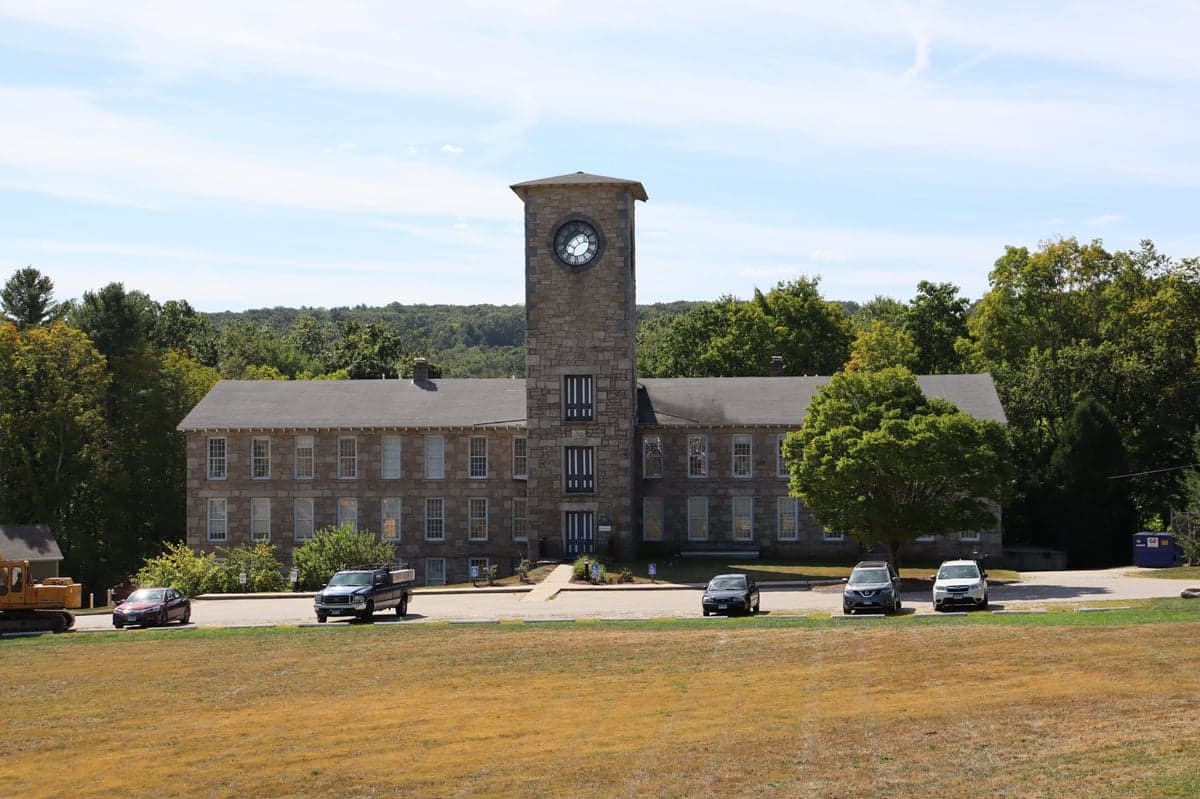
Photo: Wikipedia
Political ClimatePolitical Climate in Mansfield, CT
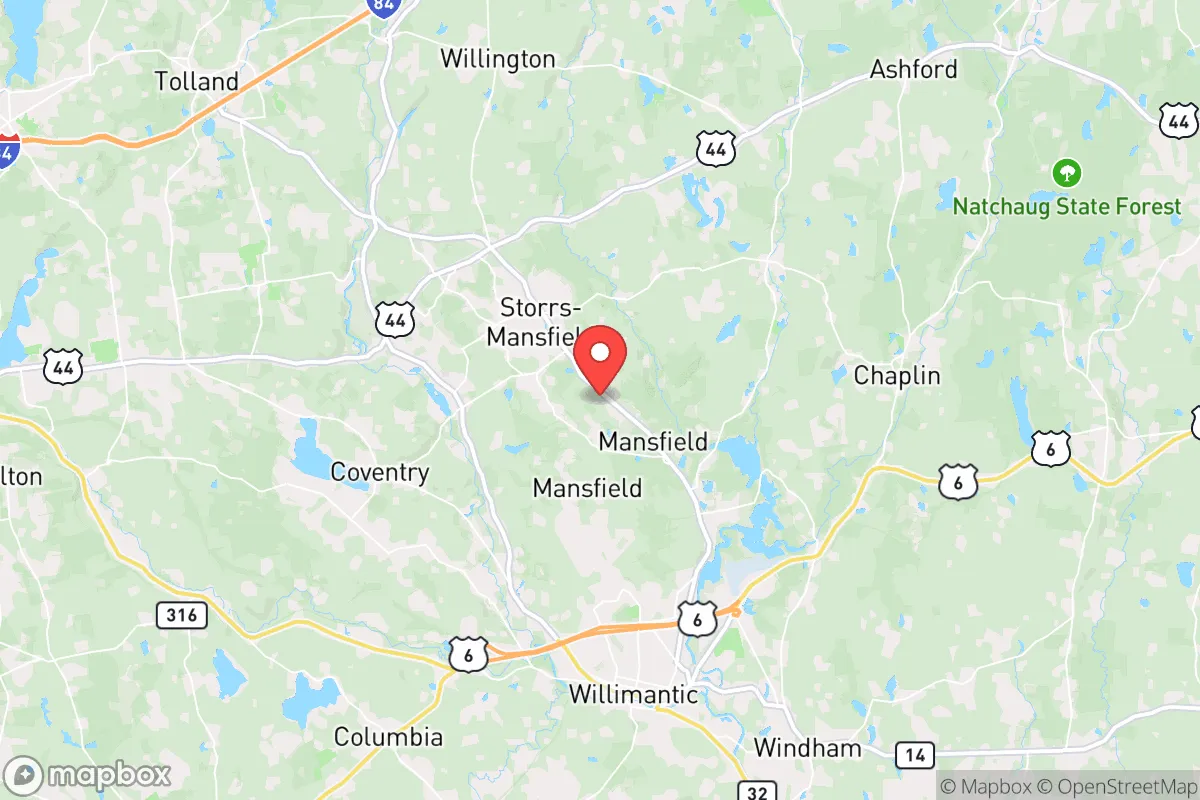
District shown is the primary district for this city’s centroid. Cities may span multiple districts.
Inherited from parent state — no local data available.
Local Political AnalysisPolitical Analysis of Mansfield, CT
Mansfield, Connecticut, is a reliably Democratic stronghold, driven largely by the presence of the University of Connecticut (UConn) in Storrs. The town’s political lean is significantly more progressive than the state average, with Democratic presidential candidates routinely winning over 70% of the vote here. In 2020, Joe Biden captured roughly 74% of Mansfield’s vote, compared to about 59% statewide. This isn’t a recent shift—Mansfield has voted Democratic in every presidential election since at least 1992, and the margin has only widened as UConn’s student and faculty population has grown. The town’s trajectory suggests it will remain a deep-blue anchor in eastern Connecticut for the foreseeable future, though local elections can see more moderate candidates prevail, especially in off-years when student turnout dips.
How it compares
Connecticut as a whole has a Cook Partisan Voting Index (PVI) of D+8, meaning it leans Democratic by eight points relative to the national average. Mansfield, by contrast, is likely in the D+25 to D+30 range, making it one of the most Democratic towns in the state. For context, nearby towns like Windham and Willimantic also lean Democratic but with smaller margins, while rural communities just a few miles away—such as Ashford and Chaplin—tilt Republican. The contrast is stark: drive 15 minutes north from UConn’s campus to Stafford Springs, and you’ll find a town that voted for Donald Trump in 2020. This creates a political patchwork where Mansfield feels like an island of progressive politics surrounded by more conservative small towns. The state’s D+8 PVI reflects a balance of urban and suburban Democratic strongholds (like Hartford and New Haven) with more conservative exurbs and rural areas, but Mansfield’s intensity of Democratic support is closer to what you’d see in New Haven or Hartford than in the rest of eastern Connecticut.
What this means for residents
For liberal residents, Mansfield offers a comfortable environment where progressive policies on climate, social justice, and public transit are generally supported by local government. The town council and board of education often reflect these values, and you’ll find active grassroots groups focused on issues like affordable housing and environmental sustainability. For conservative residents, the reality is more nuanced. You won’t face hostility, but you’ll be in a clear minority in local politics. School board and town council candidates who identify as Republican rarely win, though they can influence debates on taxes and development. The practical impact is that Mansfield’s budget priorities tilt toward public services, education, and infrastructure that supports the university—things like expanded bus routes and bike lanes. Property taxes are moderate for the region, but the town’s reliance on UConn as a major employer means economic policy is closely tied to the university’s fortunes. In day-to-day life, most residents find the political climate civil, with the biggest friction points being debates over student housing, noise ordinances, and the pace of commercial development near campus.
Culturally, Mansfield stands out for its blend of academic energy and small-town New England character. The presence of UConn brings a steady stream of lectures, arts performances, and Division I sports that you won’t find in neighboring towns. The town’s zoning and land-use policies are more restrictive than in rural areas—there’s a strong emphasis on preserving open space and controlling sprawl, which appeals to environmentalists but can frustrate developers and residents who want more retail options. Politically, Mansfield has been a testing ground for state-level progressive initiatives, like local resolutions supporting sanctuary city policies and renewable energy mandates. If you’re moving here, expect a community where political engagement is high, especially around university-related issues, but where the broader cultural vibe is more “college town” than “activist hub.” It’s a place where you can have a thoughtful conversation about local politics over coffee at the Storrs Center, even if you disagree on the outcome.

State Political ClimatePolitical Climate in Connecticut
State Political AnalysisPolitical Environment in the State
Connecticut is a solidly Democratic state with a Cook PVI of D+8, meaning it typically votes about eight points more Democratic than the national average. Over the past 10-20 years, the state has shifted further left in presidential elections—from a D+5 lean in 2004 to D+10 in 2020—driven by the growing dominance of its wealthy, educated suburbs and the decline of its once-competitive industrial cities. However, this blue veneer hides a more nuanced reality: the state’s political culture is shaped by a deep urban-rural divide, a long tradition of moderate Republicanism in the suburbs, and a recent surge of progressive activism in the cities. For a conservative-leaning relocator, the practical takeaway is that Connecticut offers a high-tax, highly regulated environment with strong gun control and liberal social policies, but also pockets of genuine conservative strength in the Litchfield Hills and eastern counties.
Urban vs. rural divide
The political map of Connecticut breaks into three distinct zones. The urban core—Hartford, New Haven, Bridgeport, and Waterbury—is overwhelmingly Democratic, often voting 70-80% for the party. These cities are home to large minority populations, unionized public-sector workers, and a growing base of young progressives. The suburbs of Fairfield County, particularly Greenwich, Stamford, and Darien, are the engine of the state’s Democratic lean. These wealthy commuter towns have shifted sharply left since 2016, driven by college-educated professionals who prioritize social issues and climate policy. In contrast, the rural and exurban areas—Litchfield County, the Quiet Corner (Windham County), and the eastern shoreline towns like Old Lyme—vote reliably Republican. The 2020 presidential race saw Litchfield County vote for Trump by a 5-point margin, while Windham County went for Trump by 8 points. The state’s political center of gravity, however, lies in the densely populated I-95 corridor, which delivers enough Democratic votes to swamp the rural GOP strongholds.
Policy environment
Connecticut’s policy environment is defined by high taxes and a strong regulatory state. The state has a progressive income tax with rates up to 6.99%, one of the highest property tax burdens in the nation (average effective rate of 1.70%), and a 6.35% sales tax. There is no right-to-work law, and union density is among the highest in the country, with 15.5% of workers unionized. Education policy is centralized: the state has a per-pupil spending of over $20,000, among the top five nationally, but also mandates a controversial “Fair Share” funding formula that redistributes property tax revenue from wealthy towns to poorer districts. Healthcare is heavily regulated, with a state-run exchange (Access Health CT) and strict insurance mandates. Election laws are relatively liberal: same-day voter registration is allowed, no-excuse absentee voting was expanded during COVID and made permanent, and the state has automatic voter registration through the DMV. Gun laws are among the strictest in the nation, including a ban on assault weapons, a 10-round magazine limit, and a permit-to-purchase requirement for handguns.
Recent policy direction
Over the past five years, Connecticut has moved decisively left on several fronts. In 2023, the legislature passed a major gun control package (HB 6667) that expanded the state’s existing assault weapons ban, raised the minimum age to purchase a long gun to 21, and required safe storage of firearms. On education, the state enacted a law (PA 21-2) that requires all public schools to include LGBTQ+ history in their curriculum, and in 2022, it passed a law (PA 22-82) that prohibits school districts from banning books based on content. On medical and bodily autonomy, Connecticut has become a safe haven for abortion access: in 2022, it passed a law (PA 22-19) that protects providers and patients from out-of-state lawsuits, and it expanded Medicaid coverage for abortion services. On property rights, the state has a strong “fair share” housing law (PA 21-29) that allows developers to override local zoning in towns that fail to meet affordable housing targets—a policy that has sparked fierce opposition in suburbs like Westport and Glastonbury. On privacy and surveillance, Connecticut passed a comprehensive data privacy law (CTDPA) in 2022, giving residents the right to opt out of data collection. On voting, the state expanded early voting in 2023 (PA 23-5) and made no-excuse absentee voting permanent. For a conservative relocator, the key takeaway is that the state is actively moving toward greater regulation of firearms, education, and housing, while expanding individual rights on abortion and data privacy.
Civil unrest & political movements
Connecticut has seen relatively low levels of civil unrest compared to larger states, but there have been notable flashpoints. The 2020 Black Lives Matter protests in Hartford and New Haven were large but mostly peaceful, though there were isolated incidents of property damage. The state’s sanctuary policy—enacted by executive order in 2013 and codified into law in 2021 (PA 21-167)—prohibits state and local law enforcement from cooperating with federal immigration authorities, which has been a source of tension in towns like Danbury and Shelton, where some residents have pushed back. Election integrity controversies have been muted, but in 2020, the state’s expansion of absentee voting led to a lawsuit from the Republican Party, which was ultimately dismissed. Organized political movements are active on both sides: the Connecticut Citizens Defense League (CCDL) is a well-organized gun rights group that holds regular rallies at the state capitol, while progressive groups like the Working Families Party have successfully pushed for paid family leave and a $15 minimum wage. The most visible flashpoint for a new resident would likely be the ongoing debate over local zoning and affordable housing, which has become a proxy war between suburban homeowners and state-level developers.
Projection
Over the next 5-10 years, Connecticut is likely to become more Democratic and more progressive, driven by two demographic trends. First, the state’s population is aging and shrinking, but the growth that does occur is concentrated in the wealthy, educated suburbs of Fairfield County, which are trending left. Second, the state’s urban centers—Hartford, New Haven, and Bridgeport—are seeing an influx of younger, more diverse residents who are reliably Democratic. The rural and exurban areas that vote Republican are losing population, which will further dilute their political influence. The state’s tax burden is unlikely to decrease significantly, as the Democratic supermajority in the legislature has shown no appetite for broad-based tax cuts. However, the state’s fiscal outlook has improved somewhat due to the “fiscal guardrails” adopted in 2017, which have limited spending growth and built up a budget reserve. For a conservative relocator, the realistic expectation is that Connecticut will remain a high-tax, high-regulation state with strong gun control and liberal social policies, but with enough local variation—particularly in Litchfield County and the eastern towns—to find a community that aligns with their values.
For a new resident, the bottom line is that Connecticut offers a high quality of life in its affluent suburbs and scenic rural areas, but at a significant cost in taxes and regulatory compliance. If you value strong public schools, low crime, and proximity to New York City, the state’s suburbs are hard to beat—but you will pay for it. If you are a conservative who prioritizes gun rights, low taxes, and local control over zoning and education, you will find the state’s policy direction frustrating, though you can find like-minded communities in the Litchfield Hills or the Quiet Corner. The state’s political trajectory is firmly leftward, but it is a slow, incremental shift rather than a radical transformation. Plan accordingly.
* Values derived from national, state, county, city and local statistics and may differ in a specific area. Last updated: 2026-10-29T02:36:58.000Z
Narrative content on this page is AI-generated and may contain mistakes. Verify any details that matter before acting on them.
ReloMaps may earn a commission from affiliate links at no extra cost to you.

