
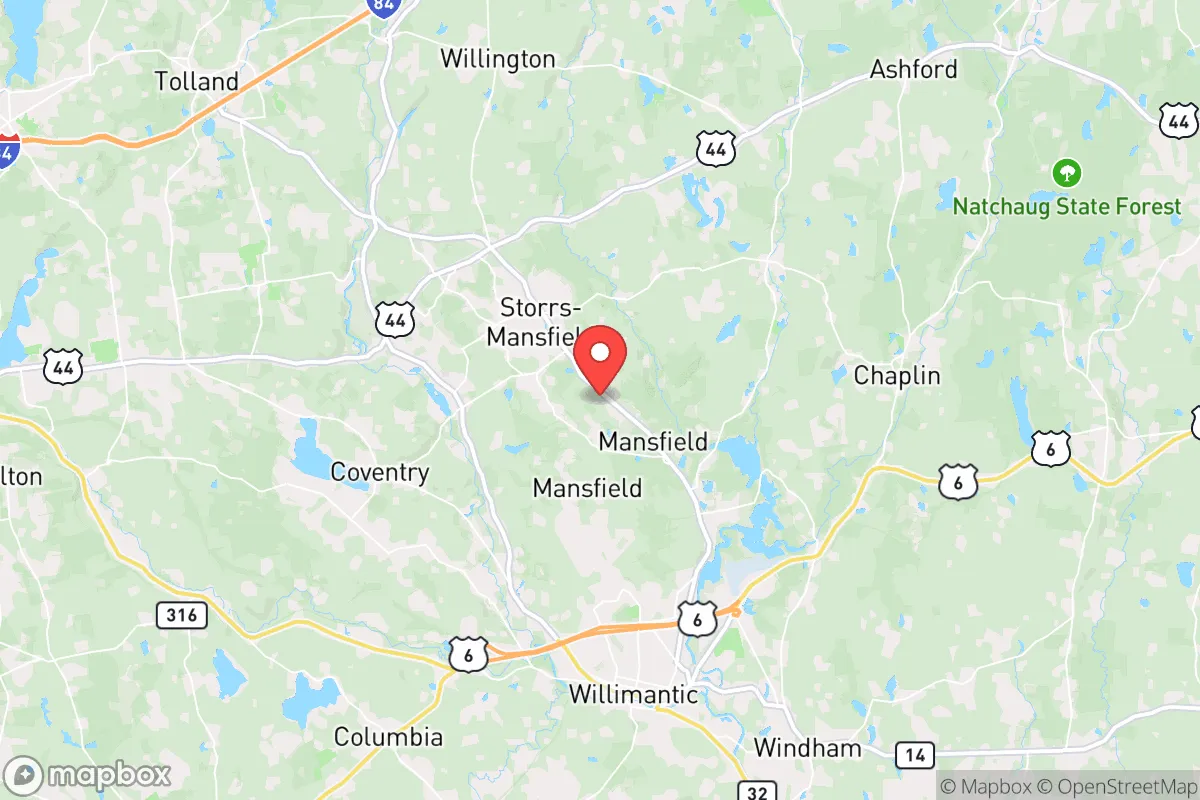
Photo: Wikipedia
Personal Sovereignty in Mansfield, CT
Viable for self-reliance. Generally workable, though some barriers may limit total independence.
What does Personal Sovereignty tell us?
Personal Sovereignty measures your capacity for self-reliance and independence with minimal government friction. Higher scores mean fewer barriers between you and the way you want to live... but it assumes you have the space you need and good neighbors.
What does this tell us?
Personal Sovereignty measures your capacity for self-reliance and independence with minimal government friction. Higher scores mean fewer barriers between you and the way you want to live... but it assumes you have the space you need and good neighbors.
State Policy
Energy independence: Importer (5% of energy produced in-state)
Personal Liberty
Homesteading

Personal Liberty Analysis
Mansfield, Connecticut, presents a mixed picture for those prioritizing personal sovereignty, where the town’s own relatively hands-off character is often constrained by the state’s broader regulatory and fiscal framework. While Mansfield itself does not impose many local ordinances that restrict individual autonomy, residents must navigate Connecticut’s status as one of the most heavily regulated states in the Northeast, particularly regarding taxation, firearms, and property use. For a relocation audience that values self-reliance and minimal government intrusion, the key question is whether the town’s local culture of independence can outweigh the state-level burdens that accompany life in Connecticut.
Tax burden and regulatory posture: what you pay for limited local interference
Mansfield’s tax environment is shaped by its status as a college town (home to the University of Connecticut’s main campus) and its reliance on property taxes to fund local services. The town’s mill rate for 2025 is approximately 29.5 mills, meaning a property assessed at $300,000 would incur roughly $8,850 in annual property taxes. This is moderate by Connecticut standards but high compared to most of the country. The state’s income tax is progressive, with rates from 3% to 6.99%, and the sales tax is 6.35% (with no local add-on). The regulatory posture in Mansfield itself is relatively light-touch: the town has no local business licensing requirements beyond state mandates, and zoning enforcement is generally complaint-driven rather than proactive. However, Connecticut’s state-level regulatory environment is dense. The state ranks in the top 10 for regulatory burden according to the Mercatus Center, with extensive environmental, labor, and land-use rules. For a resident seeking to run a home-based business, for example, the state’s home occupation permit process requires a zoning application and public hearing if the business involves customers visiting the home. This is not prohibitive, but it adds a layer of bureaucratic friction that a more autonomy-focused person would find irksome. The bottom line: Mansfield’s local government is not heavy-handed, but the state’s tax and regulatory apparatus will feel like a constant, moderate drag on personal economic freedom.
Self-defense and gun law specifics: what you can and cannot do
Connecticut’s gun laws are among the strictest in the nation, and Mansfield residents must comply fully with state mandates. The state requires a permit to purchase any handgun or long gun, which involves a background check, a safety course, and a 14-day waiting period. Open carry is legal only with a valid permit, but in practice it is rare and may draw police attention. The state also bans “assault weapons” (defined by a feature-based test) and magazines over 10 rounds. For self-defense in the home, Connecticut law recognizes the “castle doctrine” but does not have a “stand your ground” statute; there is a duty to retreat in public spaces if safe to do so. Mansfield itself has no additional local gun ordinances, so the town is not more restrictive than the state baseline. However, the practical effect for a sovereignty-minded resident is that carrying a firearm for self-defense requires proactive compliance with a permitting system that can take 8-12 weeks to process. The state also maintains a firearm registry for handguns sold after 2013, which some residents view as an infringement on privacy. For those who prioritize the right to self-defense, Mansfield is a location where that right is heavily regulated, not prohibited, but the administrative burden is real. The local sheriff’s office (Tolland County) processes permits efficiently, but the state’s legal framework remains a significant constraint.
Self-reliance and homesteading viability: lot sizes, zoning, and off-grid feasibility
Mansfield offers genuine opportunities for self-reliance, though with important caveats. The town’s zoning code allows for agricultural uses on parcels of two acres or more, and many residential lots in the rural parts of town (such as the Gurleyville and Mansfield Center areas) are 1-5 acres. Raising chickens, goats, and even a small number of pigs is permitted without a special permit, provided the animals are kept for personal use and not for commercial sale. Beekeeping is allowed on lots of at least half an acre. However, off-grid living is effectively impossible under current regulations. Connecticut law requires all habitable dwellings to be connected to the electrical grid or have a state-approved alternative energy system (solar with battery storage is the only practical option), and the town requires a building permit for any structure with a foundation. Rainwater collection is legal but limited to 50 gallons per property per day without a permit, and composting toilets are not allowed as a primary sanitation method—the town requires connection to public sewer or a state-approved septic system. Wood stoves are permitted as a secondary heat source but must meet EPA emissions standards. For a family seeking to reduce dependence on utilities, Mansfield allows significant self-sufficiency in food production and some energy independence, but full off-grid autonomy is not legally feasible. The town’s zoning also prohibits “tiny houses” on wheels as permanent residences, though accessory dwelling units (ADUs) are allowed on lots of one acre or more with a special permit. The regulatory posture here is moderate: the town does not actively discourage homesteading, but state building and health codes impose a baseline of infrastructure that limits radical self-reliance.
Personal liberties: parental rights, medical autonomy, speech, and property
On personal liberties, Mansfield reflects Connecticut’s generally progressive state policies, which can feel restrictive to a conservative-leaning audience. Parental rights in education are limited: Connecticut law does not require schools to notify parents of a child’s gender identity changes, and the state’s curriculum standards include comprehensive sex education that parents cannot opt out of entirely (though they can request alternative materials). The town’s school district, Mansfield Public Schools, follows state guidelines closely, so there is no local variance. Medical autonomy is similarly constrained: Connecticut has a vaccine mandate for school attendance (with medical exemptions only), and the state’s public health code gives the Department of Public Health broad authority during emergencies. The state also has a “red flag” law allowing courts to temporarily seize firearms from individuals deemed a risk, which some residents view as a due process concern. On the positive side for personal sovereignty, Mansfield has no local noise ordinances beyond state nuisance laws, and property rights are generally respected: the town does not have rent control, and short-term rentals (Airbnb) are allowed without a special permit for owner-occupied properties. Free speech is protected under the First Amendment, and the town has no local restrictions on political signage or public assembly beyond state campaign finance laws. The overall environment for personal liberties is one where the state sets a relatively high floor for regulation, particularly in education and health, but the town itself does not add additional layers. For a family that values parental control over children’s education and medical decisions, Mansfield will feel like a place where those choices are partially pre-empted by state law.
In the broader context of personal sovereignty, Mansfield offers a local culture of live-and-let-live that is somewhat at odds with Connecticut’s state-level regulatory density. Compared to towns in New Hampshire or northern Maine, Mansfield’s tax burden and gun laws are significantly more restrictive, and its off-grid possibilities are limited. However, compared to other parts of Connecticut—especially Fairfield County or the Hartford suburbs—Mansfield’s rural character, larger lot sizes, and permissive agricultural zoning give residents more room to exercise self-reliance in daily life. The town’s university presence also means a relatively tolerant social environment, which may appeal to those who prioritize personal freedom in lifestyle choices. For a relocation decision, Mansfield is best suited to someone who values local autonomy in land use and daily routines but is willing to accept state-level constraints on firearms, taxes, and medical choice. It is not a sovereignty stronghold, but it is a place where a determined individual can carve out a significant degree of independence within a regulated framework.

* Values derived from national, state, county, city and local statistics and may differ in a specific area. Last updated: 2026-10-29T02:36:58.000Z
Narrative content on this page is AI-generated and may contain mistakes. Verify any details that matter before acting on them.
ReloMaps may earn a commission from affiliate links at no extra cost to you.

