Photo: Wikipedia
Demographics of Lubec, ME
Affluence Level in Lubec, ME
A middle-class area roughly in line with national averages across income, home values, education, and employment.
People of Lubec, ME
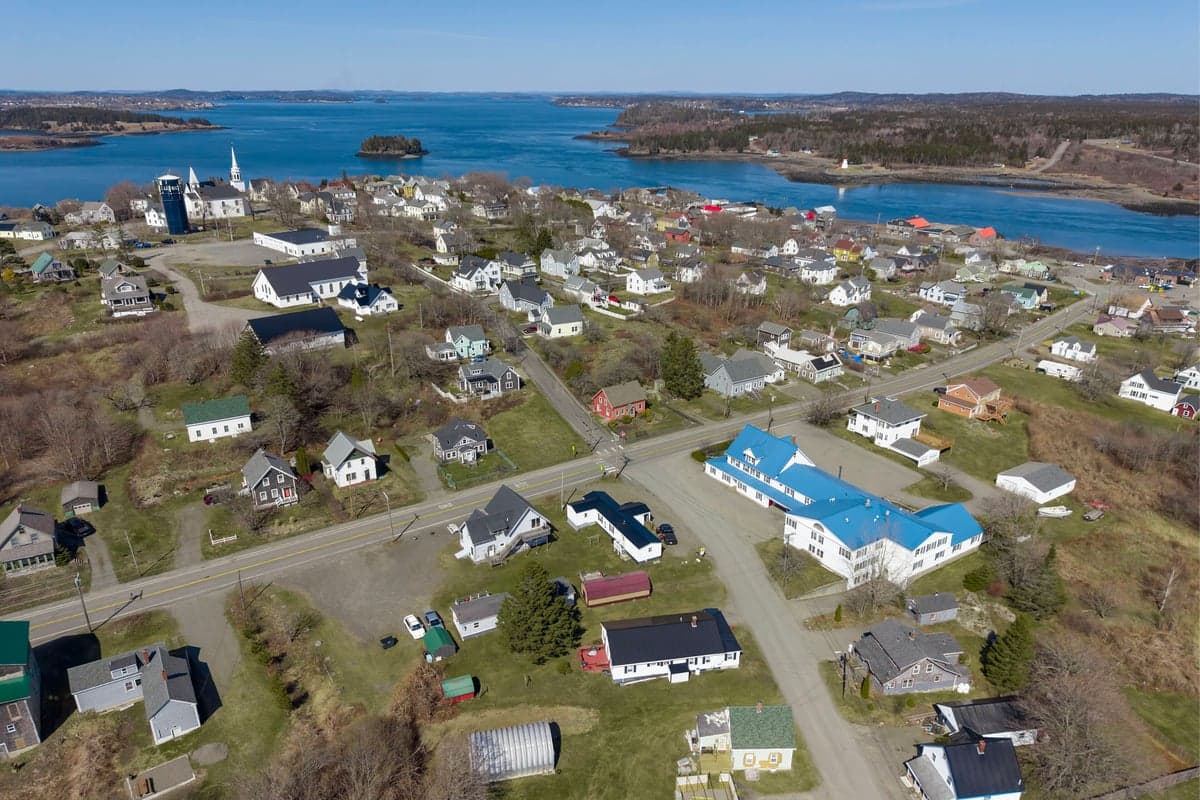
The people of Lubec, Maine, today number just 320, making it one of the smallest incorporated communities on the eastern seaboard. The population is overwhelmingly white (90.0%), with a notable Hispanic presence (10.0%) and a foreign-born share of only 0.9%. Despite its tiny size, Lubec carries a distinctive identity as a working waterfront town with a high proportion of college-educated residents (60.5%), a legacy of its history as a border fishing village and its recent draw for remote workers and retirees seeking solitude.
How the city was settled and grew
Lubec’s human history begins with the Passamaquoddy people, who used the area’s coves and islands for seasonal fishing and shellfish harvesting long before European contact. The first permanent European settlers arrived in the late 1700s, primarily English-descended families from Massachusetts and New Hampshire, drawn by abundant cod, herring, and timber. By the early 1800s, Lubec had become a thriving fishing and shipbuilding center. The original settlement clustered around Water Street and the Lubec Harbor district, where wharves, smokehouses, and sail lofts lined the shore. A second wave of immigrants—mostly Irish and Scottish-Canadian laborers—arrived in the mid-1800s to work in the sardine canneries that dotted the waterfront. These families settled in the South Lubec area, near the canneries and the ferry landing to Campobello Island. A smaller group of French-Canadian families from Quebec moved in around 1900, taking up residence in the North Lubec neighborhood, where they worked in the lumber mills and seasonal fisheries. By 1900, Lubec’s population peaked at roughly 2,500, making it a bustling port town.
Modern era (post-1965)
After the collapse of the sardine industry in the 1950s and 1960s, Lubec’s population plummeted. The 1965 Hart-Cellar Act had almost no effect here—the town saw virtually no immigration from Asia, Africa, or Latin America during this period. Instead, the post-1965 story is one of domestic out-migration and a slow, selective in-migration of retirees and second-home buyers. The Pleasant Point area, a former fishing hamlet along the coast, saw a handful of seasonal homes built by out-of-state families. The Lubec Village core (Water Street and Main Street) lost most of its commercial activity, with many buildings converted to summer rentals or left vacant. The Hispanic population (now 10.0%) is a very recent development, almost entirely concentrated in the South Lubec and Pleasant Point areas, where a small number of Mexican-origin families have moved in since 2010 to work in the remaining lobster-processing plants and aquaculture operations. The Black and Asian populations remain at 0.0%, reflecting the town’s extreme geographic isolation and lack of economic draw for those groups.
The future
Lubec’s population is projected to continue its slow decline, with the median age rising as younger residents leave for Bangor or Portland. The town’s high college-education rate (60.5%) is a statistical quirk of a small base—many of those degree-holders are retirees or remote workers who moved in during the pandemic. The Hispanic share may grow modestly as the seafood processing industry continues to recruit labor, but the overall population is unlikely to become significantly more diverse. New residents are dispersing across the existing neighborhoods rather than forming new enclaves, with Lubec Village seeing a slight uptick in year-round occupancy as broadband access improves. The cultural identity remains deeply rooted in the working waterfront and the town’s historic isolation, with little pressure for suburban-style development.
For someone moving in now, Lubec offers a quiet, insular community with a strong sense of place but very limited services and economic opportunity. The population is aging, white, and stable—a place where newcomers are welcomed slowly and expected to respect the town’s fishing heritage. It is not a place of rapid demographic change, but rather a pocket of coastal Maine where the past still shapes daily life.

* Values derived from national, state, county, city and local statistics and may differ in a specific area. Last updated: 2026-09-20T21:56:04.000Z
Narrative content on this page is AI-generated and may contain mistakes. Verify any details that matter before acting on them.
ReloMaps may earn a commission from affiliate links at no extra cost to you.

