
Photo by Ron Dauphin on Unsplash
Quality of Life in St Landry County
A livable area that tracks near national norms for affordability, walkability, and neighborhood health.
What does Quality of Life tell us?
Quality of Life measures an area by evaluating factors like cost of living, nearby amenities, country club access, airport proximity, socioeconomic signals and neighborhood character. For large states, this is a general average — quality of life can vary dramatically between metro areas, suburbs, and rural communities within the same state.
What does this tell us?
Quality of Life measures an area by evaluating factors like cost of living, nearby amenities, country club access, airport proximity, socioeconomic signals and neighborhood character. For large states, this is a general average — quality of life can vary dramatically between metro areas, suburbs, and rural communities within the same state.
Cost of Living
41% below national average
112%
The Real Cost of Living in St Landry County for 2026
| Tier | Individual | Family (4) |
|---|---|---|
| Survival | $12k | $22k |
| Comfortable | $28k | $41k |
| Luxury | $82k+ | $128k+ |
| Elite (Top 5%) | $104k+ | $161k+ |
Quality-of-Life Analysis
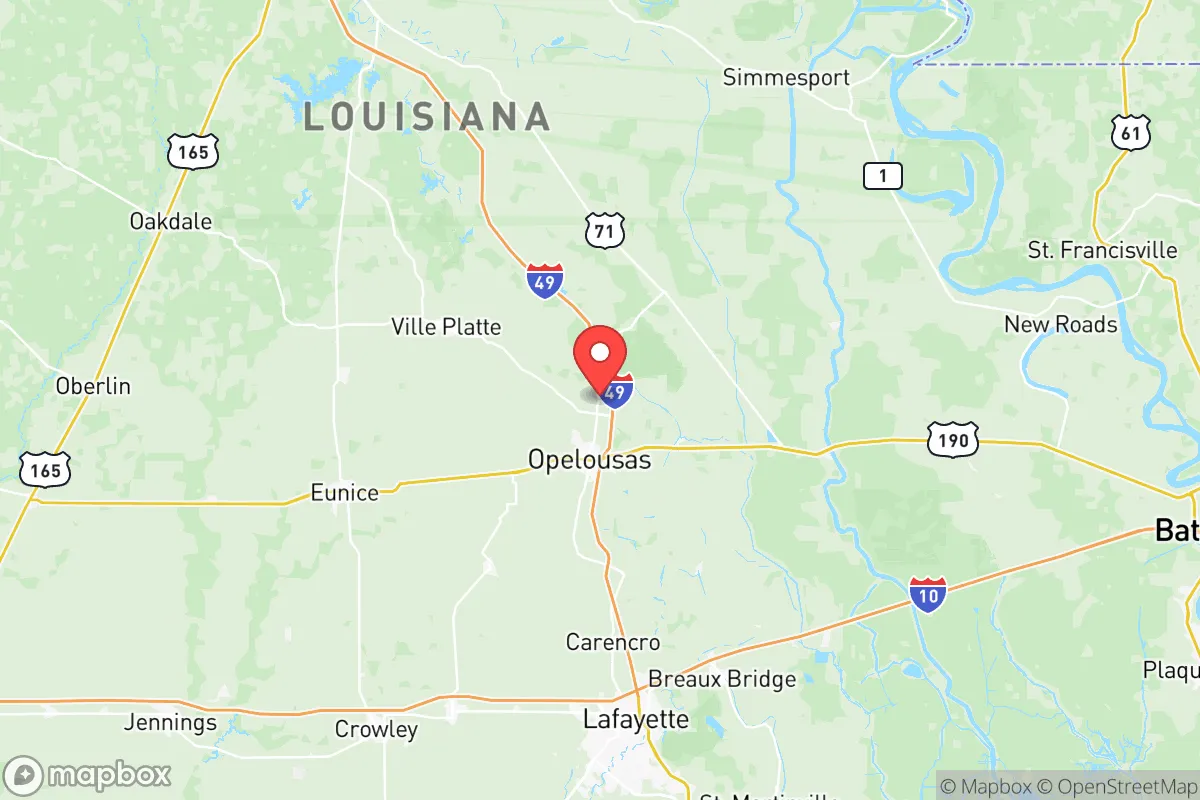
St. Landry Parish, Louisiana — officially a parish rather than a county — offers a broad quality-of-life spectrum that ranges from the historic, walkable center of Opelousas through quieter small towns like Eunice and Port Barre to remote, sparsely populated hamlets such as Lebeau and Morrow. The parish’s character shifts noticeably across its 938 square miles: the eastern side near I-49 attracts commuters to Lafayette (about 30 minutes away), while the western and northern reaches remain deeply agricultural, with sugar cane fields and rice farms defining both the landscape and the pace of daily life. Residents drawn to St. Landry typically value low housing costs — the median home value sits at $142,900 and the cost-of-living index is 59 (41% below the U.S. national average) — and are comfortable trading some urban amenities for space and affordability.
Largest town(s) & population centers
Opelousas, the parish seat and largest town (population roughly 16,000), is the commercial and cultural heart of St. Landry. Daily life centers on the historic downtown square, with its courthouse, independent restaurants, and antique shops, plus big-box retail along U.S. 190. Residents appreciate the walkable core but note that job opportunities are limited outside education (St. Landry Parish School Board and University of Louisiana at Lafayette’s satellite campus provide many positions), healthcare (Opelousas General Health System), and local government. Eunice (population about 10,000), 15 miles west of Opelousas, has a distinctly different feel: it is a tight-knit Cajun and Creole community known for the Liberty Theatre and the Prairie Acadian Cultural Center. The median rent in St. Landry is just $742, which makes even the larger towns extremely affordable for renters, and the average commute of roughly 30 minutes is manageable, especially for those driving south to Lafayette or north to Alexandria.
Smaller towns & rural pockets
Beyond the two population centers, St. Landry is dotted with unincorporated communities and small towns that define its rural character. Port Barre (population around 1,700) sits on Bayou Courtableau and offers a working waterfront and a slower pace, with most residents commuting to Opelousas or Lafayette for work. Washington (population roughly 1,000) is a historic river town on the Atchafalaya River known for its antebellum homes and annual Louisiana Governor’s Antiques Show & Sale; its economy relies heavily on tourism and agriculture. Further west, Melville (under 1,000 residents) and Krotz Springs (about 1,200) are service-oriented communities along the Atchafalaya Basin that draw hunters, fishers, and swamp-tour visitors. In the northern part of the parish, unincorporated areas like Swords, Lebeau, and Morrow are true rural pockets with limited services — no grocery stores, no gas stations — where residents must drive 20–30 minutes to Opelousas for basic necessities. These areas are predominantly agricultural, with cattle pastures and soybean fields interspersed with single-family homes on 5- to 10-acre lots.
Cost & lifestyle range
The financial spread across St. Landry is wide, but even at the high end costs remain below the national average. Opelousas proper represents the middle of the range: a three-bedroom home downtown might cost around $150,000–$180,000, while newer subdivisions on the south and west edges of town push into the $200,000–$250,000 range. Eunice is slightly cheaper, with median home values near $130,000 and rents often below $700. At the low-cost extreme, rural areas like Lebeau and Morrow have median home values that can dip below $100,000, though buyers should expect older, smaller homes (often 1,000–1,200 square feet) on large lots with well and septic systems. The high end of the market is concentrated on the southern edge of the parish near the Lafayette border, particularly around the communities of Cankton and Sunset, where newer construction and acreages command prices of $300,000–$400,000 — still well below comparable properties in Lafayette Parish. For renters, the difference is less dramatic: apartments in Opelousas average $750–$900, while rural rental houses (often older and less updated) can be found for $600–$700. The trade-off in cheaper rural areas is longer drives for work, groceries, and healthcare; residents of Lebeau, for example, face a 35-minute commute to Opelousas and an hour-plus to Lafayette.
The resident who thrives in St. Landry Parish is typically someone who values low costs, wide-open spaces, and a slower rhythm of life over the convenience of urban density. Retirees on fixed incomes gravitate toward Opelousas and Eunice for walkability and social services, while families with children find the affordable housing allows for homeownership and space — but should plan for longer commutes if working outside the parish. Young professionals and remote workers are increasingly drawn to the southern edge near Lafayette for lower home prices while maintaining access to city jobs. The parish’s enduring appeal lies in its past: for those who appreciate Louisiana’s Cajun and Creole heritage, St. Landry offers authentic culture, annual festivals, and a cost of living that makes traditional life financially sustainable.

Crime in St Landry County
Crime rates similar to the national median for U.S. locations.
Violent CrimeViolent Crime Analysis
Property CrimeProperty Crime Analysis
Crime Analysis
St. Landry Parish in south-central Louisiana reports a violent crime rate of 361.5 incidents per 100,000 residents and a property crime rate of 1,446.4 per 100,000, figures that place the parish near the middle of the state’s crime rankings but notably above the national average for property offenses. Safety conditions vary widely across the parish, with the more urbanized areas around Opelousas and Eunice experiencing higher incident concentrations, while smaller communities like Grand Coteau and Washington tend to see fewer reported crimes. The parish’s judicial and law enforcement landscape, shaped by elected district attorneys and local judges, plays a direct role in how offenses are prosecuted and how public safety is maintained.
Crime in context
St. Landry’s violent crime rate of 361.5 per 100,000 is roughly 8% above the national average of 335 per 100,000, but it remains below the Louisiana state average of approximately 542 per 100,000 — meaning the parish is safer than many of its peers across Louisiana. The property crime rate of 1,446.4 per 100,000, however, is about 20% higher than the national average, driven largely by theft and vehicle break-ins concentrated in Opelousas, the parish seat and largest city. By comparison, neighboring Lafayette Parish reports a similar property crime rate but a higher violent crime figure, while rural Avoyelles Parish to the north has lower rates across both categories. The 27th Judicial District Court, which covers St. Landry, prosecutes cases out of Opelousas, and the political makeup of the district attorney’s office — historically conservative — contrasts with more progressive prosecutor offices in larger metropolitan areas like New Orleans or Baton Rouge, where some observers argue that softer sentencing policies contribute to higher recidivism.
What residents experience
Residents in St. Landry Parish most frequently encounter property crimes such as burglary, theft from vehicles, and occasional arson, with police reports in Opelousas and Eunice accounting for the majority of these incidents. In the unincorporated areas and smaller towns like Port Barre and Palmetto, violent crime is rarer, though domestic disputes and drug-related offenses still surface. The parish’s location along Interstate 49, which connects Lafayette to Alexandria, creates a corridor for transient crime — including vehicle thefts and drug trafficking — that disproportionately affects Opelousas’s commercial districts and highway-adjacent neighborhoods. Local law enforcement agencies, including the St. Landry Parish Sheriff’s Office and the Opelousas Police Department, have implemented community policing initiatives and crime suppression task forces, but resource constraints limit proactive patrols in rural stretches. Many residents install security cameras and join neighborhood watch groups, particularly in suburban subdivisions near the Port Barre and Leonville areas, as a practical response to the elevated property crime risk.
Neighborhood-level variation
Crime is not evenly distributed across St. Landry Parish. Opelousas, with a population just over 15,000, sees the highest volume of reported incidents, especially along Creswell Lane, near the I-49 exits, and in the older northside neighborhoods near the St. Landry Parish Courthouse. Eunice, the second-largest town, has a similar but less intense pattern, with thefts concentrated near the downtown square and along Highway 190. In contrast, the quieter communities of Grand Coteau — home to the historic Academy of the Sacred Heart — and Washington, a small town centered around the St. Landry Parish School Board, report significantly lower crime numbers, often with entire months passing without a violent offense. Property crime in these smaller towns is typically limited to isolated mailbox thefts or unlocked vehicle entries. For prospective residents, moving to a rural subdivision outside Opelousas proper — such as the areas near Sunset or Arnaudville — generally offers a noticeable drop in crime risk, though the trade-off is longer travel distances for shopping and services. Renters and homebuyers should check block-level data for specific streets, as even within Opelousas, some older, well-maintained neighborhoods near Le Vieux Village remain relatively safe while others just a few blocks away report frequent disturbances.
* Values derived from national, state, county, city and local statistics and may differ in a specific area. Last updated: 2026-06-24T18:05:00.000Z
Narrative content on this page is AI-generated and may contain mistakes. Verify any details that matter before acting on them.
ReloMaps may earn a commission from affiliate links at no extra cost to you.

