Photo: Wikipedia
Political ClimatePolitical Climate in Kittery, ME
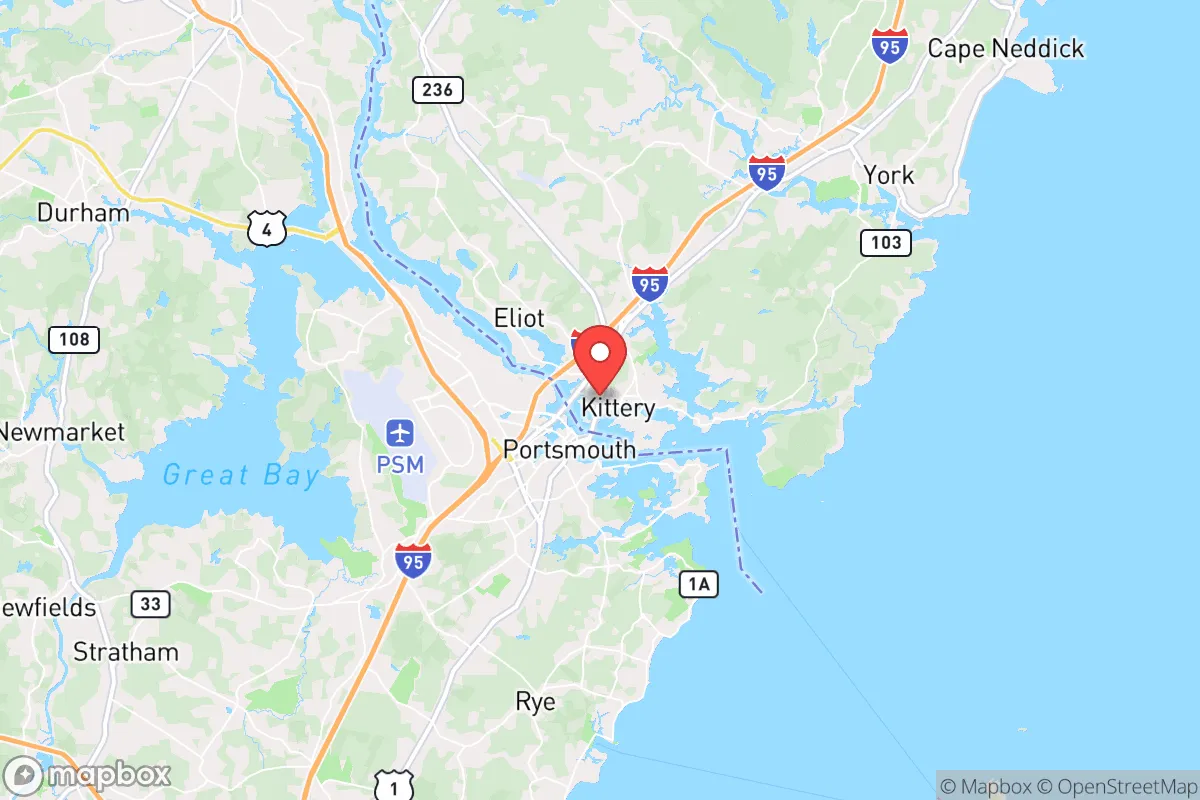
District shown is the primary district for this city’s centroid. Cities may span multiple districts.
Local Political AnalysisPolitical Analysis of Kittery, ME
Kittery has long been the most reliably Democratic town in southern York County, and that hasn't changed. With a Cook Partisan Voting Index of D+11, it votes about eleven points more Democratic than the nation as a whole. In presidential elections, Kittery routinely delivers 60-65% of its vote to Democratic candidates, a pattern that has held steady since at least 2008. The town's trajectory is slightly bluer than it was twenty years ago, but the shift has been gradual—more a slow drift leftward than a sudden lurch. Neighboring Eliot and South Berwick are more competitive, often splitting tickets, while York to the east leans Republican in local races but can swing in presidential years. Head north to Berwick or Sanford, and you'll find much more conservative territory, especially in the rural stretches.
How it compares
Maine as a whole is a classic swing state at the presidential level, with a Cook PVI of D+2—meaning it's only two points more Democratic than the national average. Kittery's D+11 puts it in a different league entirely, more in line with Portland or South Portland than with the rest of York County. The contrast is stark: while Maine's Second Congressional District (north of Augusta) is reliably Republican in presidential years, Kittery sits in the First District, which is solidly Democratic. In state legislative races, Kittery's House district (District 1) has been held by Democrats for over a decade, and the town's Senate district (District 35) is represented by a Democrat as well. The town's political DNA is shaped by its proximity to Portsmouth Naval Shipyard, a major federal employer, and by its status as a bedroom community for Portsmouth, New Hampshire—a city that votes even more Democratic than Kittery does.
What this means for residents
For liberal residents, Kittery feels like a safe bet. Local elections rarely feature competitive Republican candidates, and the town council and school board are dominated by Democrats or left-leaning independents. Policy priorities—like funding for public schools, affordable housing initiatives, and environmental protections—tend to pass without much drama. For conservative residents, the reality is more nuanced. You won't be silenced or ostracized, but you'll be in the minority. Republican candidates for local office often run unopposed or lose by 10-15 points. In presidential years, you might feel like your vote doesn't count locally, though Maine's statewide races (like the 2020 Senate race) can be competitive enough to keep you engaged. The town's political culture is polite but firm; debates over development, taxes, and town spending are civil but rarely result in conservative wins.
Culturally, Kittery's politics show up in its policies. The town has a strong recycling program, a local food scene that leans organic and farm-to-table, and a downtown that prioritizes walkability over car-centric development. There's no sales tax in Maine, but Kittery's property taxes are higher than the state average, funding schools and services that residents generally support. The town's proximity to the shipyard means a steady influx of federal workers and military retirees, many of whom lean moderate to liberal. If you're looking for a place where politics are front and center, Kittery isn't that—it's a quiet, coastal town where the biggest political fights are about zoning and school budgets, not culture wars. That's likely to remain the case for the foreseeable future, as the town's demographic profile (older, educated, and increasingly wealthy) reinforces its blue lean.

State Political ClimatePolitical Climate in Maine
State Political AnalysisPolitical Environment in the State
Maine has long been one of the most politically independent states in the nation, but over the past 20 years it has shifted from a classic swing state to a reliably blue-leaning one at the presidential level, while maintaining a fiercely independent streak in its state legislature and local offices. The state voted for Barack Obama twice, Hillary Clinton in 2016, and Joe Biden in 2020, with Biden winning by about 9 points. However, Maine’s unique system of allocating electoral votes by congressional district means its 2nd Congressional District—covering the vast, rural northern and eastern parts of the state—has gone for Donald Trump twice, making it one of the few places in the Northeast where a Republican presidential candidate can reliably pick up an electoral vote. The state’s overall trajectory is a slow but steady Democratic drift driven by the growth of Portland and its suburbs, even as the rural interior remains deeply conservative and skeptical of the coastal establishment.
Urban vs. rural divide
The political map of Maine is essentially a story of two Maines. The southern coastal corridor—anchored by Portland, the state’s largest city, and extending through South Portland, Brunswick, and Biddeford—is the engine of Democratic votes. These areas are growing, attracting out-of-state transplants, younger professionals, and remote workers, and they vote consistently blue. Portland itself is one of the most liberal cities in New England, with a strong progressive activist scene. In contrast, the vast 2nd Congressional District, which includes cities like Bangor, Lewiston, Augusta, and Presque Isle, is a mix of old mill towns, working-class communities, and vast stretches of forest and farmland. This region has trended sharply Republican over the past decade, driven by cultural conservatism, frustration with coastal elites, and economic anxiety over the decline of manufacturing and logging. The divide is stark: in 2020, Trump won the 2nd District by 7 points, while Biden won the 1st District by 23 points. Even within the 2nd District, there are pockets of blue—Lewiston and Auburn have significant Somali immigrant populations that vote heavily Democratic—but the overall trend is redder with each cycle.
Policy environment
Maine’s state-level policy environment is a mixed bag that reflects its independent character. The state has a progressive income tax structure with rates ranging from 5.8% to 7.15%, and a sales tax of 5.5% that is relatively low by national standards. Property taxes are high, particularly in rural areas where the tax base is thin. The state has a strong regulatory posture on environmental issues, including strict land-use laws and a push toward renewable energy, which can frustrate property owners and developers. On education, Maine has a well-funded public school system, but rural districts struggle with declining enrollment and consolidation pressures. Healthcare is a major issue: Maine expanded Medicaid under the Affordable Care Act via a 2017 ballot initiative, and the state has some of the highest health insurance costs in the country. Election laws are relatively accessible—Maine was the first state to adopt ranked-choice voting for federal elections, and it offers same-day voter registration and no-excuse absentee voting. For a conservative relocator, the tax burden and regulatory climate are likely the biggest friction points, while the election system and healthcare access may be neutral or positive depending on personal priorities.
Recent policy direction
Over the past five years, Maine’s Democratic-controlled legislature and governor’s office have pushed a distinctly progressive agenda, though often tempered by the state’s independent streak. On gun policy, Maine has historically been permissive—no permit required for concealed carry, no assault weapons ban—but in 2023, following the Lewiston mass shooting, the legislature passed a 72-hour waiting period for gun purchases and expanded background checks for private sales, a significant shift that drew sharp opposition from rural gun owners. On education and parental rights, Maine has been a battleground: the state requires schools to allow transgender students to use facilities matching their gender identity, and it has a strong anti-discrimination law that covers sexual orientation and gender identity. In 2021, the legislature passed a law prohibiting schools from requiring parental notification when a student changes their name or pronouns, which has been a flashpoint for conservative families. On medical and bodily autonomy, Maine has codified abortion rights into state law and expanded access to abortion providers, and it was one of the first states to allow physician-assisted suicide. Property rights are a perennial issue, with ongoing fights over shoreland zoning, wind energy development, and the North Woods—the state’s vast unorganized territory where development is heavily restricted. On voting, ranked-choice voting remains controversial among conservatives who see it as a Democratic power grab, but it has survived multiple repeal attempts. The overall direction is clearly leftward on social and cultural issues, even as the state maintains a relatively libertarian bent on some economic and personal freedoms.
Civil unrest & political movements
Maine is not known for large-scale civil unrest, but it has seen its share of organized political movements and flashpoints. The most visible in recent years has been the debate over immigration and sanctuary policies. Portland has declared itself a sanctuary city, and the state has a law limiting local law enforcement’s cooperation with federal immigration authorities. This has created tension with rural communities, particularly in Lewiston, where the arrival of Somali refugees in the early 2000s reshaped the city’s demographics and politics. In 2022, a neo-Nazi group held a rally in Augusta that was met with a large counter-protest, but such events are rare and generally draw widespread condemnation. The state has a strong tradition of grassroots activism on both sides: the Maine Gun Owners Association is a vocal and well-organized force, while progressive groups like Maine People’s Alliance and the Maine Women’s Lobby are influential in Augusta. Election integrity has been a lower-tension issue here than in many states, though some conservative activists have raised concerns about ranked-choice voting and mail-in ballot procedures. The most notable recent political movement has been the push for a state-level version of the “right to repair” law, which passed overwhelmingly via ballot initiative in 2021 and has made Maine a national leader in consumer data rights.
Projection
Looking ahead 5 to 10 years, Maine’s political trajectory points toward continued Democratic dominance at the statewide level, but with a deepening rural-urban divide that could make governance increasingly contentious. The southern coast will continue to grow, driven by remote workers and retirees from Massachusetts and New York, further solidifying the Democratic base. Meanwhile, the 2nd District will likely remain Republican, but its population is shrinking, which could eventually cost it its congressional seat after the 2030 census. The wild card is the independent vote: Maine has a long history of electing independents like Angus King and Eliot Cutler, and if the two-party system continues to polarize, a centrist third-party candidate could shake things up. For a conservative moving to Maine, the practical reality is that you will likely live in a red or purple area—most of the state outside of Portland and its immediate suburbs is politically mixed—but you will be governed by a blue state government that is increasingly progressive on social and environmental issues. The property tax burden and regulatory environment are unlikely to improve, but the state’s strong sense of local control means that many conservative communities can still chart their own course on issues like school curriculum and land use.
For a new resident, the bottom line is that Maine offers a unique political environment where you can find a community that matches your values, but you will have to accept that the state government will often be at odds with those values if you lean conservative. The trade-off is a high quality of life, low crime, beautiful natural surroundings, and a culture of neighborliness that transcends politics. If you are moving here, expect to engage in local politics if you want to protect your interests—town meetings and school board elections matter more here than in many states. And if you are coming from a deep red state, be prepared for a tax and regulatory shock, but also for a level of personal freedom and community trust that is increasingly rare in America.
* Values derived from national, state, county, city and local statistics and may differ in a specific area. Last updated: 2026-10-11T02:58:03.000Z
Narrative content on this page is AI-generated and may contain mistakes. Verify any details that matter before acting on them.
ReloMaps may earn a commission from affiliate links at no extra cost to you.

