Photo: Wikipedia
Political ClimatePolitical Climate in Kent, OH
District shown is the primary district for this city’s centroid. Cities may span multiple districts.
Local Political AnalysisPolitical Analysis of Kent, OH
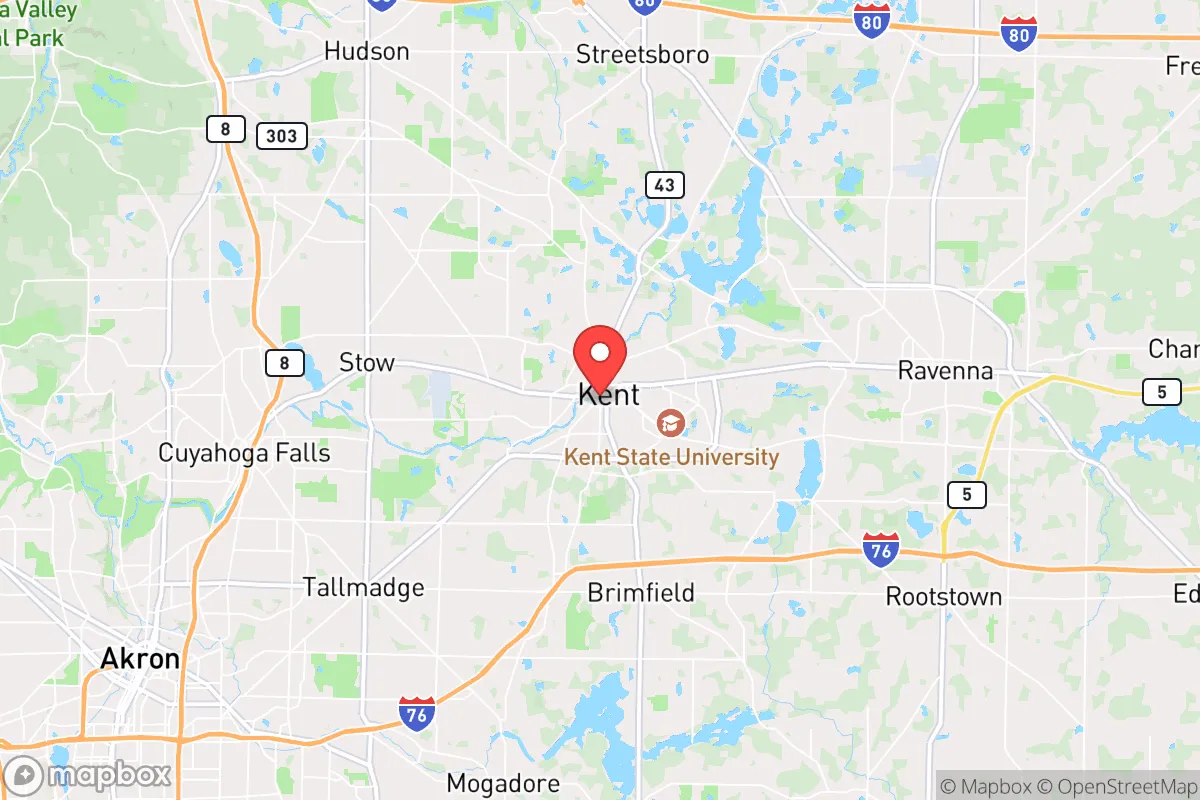
Kent, Ohio, is one of those rare places in the Buckeye State where the political needle sits dead center. With a Cook Partisan Voting Index (PVI) of EVEN, the city and its immediate surroundings are a genuine toss-up, a far cry from the state’s overall R+5 lean. This isn’t a fluke of recent elections; it’s a long-standing reality shaped by the presence of Kent State University, which pulls the electorate left, balanced against the more conservative, rural townships that ring the city. You’ll find that a precinct just off campus can vote 70% Democratic, while a few miles down the road in Ravenna or Streetsboro, you’re looking at a solid 60% Republican vote. The trajectory here is subtle: the student population is growing and becoming more reliably Democratic, but the surrounding county (Portage) is aging and trending slightly redder, keeping the overall balance remarkably stable.
How it compares
The contrast with Ohio as a whole is stark. The state’s R+5 PVI means that in a typical statewide race—say for Governor or U.S. Senate—Republicans start with a structural advantage of about five points. In Kent, that advantage evaporates. A Democrat running statewide might lose Ohio by 5 points but can win Kent by 5 to 10 points, depending on turnout. Look at the 2022 Senate race: J.D. Vance won Ohio by about 6 points, but he lost Portage County by a slim 1.5 points, and Kent’s city precincts likely went for Tim Ryan by double digits. Meanwhile, just 15 minutes east in Warren or 20 minutes south in Canton, the political landscape flips hard to the right. Kent is an island of purple in a sea of red and light-red, functioning more like a mini-version of Cuyahoga County (Cleveland) than its own immediate neighbors. The university acts as a gravitational anchor, preventing the area from drifting as far right as the rest of the state has over the past decade.
What this means for residents
For a conservative living in Kent, you’re not in hostile territory, but you’re definitely in a place where you’ll have to engage. You’ll find plenty of like-minded folks at the local coffee shops and churches, but you’ll also be sharing the school board and city council with progressive voices. The practical reality is that local elections are often decided by a few hundred votes, so your vote genuinely counts more here than in a deep-red suburb. For a liberal resident, Kent feels like a safe harbor. You can put a Bernie Sanders sign in your yard without worrying about it being vandalized, and the city council has passed symbolic resolutions on climate and social justice that would never fly in neighboring towns. However, you’ll still have to drive 10 minutes to get to a Walmart that doesn’t have a “Make America Great Again” flag flying out front. The biggest practical difference is in policy: Kent has a relatively robust rental inspection code and a strong public transit system (PARTA) that connects to the university, while surrounding townships are more laissez-faire on regulation and rely almost entirely on cars.
Culturally, the biggest distinction is the university’s influence. Kent has a vibrant, if small, arts scene, a nationally recognized folk music festival, and a downtown that’s walkable and bike-friendly—rare for Northeast Ohio. The city also has a more visible LGBTQ+ community and a higher density of independent bookstores and vegan-friendly restaurants than you’d find in, say, Stow or Cuyahoga Falls. The shadow of the May 4, 1970 shootings still hangs over the town, creating a permanent undercurrent of anti-authoritarian, progressive sentiment that you just don’t feel in the rest of Portage County. For a conservative, this can feel like a lot of “woke” posturing, but most long-time residents will tell you it’s just part of the town’s DNA. Looking ahead, as long as Kent State remains a major employer and draws young people from across the state, Kent will likely stay a purple dot on the map—a place where the national political war plays out in miniature, but with a local flavor that’s all its own.

State Political ClimatePolitical Climate in Ohio
State Political AnalysisPolitical Environment in the State
Ohio has shifted from a quintessential battleground state to a solidly Republican-leaning one, with a Cook PVI of R+5 that reflects a decade-long rightward march. The state voted for Donald Trump by 8 points in both 2016 and 2020, and by a wider 11-point margin in 2024, cementing a trajectory that began with the collapse of the old industrial coalition. The dominant coalition today is a mix of rural and exurban conservatives, working-class voters who have abandoned the Democratic Party over cultural and trade issues, and a growing population of conservative-leaning retirees and remote workers moving into smaller cities. Democrats still hold the major cities and some inner-ring suburbs, but their statewide bench has thinned dramatically—no Democrat has won a U.S. Senate race since 2012, and the party has lost every statewide executive office since 2018.
Urban vs. rural divide
The political map of Ohio is a stark checkerboard. The three major metros—Cleveland, Columbus, and Cincinnati—vote reliably Democratic, but their influence is diluted by the vast, deeply red rural and exurban expanse that surrounds them. Cuyahoga County (Cleveland) gave Biden 66% in 2020, while Franklin County (Columbus) gave him 62%, and Hamilton County (Cincinnati) gave him 57%. But outside these islands, the landscape is overwhelmingly Republican. Counties like Mercer (R+53), Holmes (R+52), and Putnam (R+49) in the northwest are among the most conservative in the entire Midwest. The real story, though, is the suburbs that have flipped. Delaware County, north of Columbus, was a swing county in the 1990s but now votes R+20; Warren County, north of Cincinnati, is R+30 and growing fast. Meanwhile, the old Democratic strongholds in the Mahoning Valley (Youngstown) and the Appalachian southeast have flipped hard—Jefferson County went from D+10 in 2008 to R+18 in 2020. The urban-rural divide is so sharp that a drive from downtown Columbus to the farm country of Madison County feels like crossing a political border.
Policy environment
Ohio’s policy environment is broadly conservative but with notable populist and moderate streaks. The state income tax was cut from a top rate of 4.75% to 3.5% in 2023, and the sales tax is 5.75% (local add-ons push it to 7-8% in most cities). Property taxes are moderate but vary wildly—average effective rates range from 1.2% in rural counties to 2.1% in Cuyahoga County. The state is a right-to-work state in practice (no union security agreements are enforced, though the law was repealed by referendum in 2011). Education policy is a battleground: Ohio has one of the largest school voucher programs in the country (the EdChoice program), and charter schools are widespread, especially in Cleveland and Columbus. Healthcare is mixed—Medicaid expansion was accepted under the Affordable Care Act, but the state has not expanded eligibility further. Election laws have tightened: voter ID is now required (with a limited list of acceptable IDs), early voting is 28 days, and drop boxes are limited to one per county. The state has a Republican trifecta (governor, House, Senate) that has held since 2019, and the state supreme court flipped to a 4-3 Republican majority in 2022.
Recent policy direction
The last five years have seen a clear conservative shift across multiple fronts. On guns, Ohio became a permitless carry state in 2022 (HB 227), and a "stand your ground" law was passed in 2021 (SB 175). On education and parental rights, the state passed the "Parents' Bill of Rights" (HB 8) in 2023, requiring schools to notify parents of curriculum changes and medical services. On abortion, a 2023 constitutional amendment (Issue 1) enshrined the right to abortion up to fetal viability, overriding a 2019 "heartbeat" ban—a major defeat for the legislature. On voting, the state passed stricter voter ID laws (SB 1 in 2023) and limited ballot drop boxes. On property rights, the state has not passed a broad "takings" reform, but local zoning battles over solar and wind farms have become flashpoints. On privacy and surveillance, Ohio has no comprehensive data privacy law, but a 2024 bill (HB 123) would restrict government use of facial recognition. On taxes, the income tax cuts have been paired with a phase-out of the commercial activity tax (CAT) for small businesses. The overall direction is toward lower taxes, looser gun laws, and tighter election rules, with the abortion amendment representing a rare progressive check.
Civil unrest & political movements
Ohio has seen its share of political flashpoints. The 2020 George Floyd protests in Columbus and Cleveland were large but mostly peaceful, though looting and arson occurred in downtown Columbus. The 2023 East Palestine train derailment sparked a populist backlash against both railroads and federal regulators, with local officials (including Republican Governor Mike DeWine) criticizing the EPA’s response. Immigration politics are less visible than in border states, but the issue flared in 2024 when a surge of Haitian migrants in Springfield (Clark County) led to local tensions and a state-level push for stricter enforcement. There is no sanctuary city policy in Ohio; in fact, a 2024 law (HB 123) requires local law enforcement to cooperate with ICE. Election integrity controversies have been muted compared to 2020, but the 2022 and 2024 elections saw no major disputes. On the left, the Ohio Organizing Collaborative and the ACLU remain active on voting rights and criminal justice reform. On the right, the Buckeye Firearms Association and Ohio Right to Life are powerful lobbying forces. The most visible political movement in recent years has been the pro-union backlash to the 2011 anti-collective bargaining law (SB 5), which was repealed by a 62% vote—a reminder that the state’s populist streak can cut both ways.
Projection
Over the next 5-10 years, Ohio is likely to become more Republican at the state level, but the margin of that shift will depend on suburban migration patterns. The Columbus metro is growing fastest (adding about 30,000 people per year), and its suburbs are trending leftward—Dublin and Westerville voted for Biden in 2020 after backing Romney in 2012. This could eventually make the state more competitive in presidential races, but the rural and exurban areas are growing even faster in raw votes. The Democratic Party’s base is aging and shrinking in Cleveland and Youngstown, while the Republican base in the outer-ring suburbs and small cities (like Delaware, Pickerington, and Mason) is expanding. The state’s electoral college votes (17, down from 20 in 2000) will continue to shrink relative to the Sun Belt. The biggest wildcard is the state’s economic transition: if the semiconductor and EV battery plants (Intel in Licking County, Honda in Fayette County) bring in a younger, more diverse workforce, it could shift the political calculus. But for now, the trajectory is toward a solidly red state with a blue urban archipelago.
For a new resident, the practical takeaway is that Ohio offers a conservative policy environment with a few progressive exceptions (abortion rights, Medicaid expansion). You’ll find lower taxes and looser gun laws than in neighboring Michigan or Pennsylvania, but you’ll also find a state government that is actively restricting voting access and expanding school choice. If you’re a conservative, you’ll feel at home in most of the state outside the major cities; if you’re a liberal, you’ll find your political community in Columbus, Cleveland, or Cincinnati, but you’ll be outvoted on most statewide issues. The politics are real and visible—yard signs, bumper stickers, and local news coverage of school board meetings—but the state is not a hotbed of civil unrest. It’s a place where the political divide is geographic, not personal, and where most people get along fine with their neighbors regardless of party.
* Values derived from national, state, county, city and local statistics and may differ in a specific area. Last updated: 2026-10-14T09:25:06.000Z
Narrative content on this page is AI-generated and may contain mistakes. Verify any details that matter before acting on them.
ReloMaps may earn a commission from affiliate links at no extra cost to you.

