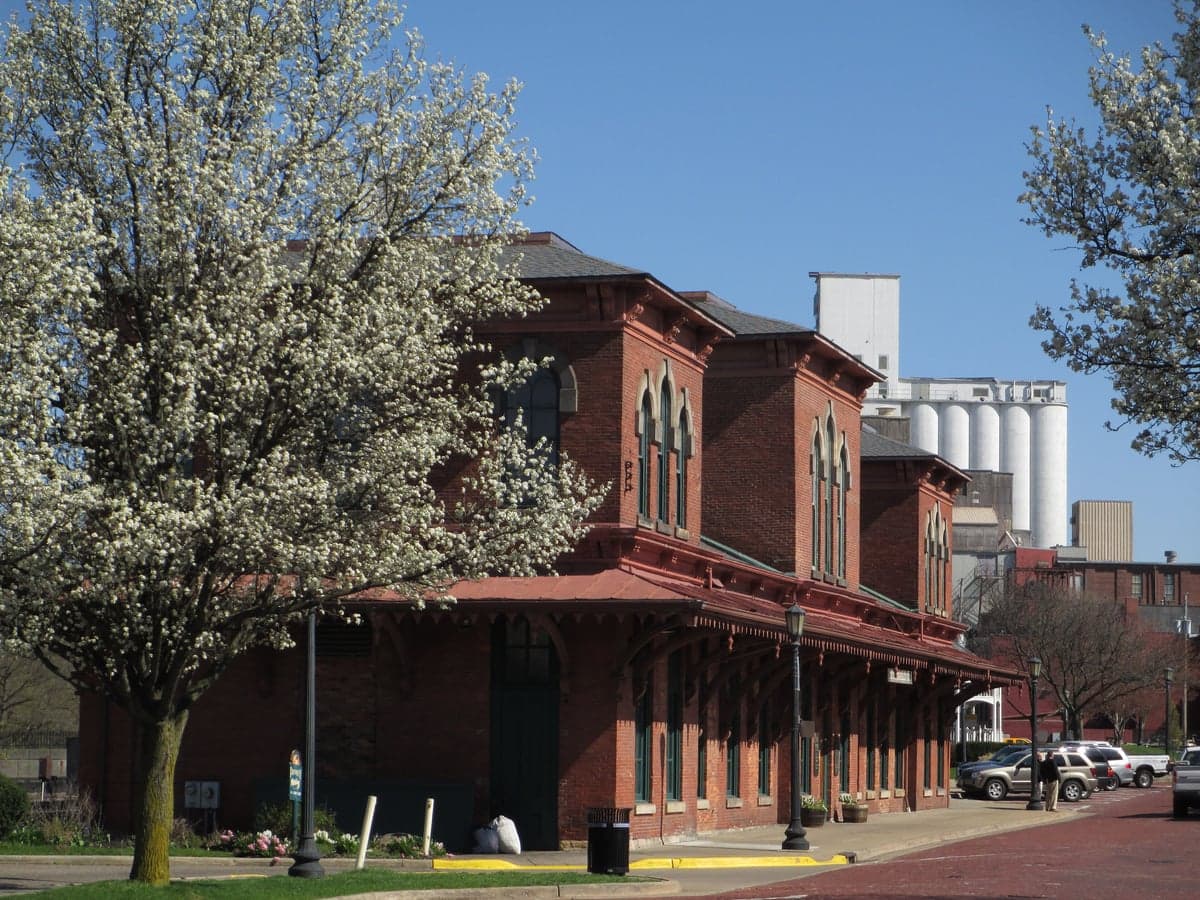
Photo: Wikipedia
Demographics of Kent, OH
Affluence Level in Kent, OH
A below-average socioeconomic profile. Incomes, home values, and educational attainment trail the U.S., with higher poverty and unemployment.
People of Kent, OH
The people of Kent, Ohio today number roughly 27,190, forming a compact, college-town population that is notably more educated and racially diverse than the surrounding Portage County countryside. With 46.6% of adults holding a bachelor’s degree or higher—driven largely by Kent State University—the city’s character blends academic professionals, long-standing working-class families, and a growing number of young renters. The population is 79.9% white, 8.3% Black, 3.0% Hispanic, 2.2% Indian (subcontinent), and 0.9% East/Southeast Asian, with 4.0% foreign-born, giving Kent a distinctly more cosmopolitan feel than nearby towns like Ravenna or Streetsboro.
How the city was settled and grew
Kent’s human history begins with the 1805 founding of the village of Carthage along the Cuyahoga River, renamed Kent in 1864 after the railroad financier Marvin Kent. The original settlers were primarily Yankee Protestants from Connecticut and Massachusetts, drawn by water power for gristmills and sawmills. The arrival of the Atlantic & Great Western Railroad in the 1860s turned Kent into a manufacturing hub, attracting Irish and German immigrants who built homes in the Franklin Township area and along South Water Street. By the early 1900s, the city’s population had swelled with Italian and Eastern European immigrants—Poles, Slovaks, and Hungarians—who worked in the Erie Railroad shops and the Kent Oil Company. These groups concentrated in the West Side neighborhoods near the railroad tracks and in the River District, where many of their descendants still live today. The founding of Kent State Normal School in 1910 (now Kent State University) brought a steady influx of faculty and students, but the city remained a blue-collar railroad town through the 1950s.
Modern era (post-1965)
The post-1965 era reshaped Kent’s population dramatically. The Hart-Cellar Immigration Act opened doors for new arrivals, but the most significant shift came from domestic migration. The 1970 Kent State shootings and subsequent economic decline of manufacturing pushed many white working-class families to outlying townships like Brimfield and Franklin Township, while the university’s expansion drew a more transient, educated population into the University District—the neighborhoods immediately north and east of campus. Black residents, who had been a small presence since the Great Migration, grew to 8.3% of the population, with many settling in the South End near the Cuyahoga River and in the Haymaker-Fairview area. The Indian-subcontinent population (2.2%) arrived primarily from the 1990s onward, tied to Kent State’s graduate programs in engineering and business; they tend to cluster in the University Heights apartments and the newer subdivisions off State Route 59. East/Southeast Asian residents (0.9%) are mostly faculty and graduate students, scattered across the city rather than forming a single ethnic enclave. Hispanic residents (3.0%) have grown steadily since 2000, working in service industries and settling in the West Side and along Lake Street.
The future
Kent’s population is slowly becoming more diverse, though the pace is modest. The white share has declined from roughly 85% in 2000 to 79.9% today, while the Hispanic and Indian-subcontinent shares are the fastest-growing segments. New residential construction is concentrated in the Kent Station area (a mixed-use development near the downtown train station) and in the North Water Street corridor, which is attracting young professionals and empty-nesters. The university’s continued enrollment growth—particularly in international graduate programs—will likely sustain the Indian and East/Southeast Asian populations, while the Black population is expected to remain stable. The biggest demographic question is whether the city can retain families: the under-18 population has shrunk slightly, and many graduates leave after college. If Kent can add more family-friendly housing in the River District and University Heights, it may slow that outflow. Over the next 10–20 years, expect Kent to become slightly more Hispanic and Indian, slightly less white, and to remain a highly educated, politically moderate-to-liberal island in a conservative county.
For someone moving in now, Kent offers a small-city experience with a genuine intellectual and cultural edge—more diverse and educated than most Ohio towns of its size, but still affordable and walkable. The population is stable but aging, and the city’s future depends on whether it can convert its transient student population into permanent residents. If you value a place where your neighbors are as likely to be a professor as a railroad retiree, and where the downtown is lively but not overrun, Kent is a solid bet.

* Values derived from national, state, county, city and local statistics and may differ in a specific area. Last updated: 2026-10-14T09:25:06.000Z
Narrative content on this page is AI-generated and may contain mistakes. Verify any details that matter before acting on them.
ReloMaps may earn a commission from affiliate links at no extra cost to you.

