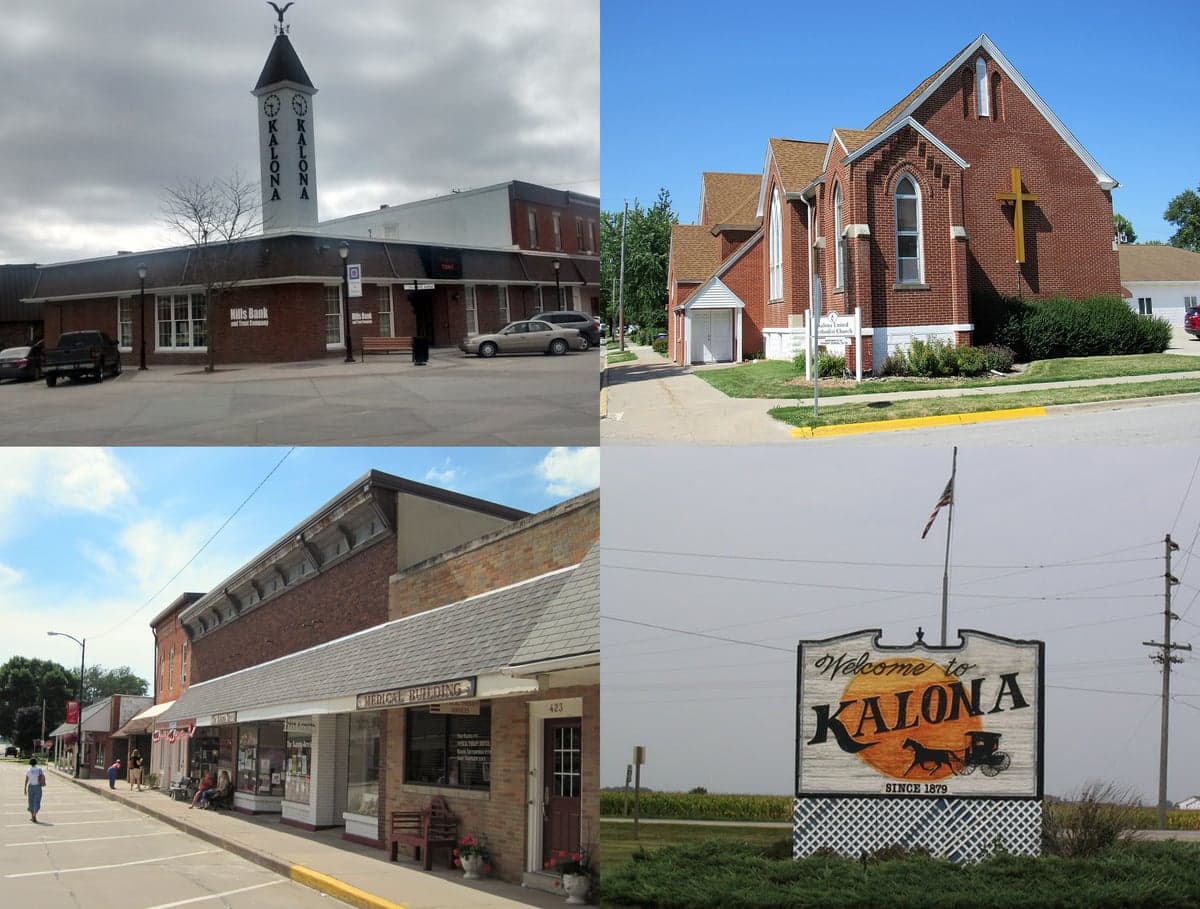
Photo: Wikipedia
Political ClimatePolitical Climate in Kalona, IA
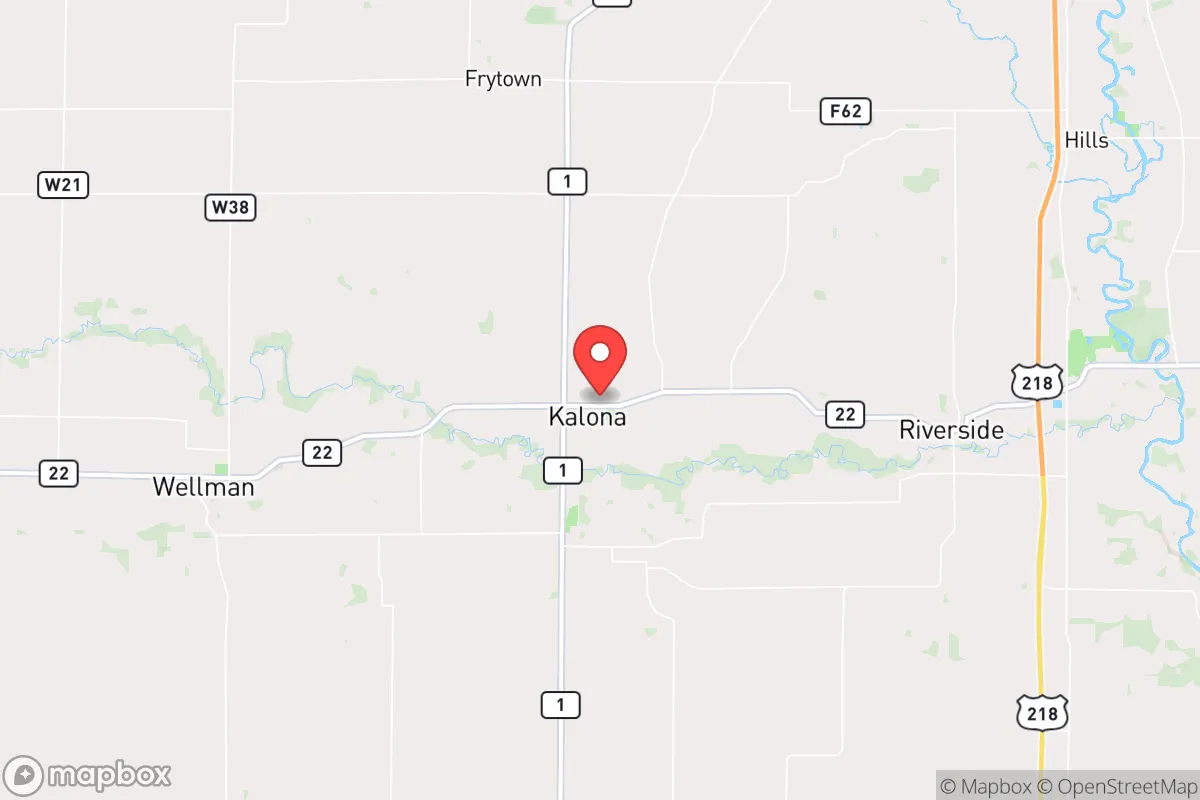
District shown is the primary district for this city’s centroid. Cities may span multiple districts.
Local Political AnalysisPolitical Analysis of Kalona, IA
Kalona is a solidly Republican town, but its politics feel a bit more tempered than the surrounding countryside. The area’s Cook PVI of R+4 is a notch less conservative than Iowa’s statewide R+6, and that small gap reflects a real local dynamic: Kalona’s strong Mennonite and Amish communities tend to vote Republican but prioritize fiscal conservatism and community stability over the culture-war edge you’ll hear in more rural parts of Washington County. Over the past decade, the town has held steady—no dramatic leftward shift, but also no lurch further right. If anything, the influx of a few younger families priced out of Iowa City has nudged the local GOP primary electorate slightly more pragmatic, though the general election results still reliably go red by 10-15 points.
How it compares
Drive 20 minutes north to Iowa City and you’re in a Democratic stronghold (Johnson County voted +30 D in 2024), a world away in both culture and voting patterns. Kalona sits right on the edge of that blue bubble, and the contrast is stark. In Iowa City, you’ll see yard signs for progressive candidates and heated debates over zoning and bike lanes. In Kalona, the local conversation is more about school funding, property taxes, and keeping the downtown businesses alive. The surrounding Washington County as a whole leans R+8 or so, meaning Kalona itself is actually a bit of a moderating influence—its small-town social conservatism is real, but it lacks the combative edge you’ll find in, say, rural Keokuk County to the south. Compared to the statewide R+6, Kalona’s R+4 puts it in the same ballpark as places like Pella or North Liberty, where conservative values coexist with a quiet openness to newcomers.
What this means for residents
For conservative residents, Kalona is a comfortable place to live. You’ll find your views reflected in local government, school board decisions, and most casual conversations. The Republican lean means lower taxes relative to Johnson County, and the local GOP is more focused on infrastructure and fiscal restraint than on hot-button social issues. For liberal residents, it’s a different story. You won’t face hostility—Kalona is too polite for that—but you’ll often be the only person in the room with a different take. There’s no active Democratic Party presence in town, and local elections are decided in the Republican primary. That said, the proximity to Iowa City means you can easily access progressive events, diverse restaurants, and a more liberal social scene within a 20-minute drive. The practical reality is that Kalona works best for people who are comfortable being in the minority politically, or who prioritize small-town life over political alignment.
One cultural distinction worth noting: Kalona’s large Plain community (Old Order Amish and Mennonites) doesn’t vote in large numbers, but their values of thrift, self-reliance, and non-confrontation subtly shape the town’s political tone. You won’t see the same kind of partisan bumper stickers or lawn signs here that you’d find in a place like Wellman or Washington. The local paper’s letters to the editor are more likely to be about school bus routes than national politics. Looking ahead, I’d expect Kalona to stay R+4 to R+6 for the next decade—too rooted in its agricultural and religious traditions to swing blue, but too neighborly and practical to go full culture-war red. It’s a conservative town with a gentle handshake, not a clenched fist.

State Political ClimatePolitical Climate in Iowa
State Political AnalysisPolitical Environment in the State
Iowa has shifted from a classic purple swing state to a solidly Republican R+6 lean over the past decade, driven by a dramatic realignment of its rural and small-town voters. The state that went for Obama in 2008 and 2012 by narrow margins has now voted for Trump by roughly 9 points in both 2020 and 2024, with Republicans holding unified control of the governor’s office and both legislative chambers since 2017. The dominant coalition is a mix of evangelical conservatives, rural farmers, and working-class voters in smaller industrial towns, while Democrats hold a shrinking but still potent base in the state’s three largest metro areas and a handful of college towns.
Urban vs. rural divide
The political map of Iowa is a textbook case of the urban-rural split. The Democratic strongholds are concentrated in Polk County (Des Moines), Johnson County (Iowa City), and Story County (Ames). Des Moines itself is reliably blue, but the surrounding suburbs like Ankeny and Waukee have become competitive swing territory — they voted for Trump in 2020 but have trended slightly toward Democrats in local races since. Iowa City, home to the University of Iowa, is the state’s most liberal enclave, routinely delivering 70%+ margins for Democrats. Meanwhile, the rural counties along the Missouri River in western Iowa — places like Sioux County (Orange City, Sioux Center) — are among the most Republican in the nation, often voting 80%+ for GOP candidates. The northeastern driftless region, including Decorah and Dubuque, is more mixed: Dubuque County flipped from Obama to Trump in 2016 and has stayed red, while Decorah’s Winneshiek County remains a rare rural Democratic holdout. The key swing region is the Quad Cities (Scott County), which voted for Trump in 2016 and 2020 but elected a Democratic state senator in 2024, signaling it’s still up for grabs.
Policy environment
Iowa’s policy environment is now firmly conservative, with a low-tax, low-regulation posture. The state has a flat income tax of 3.8% (phased down from a top rate of 8.98% in 2018), and property taxes are among the lowest in the Midwest. There is no state-level estate or inheritance tax. Education policy has been a flashpoint: in 2023, Governor Kim Reynolds signed a universal school voucher program (Education Savings Accounts) allowing any K-12 student to use public funds for private school tuition, a major win for school choice advocates. The state also passed a law requiring schools to notify parents of any student requests for pronoun or name changes, and banned instruction on sexual orientation and gender identity through 6th grade (SF 496). On healthcare, Iowa expanded Medicaid under the Affordable Care Act in 2014, but the program has been managed through private managed-care organizations, and the state has not expanded postpartum coverage beyond 60 days. Election laws have tightened: in 2021, the legislature reduced early voting from 29 days to 20, shortened the absentee ballot request window, and closed polls at 8 p.m. instead of 9 p.m. Voter ID is required at the polls.
Recent policy direction
The last three years have seen Iowa move aggressively on a broad front. On gun rights, the state enacted permitless carry (constitutional carry) in 2021, allowing any legal adult to carry a concealed firearm without a permit. Stand-your-ground laws are already on the books. On parental rights and education, the 2023 law requiring parental notification of pronoun changes and the ban on gender-affirming care for minors (HF 626) are among the strictest in the nation. On speech and privacy, Iowa passed a law in 2024 prohibiting government entities from requiring “diversity, equity, and inclusion” (DEI) statements or training in hiring or contracting, and banned the use of state funds for DEI offices at public universities. On medical autonomy, the state enacted a six-week abortion ban (the “fetal heartbeat” law) in 2023, which was upheld by the Iowa Supreme Court in 2024; there are no exceptions for rape or incest, only for medical emergencies. On property rights, Iowa has strong eminent domain protections for landowners, and in 2022 passed a law limiting county and city authority to regulate agricultural land use. On taxation, the flat income tax is scheduled to drop to 3.5% by 2027, and the corporate income tax is being phased down to a flat 5.5%. Voting access remains a point of contention: the 2021 law also banned drop boxes and limited who could return an absentee ballot for another person.
Civil unrest & political movements
Iowa has seen relatively low levels of civil unrest compared to coastal states, but there have been notable flashpoints. The 2020 Black Lives Matter protests in Des Moines and Iowa City were large but largely peaceful, with some property damage in downtown Des Moines. In response, the legislature passed a law in 2021 increasing penalties for rioting and blocking highways. On the right, the “Parents’ Rights” movement has been highly organized, with groups like The Iowa Standard and Moms for Liberty active in school board races, particularly in suburban districts like Ankeny and Waukee. Immigration politics have been relatively quiet, as Iowa’s foreign-born population is small (about 5%), but the state has seen a surge in migrant labor in meatpacking plants in towns like Storm Lake and Postville, leading to local tensions and occasional ICE raids. There is no sanctuary city policy anywhere in the state; in fact, a 2024 law requires local law enforcement to cooperate with federal immigration authorities. Election integrity controversies have been minimal — Iowa’s 2020 election was certified without major disputes, though the 2021 voting law was framed as a response to “concerns about security.” No serious secession or nullification rhetoric exists, though some rural counties have passed symbolic “Second Amendment sanctuary” resolutions.
Projection
Over the next 5-10 years, Iowa is likely to remain solidly Republican, but the margin could narrow slightly as the Des Moines suburbs continue to diversify and attract younger, more moderate professionals. The state’s population is aging and growing slowly (0.3% annually), with net out-migration of young adults to Minnesota and Colorado partially offset by in-migration of retirees from Illinois and California. The rural counties will continue to bleed population and political influence, while the three metro areas — Des Moines, Iowa City, and the Quad Cities — will grow their share of the electorate. The wild card is the 2026 gubernatorial election: if Reynolds runs for a third term and wins, the conservative policy agenda will likely accelerate; if she retires, a more moderate Republican or a competitive Democrat could emerge. On the policy front, expect further tax cuts, continued restrictions on abortion and transgender care, and likely a push for a school choice expansion to include homeschooling. The flat income tax will likely drop below 3% by 2030. The biggest unknown is the impact of climate change on agriculture — a prolonged drought or flood cycle could shift the economic base and, with it, political priorities.
For a new resident, the bottom line is this: if you’re conservative, you’ll find a state government that shares your values on taxes, guns, education, and abortion, and you’ll pay among the lowest income taxes in the Midwest. If you’re liberal, you’ll find a vibrant, organized community in Des Moines, Iowa City, and the Quad Cities, but you’ll be voting in a state where your ballot has limited impact on statewide races. The political climate is stable and predictable — no wild swings, no surprise upsets — but the cultural divide between the urban islands and the rural sea is real and visible in everything from school board meetings to county fair politics. Plan your move accordingly.
* Values derived from national, state, county, city and local statistics and may differ in a specific area. Last updated: 2026-10-17T20:43:27.000Z
Narrative content on this page is AI-generated and may contain mistakes. Verify any details that matter before acting on them.
ReloMaps may earn a commission from affiliate links at no extra cost to you.

