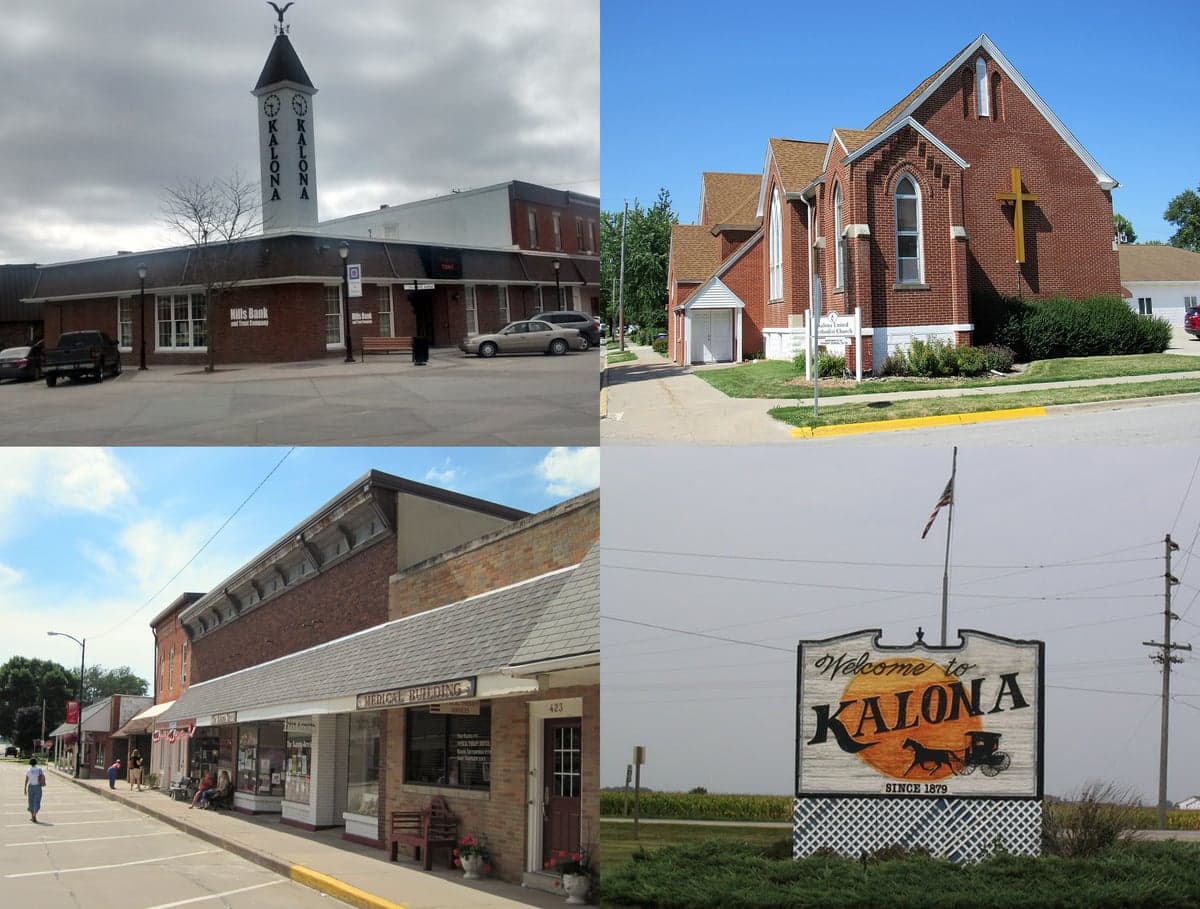
Photo: Wikipedia
Personal Sovereignty in Kalona, IA
Viable for self-reliance. Generally workable, though some barriers may limit total independence.
What does Personal Sovereignty tell us?
Personal Sovereignty measures your capacity for self-reliance and independence with minimal government friction. Higher scores mean fewer barriers between you and the way you want to live... but it assumes you have the space you need and good neighbors.
What does this tell us?
Personal Sovereignty measures your capacity for self-reliance and independence with minimal government friction. Higher scores mean fewer barriers between you and the way you want to live... but it assumes you have the space you need and good neighbors.
State Policy
Energy independence: Importer (50% of energy produced in-state)
Personal Liberty
Homesteading

Personal Liberty Analysis
Kalona, Iowa, offers a personal sovereignty environment that is among the strongest in the Midwest, driven by a state-level commitment to low taxation, expansive gun rights, and minimal zoning interference in rural areas. For individuals and families who prioritize autonomy—whether in financial decisions, self-defense, or lifestyle choices—Kalona provides a legal and regulatory framework that consistently favors individual discretion over government oversight. The town’s Amish and Mennonite heritage reinforces a culture of self-reliance, but the legal protections apply equally to all residents, making it a practical choice for those seeking maximum personal freedom within a stable, low-crime community.
Tax burden and regulatory posture: How Iowa’s flat tax and limited local rules affect your finances
Iowa’s tax and regulatory environment is among the most favorable in the nation for individuals seeking to keep more of their earnings and operate with minimal bureaucratic friction. As of 2026, the state has a flat individual income tax rate of 3.8%, down from a top rate of nearly 9% just a few years prior, with a scheduled phase-down to 3.5% by 2027. There is no state tax on Social Security benefits, and retirement income from pensions, 401(k)s, and IRAs is fully exempt for most taxpayers. Property taxes in Washington County, where Kalona is located, are moderate: the effective rate on residential property is roughly 1.2% of assessed value, slightly below the state average. Kalona itself has no city income tax, and its municipal code is notably lean—there are no local business license requirements for most home-based enterprises, and zoning regulations are minimal outside the town’s small historic core. The state’s regulatory posture is similarly light: Iowa is a right-to-work state, has no state-level minimum wage above the federal $7.25, and imposes no additional environmental or land-use restrictions beyond basic health and safety codes. For a family or individual, this means lower overhead, simpler tax filing, and fewer government touchpoints in daily economic life.
Self-defense and gun law specifics: What Kalona residents can legally do to protect themselves
Iowa is a constitutional carry state, meaning that as of July 2021, any legal resident 21 or older may carry a concealed firearm without a permit. Kalona residents face no additional local restrictions beyond state law—the town has no city-level gun ordinances, no waiting periods, and no magazine capacity limits. The state also has a strong Stand Your Ground law, codified in Iowa Code §704.1, which removes any duty to retreat before using deadly force if a person is lawfully present and reasonably believes force is necessary to prevent death or great bodily harm. Background checks are required only for commercial firearm sales; private transfers between individuals are unregulated. For those who want a permit for reciprocity while traveling, Iowa issues a non-expiring professional permit after a simple background check and a short safety course. The legal environment is unequivocally pro-self-defense: there are no red flag laws, no firearm storage mandates, and no restrictions on the types of firearms or accessories an individual may own. For a family moving to Kalona, the practical result is that self-defense decisions are left almost entirely to personal judgment, with the law providing broad protection for those who act in reasonable self-defense.
Self-reliance and homesteading viability: Lot sizes, zoning, and off-grid feasibility in Kalona
Kalona’s rural character and permissive land-use policies make it one of the more viable locations in Iowa for homesteading and off-grid living. Within the city limits, residential lots typically range from 0.25 to 1 acre, with many newer subdivisions offering half-acre or larger parcels. Outside town, in unincorporated Washington County, zoning is extremely light: there are no minimum lot size requirements for agricultural or rural residential use, and many properties are sold in 5- to 40-acre tracts. The county does not enforce building codes for owner-occupied single-family homes, though a basic electrical permit is required for grid connections. Off-grid feasibility is high: Iowa law does not prohibit rainwater collection, composting toilets, or solar panel installation, and the county has no ordinance against living in a tiny home, yurt, or RV on your own land as a primary residence. The local utility, Kalona Cooperative Technology Company, allows net metering for solar, and many residents already use private wells and septic systems. The Amish community in the area demonstrates that a fully off-grid, horse-and-buggy lifestyle is legally and socially accepted. For a modern homesteader, the main practical constraints are the need to meet state-level well water testing requirements and to obtain a septic permit from the county health department—both straightforward, one-time processes. The regulatory burden is light enough that a family could move onto raw land, install a solar array and a composting toilet, and live without municipal utilities or building inspections, all within the law.
Personal liberties: Parental rights, medical autonomy, speech, and property protections
Iowa has enacted several laws that strengthen personal liberties in areas of particular concern to conservative-leaning families. Parental rights are explicitly protected under Iowa Code §280.17, which requires schools to obtain parental consent before administering any health care service or mental health screening, and prohibits instruction on gender identity or sexual orientation in grades K-6. The state also has a Parents’ Bill of Rights, enacted in 2023, that guarantees parents access to all educational and medical records and the right to opt their children out of any curriculum or activity. Medical autonomy is similarly broad: Iowa has no state vaccine mandate for adults or children, and no requirement for employers or schools to mandate COVID-19 or other vaccines. The state does not have a prescription drug monitoring program that restricts patient access, and there are no laws prohibiting the purchase of raw milk, homeopathic remedies, or dietary supplements. Free speech protections are robust—Iowa has no hate speech laws that criminalize expression, and public universities are prohibited from requiring diversity statements or ideological pledges. Property rights are strongly protected by Iowa’s eminent domain laws, which require a public hearing and full market-value compensation for any taking, and the state has no statewide rent control or landlord licensing schemes. For a family moving to Kalona, these protections mean that decisions about children’s education, medical care, and personal expression are largely left to the individual, with the state acting as a backstop rather than a regulator.
Overall, Kalona ranks among the most sovereignty-friendly small towns in the Midwest, comparable to rural communities in South Dakota or Texas but with lower property taxes and a more established community infrastructure. The combination of a flat income tax, constitutional carry, minimal zoning, and strong parental and property rights creates an environment where personal autonomy is the default rather than the exception. For a family or individual who values independence and is willing to take on the responsibilities that come with it—maintaining a septic system, filing your own taxes, securing your own home—Kalona offers a legal and cultural framework that supports self-reliance without unnecessary interference. It is not a libertarian utopia; there are still state-level regulations on vehicle emissions, hunting licenses, and business sales tax collection. But for someone looking to maximize personal freedom within a functional, low-crime, community-oriented setting, Kalona is a strong candidate that delivers on the core promises of low taxes, broad self-defense rights, and genuine homesteading feasibility.

* Values derived from national, state, county, city and local statistics and may differ in a specific area. Last updated: 2026-10-17T20:43:27.000Z
Narrative content on this page is AI-generated and may contain mistakes. Verify any details that matter before acting on them.
ReloMaps may earn a commission from affiliate links at no extra cost to you.

