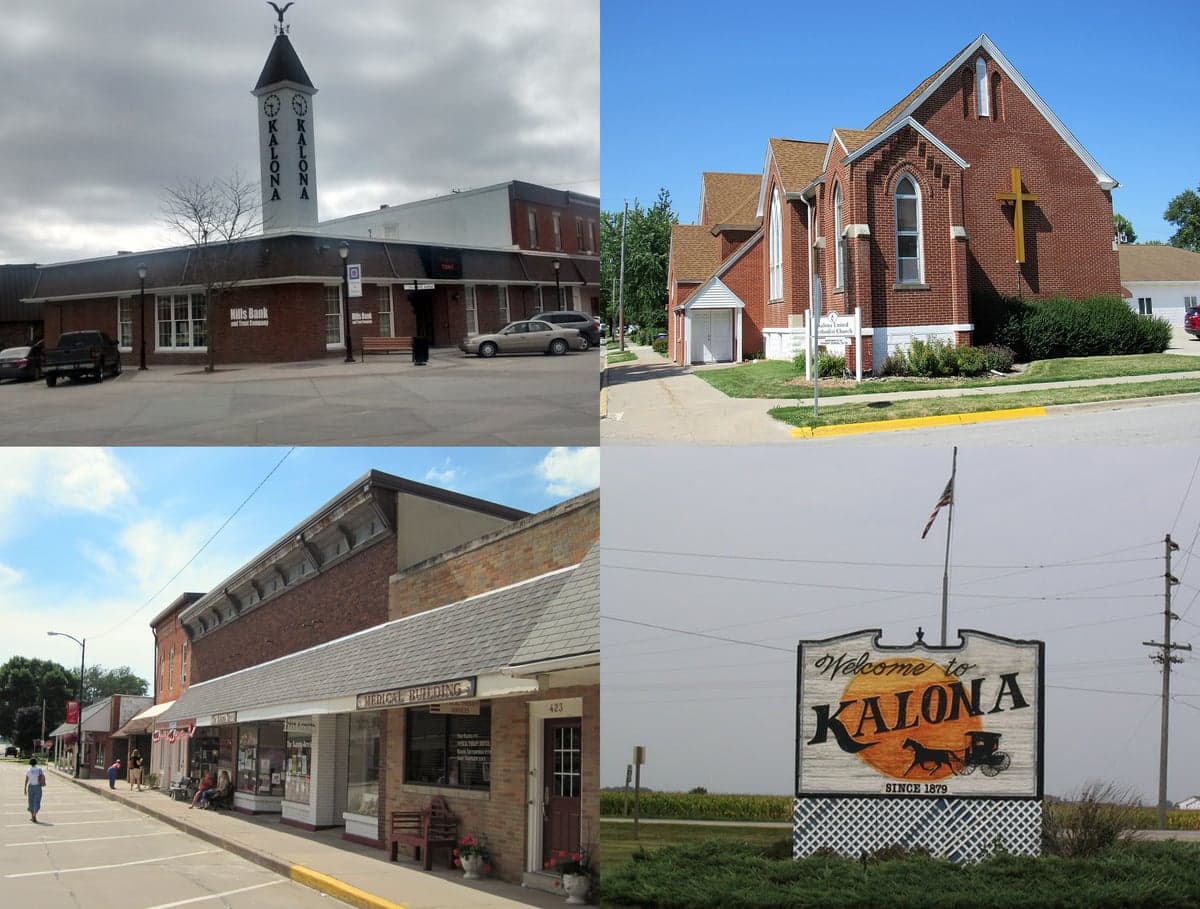
Photo: Wikipedia
Demographics of Kalona, IA
Affluence Level in Kalona, IA
A middle-class area roughly in line with national averages across income, home values, education, and employment.
People of Kalona, IA
The people of Kalona, Iowa, today number 2,679 and form a remarkably stable, tight-knit community defined by its deep Amish and Mennonite roots and a predominantly white, family-oriented character. With 91.2% of residents identifying as white and a foreign-born population of just 2.0%, the city retains a strong sense of cultural continuity, while a small but growing Hispanic community (4.7%) represents the most notable demographic shift. The population is concentrated in historic residential pockets like the central downtown grid and newer subdivisions such as Kalona Meadows, with the surrounding countryside dotted by traditional Amish homesteads. This is a place where generational ties run deep, and newcomers are often drawn by the area’s low crime, strong schools, and conservative social values.
How the city was settled and grew
Kalona’s settlement story begins in the 1840s, when the first white settlers—primarily of German and Swiss descent—arrived to farm the rich, rolling prairie of Washington County. The town itself was platted in 1879 along the Burlington, Cedar Rapids & Northern Railway, which turned a scattered farming community into a commercial hub. The defining population wave came in the 1910s and 1920s, when Old Order Amish and conservative Mennonite families migrated from Pennsylvania and Ohio, seeking affordable land and religious freedom. They established the Kalona Amish Settlement, now one of the largest Amish communities west of the Mississippi, and built their homes and churches in the rural areas immediately north and east of town, particularly along 550th Street SW and 540th Street SW. Within the city limits, the Downtown Historic District—centered on B Avenue and 5th Street—was built by German and Swiss merchants who catered to both the Amish and English-speaking farmers. By 1950, Kalona’s population hovered around 1,000, and the community was almost entirely white, with a strong agricultural and religious identity.
Modern era (post-1965)
After the 1965 Immigration and Nationality Act, Kalona saw virtually no influx of new immigrant groups from Asia or the Indian subcontinent—the city’s Asian population today is just 0.3%, and its Indian-subcontinent population is 0.0%. Instead, the modern era has been defined by domestic in-migration from other parts of Iowa and the Midwest, driven by the expansion of local manufacturing and the appeal of small-town life. The Kalona Meadows subdivision, developed in the 1990s and 2000s off Highway 1, absorbed many of these new residents—mostly white families from nearby Iowa City and Cedar Rapids seeking lower taxes and more space. The Hispanic population, now 4.7%, began growing in the 2000s, largely through workers employed at local food-processing plants and farms. These families have concentrated in rental housing along 5th Street and in the South Kalona area near the industrial park, though they remain a small minority. The Amish and Mennonite populations have remained stable, with younger generations often building new homes on family farms in the 540th Street SW corridor rather than moving into town. The city’s college-educated share (31.0%) is modest by state standards, reflecting a workforce rooted in agriculture, manufacturing, and trades rather than white-collar professions.
The future
Kalona’s population is projected to remain stable or grow slowly, with the most significant change being a gradual increase in Hispanic residents as the broader Midwest’s agricultural and processing sectors continue to attract Latino labor. The white population share (91.2%) will likely edge downward, but not dramatically, as the Amish and Mennonite communities maintain high birth rates and strong cultural retention. New development is expected to concentrate in the Kalona Meadows and North Kalona areas, where single-family homes on larger lots appeal to families priced out of the Iowa City metro. The city’s cultural identity will remain rooted in its Amish and Mennonite heritage—the weekly Kalona Quilt Show and the Kalona Fall Festival continue to draw thousands—but the growing Hispanic presence may introduce new small businesses and a modestly more diverse social fabric. No significant influx of Asian, Indian, or Black residents is anticipated given the area’s limited economic draw for those groups.
For someone moving in now, Kalona offers a stable, safe, and culturally conservative environment where community ties are strong and change comes slowly. The population is overwhelmingly white and locally rooted, with a small but growing Hispanic minority and virtually no other racial or ethnic diversity. New residents will find a place where traditional values, agricultural rhythms, and religious community still define daily life, and where the biggest demographic story is not rapid change but steady continuity.

* Values derived from national, state, county, city and local statistics and may differ in a specific area. Last updated: 2026-10-17T20:43:27.000Z
Narrative content on this page is AI-generated and may contain mistakes. Verify any details that matter before acting on them.
ReloMaps may earn a commission from affiliate links at no extra cost to you.

