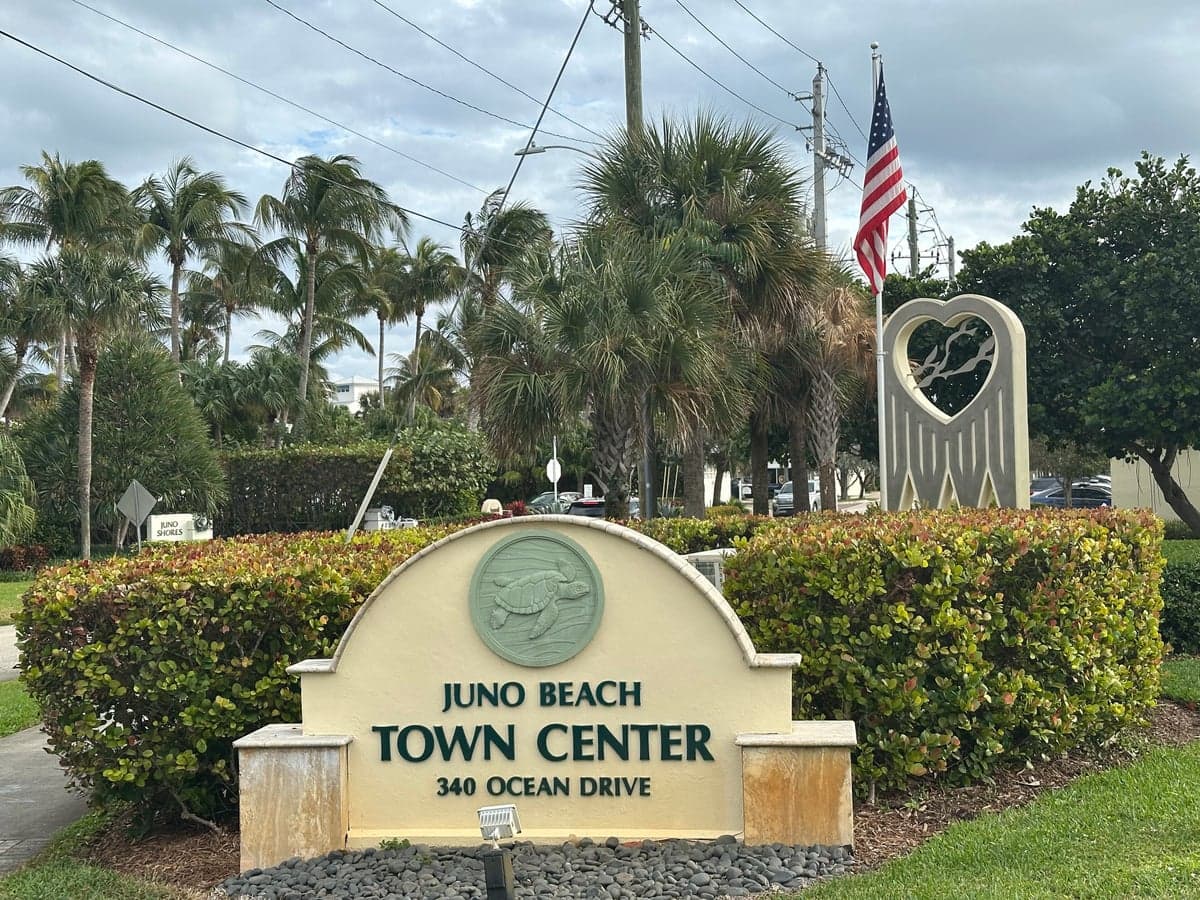
Photo: Wikipedia
Demographics of Juno Beach, FL
Affluence Level in Juno Beach, FL
An upper-middle-class area. Household wealth, education levels, and homeownership run ahead of national benchmarks.
People of Juno Beach, FL
Juno Beach, Florida, is a small, tightly-knit coastal community of 3,835 residents that remains overwhelmingly white (90.5%) and highly educated (57.4% hold a college degree). The city’s population is notably older and more affluent than the national average, with a very low foreign-born share of just 1.6% and a modest Hispanic presence at 6.5%. Its character is defined by quiet beachside living, golf-course neighborhoods, and a strong sense of local identity rooted in its mid-20th-century founding as a planned resort community.
How the city was settled and grew
Unlike many Florida towns with deep 19th-century roots, Juno Beach was essentially a 20th-century creation. The area was originally part of a larger tract owned by the Singer family (of sewing machine fame) and was developed as a resort destination in the 1920s. The first permanent residents were primarily white, middle-to-upper-class families from the Northeast and Midwest, drawn by the promise of oceanfront property and a newly built railroad connection. The Juno Beach Historic District, centered around Ocean Drive and Donald Ross Road, contains many of the original 1920s bungalows and cottages built by these early settlers. A second wave arrived after World War II, when returning veterans and their families sought affordable coastal homes. This group largely settled in the Juno Isles neighborhood, a mid-century subdivision of ranch-style homes built on the western side of US-1. The city was officially incorporated in 1953, and its population remained small and almost entirely white through the 1960s, shaped by the resort and seasonal tourism economy.
Modern era (post-1965)
The post-1965 era brought little demographic change to Juno Beach compared to larger Florida cities. The city did not experience the large-scale immigration waves that transformed nearby Palm Beach Gardens or West Palm Beach. Instead, domestic in-migration continued, with retirees and second-home buyers from the Northeast and Midwest forming the bulk of new residents. The Juno Beach Club neighborhood, a gated community built around a golf course and private beach club, became a magnet for affluent older buyers in the 1980s and 1990s. The Ocean Trail condominium complex, a high-rise development along A1A, attracted seasonal residents and empty-nesters. The city’s Black population remains negligible at 0.7%, and East/Southeast Asian residents make up just 0.8%, with Indian-subcontinent residents at 0.3%. The Hispanic share (6.5%) is slightly higher than the state average for similarly sized coastal towns but is concentrated in service-industry households, many of whom live in the Juno Beach Gardens area near the intersection of Donald Ross Road and US-1. The city’s overall character has remained stable: older, white, and affluent, with little of the ethnic diversity seen in neighboring municipalities.
The future
Juno Beach’s population is projected to remain small and demographically stable over the next 10–20 years. The city has very little undeveloped land, and zoning restrictions limit new construction to infill and redevelopment. The Juno Beach Town Center area, a mixed-use district planned around the new city hall and library, may attract a slightly younger demographic, but the high cost of housing (median home values exceed $600,000) will continue to filter for affluent buyers. The foreign-born share is unlikely to rise significantly, as the city lacks the rental stock and employment base that draw immigrant populations. The Hispanic share may grow modestly as service workers from nearby communities move into older, smaller homes in the Juno Beach Gardens area, but the overall racial and ethnic composition will remain overwhelmingly white. The city’s cultural identity will likely stay rooted in its beach-and-golf lifestyle, with seasonal residents and retirees continuing to dominate the social fabric.
For someone moving to Juno Beach today, the city offers a stable, predictable, and homogeneous environment with excellent schools and low crime. It is not a place of rapid demographic change or cultural diversity, but rather a well-established, affluent enclave where the population is aging in place. New residents should expect a quiet, orderly community where most neighbors are white, college-educated, and financially comfortable, and where the pace of life is dictated by the tides and the golf season rather than by rapid urban growth.

* Values derived from national, state, county, city and local statistics and may differ in a specific area. Last updated: 2026-11-23T03:09:20.000Z
Narrative content on this page is AI-generated and may contain mistakes. Verify any details that matter before acting on them.
ReloMaps may earn a commission from affiliate links at no extra cost to you.

