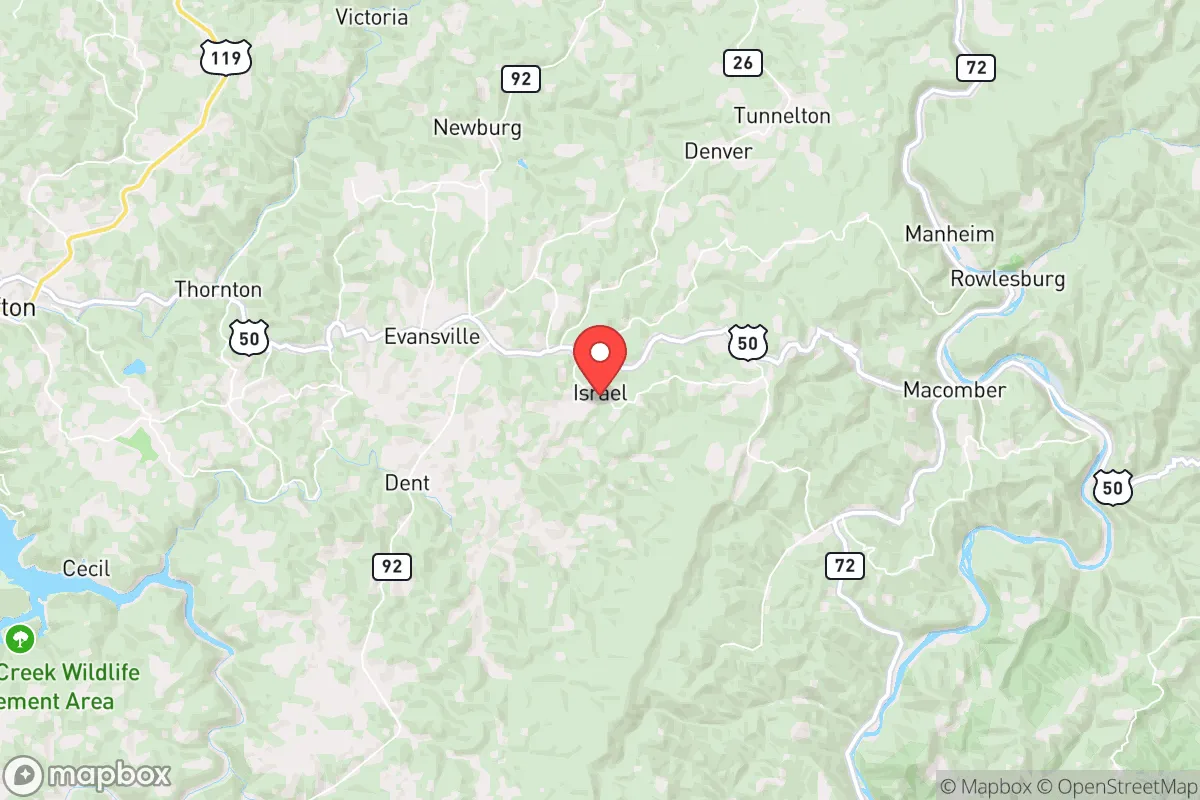
Political ClimatePolitical Climate in Israel, WV
District shown is the primary district for this city’s centroid. Cities may span multiple districts.
Local Political AnalysisPolitical Analysis of Israel, WV
Israel, West Virginia, sits in the heart of Braxton County, and politically speaking, it’s about as deep red as it gets. With a Cook Partisan Voting Index (PVI) of R+20, this is a place where Republican candidates routinely win by landslides, and the local political conversation is dominated by conservative values, coal-country economics, and a deep skepticism of federal overreach. The trajectory here isn’t shifting toward the center; if anything, the area has been solidifying its Republican identity over the last decade, mirroring the broader realignment of rural Appalachia.
How it compares
To understand Israel, you have to look at the surrounding state of West Virginia as a whole, which has become one of the most reliably Republican states in the nation. While the state’s exact Cook PVI isn’t officially published, the practical reality is that West Virginia voted for Donald Trump by roughly 39 points in 2020 and by a similar margin in 2024, making it effectively R+30 or higher in practice. That means Israel, at R+20, is actually *slightly less* Republican than the state average — a nuance that surprises people. The difference comes down to local dynamics: Braxton County has a few small pockets of union-affiliated Democrats and a scattering of independent-minded voters in the hollers who still vote their family history. Compare that to nearby towns like Sutton, the county seat, which leans even harder Republican, or head north to Buckhannon in Upshur County, where the presence of West Virginia Wesleyan College brings a small but visible liberal enclave that you simply won’t find in Israel. The contrast is stark: drive 30 minutes to Buckhannon and you’ll see a few Harris-Walz yard signs during election season; in Israel, you’d be hard-pressed to find a single one.
What this means for residents
For conservative residents, living in Israel means your worldview is the default. Local government, county commission meetings, and even the school board tend to operate with a shared set of assumptions about limited government, gun rights, and energy independence. There’s a practical benefit to this: conservative residents rarely feel the need to organize or advocate because their representatives already align with their views. For liberal residents, the reality is more isolating. You’re not going to find a Democratic Party committee meeting in Israel, and the closest active progressive groups are in Buckhannon or, further out, in Morgantown — a solid two-hour drive. That said, the political climate here isn’t hostile in a personal sense. In a community this small, people know each other by name, and political disagreements rarely break friendships. The bigger practical issue for liberals is that their vote simply doesn’t carry weight in local primaries, where the Republican nomination is effectively the general election.
What daily life is like for families
Daily life in Israel is shaped more by economics than by partisan politics. The area has been hit hard by the decline of coal and natural gas extraction, and the biggest local debates aren’t about national culture wars — they’re about school funding, road maintenance, and whether a new Dollar General will bring jobs or just undercut the local hardware store. Families here tend to be more pragmatic than ideological. A parent might vote straight-ticket Republican but still support the local teachers’ union when it comes to school levies. The political climate does influence daily life in one notable way: there’s a strong culture of self-reliance. Neighbors help each other with hay baling, snow removal, and deer processing without any government involvement, and that ethos is both a cultural trait and a political statement.
Looking ahead, the near-term future for Israel’s politics is stable — expect R+20 to hold or even edge slightly redder as younger residents who leave for college in Charleston or Morgantown often return with the same conservative values they grew up with. The long-term wildcard is demographic: the county is aging, and if new residents move in from out of state seeking cheap land and mountain views, they could bring a slightly more moderate, libertarian streak that might soften the hard-right edge. But for now, Israel remains a place where the political conversation is local, personal, and overwhelmingly Republican — a quiet, consistent corner of a very red state.

State Political ClimatePolitical Climate in West Virginia
State Political AnalysisPolitical Environment in the State
West Virginia is now one of the most reliably Republican states in the nation, a dramatic reversal from its 20th-century identity as a Democratic stronghold. The state voted for Donald Trump by nearly 39 points in 2024, and the GOP holds every statewide office and a supermajority in the legislature. This shift took about 15 years to fully consolidate, driven by cultural realignment on coal, guns, and social issues rather than a sudden economic transformation.
Urban vs. rural divide
The political map is less about urban versus rural and more about a few specific pockets of resistance in an otherwise deep-red sea. Charleston, the capital and largest metro, is the only significant blue anchor, with Kanawha County voting Democratic in recent gubernatorial races even as it backed Trump for president. Morgantown, home to West Virginia University, is the other notable liberal outpost — Monongalia County has trended Democratic in presidential elections, driven by faculty, students, and younger professionals. Huntington and Cabell County are more competitive, swinging between parties depending on the candidate, while the southern coalfields — places like Beckley, Bluefield, and Logan — have flipped hardest from ancestral Democrat to hard-core Republican. The eastern panhandle, including Martinsburg and Charles Town, is the fastest-growing region and leans Republican but with a noticeable influx of D.C. commuters who bring more moderate suburban views. The rural north-central and western counties, like Parkersburg and Clarksburg, are uniformly deep red, with margins often exceeding 70 percent for GOP candidates.
Policy environment
West Virginia's policy posture is aggressively conservative on fiscal matters but retains some populist quirks. The state has no income tax on Social Security benefits, and the legislature has been phasing down the personal income tax — a 2023 law cut rates by 21.25 percent across the board, with a path toward eventual elimination. Property taxes are among the lowest in the country, and there is no estate tax. The regulatory climate is business-friendly, particularly for energy, manufacturing, and natural resources, though the state's infrastructure and workforce participation remain weak points. Education policy has shifted sharply toward school choice, with the Hope Scholarship program providing state funds for private or homeschool expenses. Healthcare is a mixed bag: the state expanded Medicaid under the Affordable Care Act, and Charleston remains a regional medical hub, but rural hospital closures have been a persistent problem. Election laws are moderately restrictive — voter ID is required, early voting is available for 10 days, and no-excuse absentee voting is permitted. The state has not enacted the kind of sweeping voting restrictions seen in Texas or Georgia, but it has tightened ballot security measures in recent sessions.
Recent policy direction
The last five years have produced a clear legislative agenda that a relocator should understand. On guns, West Virginia is a constitutional carry state — no permit is needed to carry a concealed firearm — and the legislature passed a 2024 law prohibiting state enforcement of federal firearm regulations that conflict with state law. On education and parental rights, the state passed the Parental Bill of Rights in 2021, requiring schools to notify parents of curriculum changes and prohibiting instruction on gender identity in grades K-6. The Hope Scholarship program, expanded in 2023, now covers nearly all students and has become one of the most generous school choice programs in the country. On medical and bodily autonomy, the state passed a near-total abortion ban in 2022 with limited exceptions, and there is no ballot initiative process for voters to challenge it directly. Property rights are strongly protected, with a 2023 law limiting eminent domain for private development. On privacy and surveillance, the state has been quiet — no major facial recognition bans or data privacy laws — but it did pass a 2023 law restricting Chinese-owned apps like TikTok on government devices. Voting access has been modestly tightened, with a 2021 law requiring post-election audits and stricter voter roll maintenance.
Civil unrest & political movements
West Virginia is not a hotbed of street-level protest, but it has a distinctive political culture shaped by labor history and populist grievance. The 2018 statewide teacher strike — which shut down every public school for nine days — was the most significant mass mobilization in recent memory, drawing support from both parties and forcing a 5 percent pay raise. The state has seen periodic protests around the opioid epidemic, particularly in Huntington, which became a national symbol of the crisis. On the right, the coal industry's decline has fueled a strong anti-federal sentiment, with local movements opposing EPA regulations and the Green New Deal. There is a small but vocal Second Amendment sanctuary movement, with dozens of counties passing resolutions declaring they will not enforce certain federal gun laws. Immigration politics are largely symbolic — the state has a tiny foreign-born population — but the legislature passed a 2024 law requiring local law enforcement to cooperate with federal immigration authorities. Election integrity controversies have been minimal compared to other states; the 2020 and 2022 elections were administered without major disputes, and the secretary of state's office has emphasized voter roll accuracy rather than fraud allegations. The most visible flashpoint a new resident would notice is the tension between the state's proud labor union history and its current Republican governance — the United Mine Workers still holds significant cultural weight, even as its political influence has waned.
Projection
Over the next decade, West Virginia's political trajectory is likely to remain deeply Republican, but the character of that Republicanism may shift. The eastern panhandle's growth — driven by remote workers and D.C. exiles — is bringing a more suburban, education-focused GOP style to a state that has been dominated by rural, coal-country conservatism. The income tax phase-down, if completed, would make the state more attractive to retirees and remote workers, potentially accelerating in-migration from blue states. However, the state's population is aging and shrinking overall, which could intensify the rural-urban political gap. The Democratic Party is unlikely to recover statewide in the near term, but it could consolidate its strength in Charleston, Morgantown, and parts of the eastern panhandle, creating a more defined urban-rural split similar to neighboring Virginia. The abortion ban and school choice expansion are likely to remain settled law, but both could become flashpoints if in-migration brings more moderate voters. A new resident moving in now should expect a state that is firmly conservative on social and fiscal issues, with a growing emphasis on attracting outsiders through tax policy and deregulation — but also a state where the old labor-populist strain still runs deep beneath the surface.
For a conservative relocator, West Virginia offers a genuinely friendly political environment: low taxes, strong gun rights, school choice, and a culture that values self-reliance and local control. For a liberal relocator, the state is politically challenging, but not hostile — the small blue pockets in Charleston and Morgantown provide community, and the state's low cost of living and natural beauty are undeniable draws. The practical takeaway is that West Virginia is a place where politics is less about daily friction and more about the overall direction of state policy. If you want a state that is moving decisively toward limited government and cultural conservatism, this is it. If you want a state with robust progressive institutions and urban amenities, you will need to look elsewhere — or be prepared to build those things yourself.
* Values derived from national, state, county, city and local statistics and may differ in a specific area. Last updated: 2026-11-01T22:20:54.000Z
Narrative content on this page is AI-generated and may contain mistakes. Verify any details that matter before acting on them.
ReloMaps may earn a commission from affiliate links at no extra cost to you.

