Demographics of Israel, WV
Affluence Level in Israel, WV
A low-income area with significant economic hardship. Household wealth and educational attainment are well below national averages.
People of Israel, WV
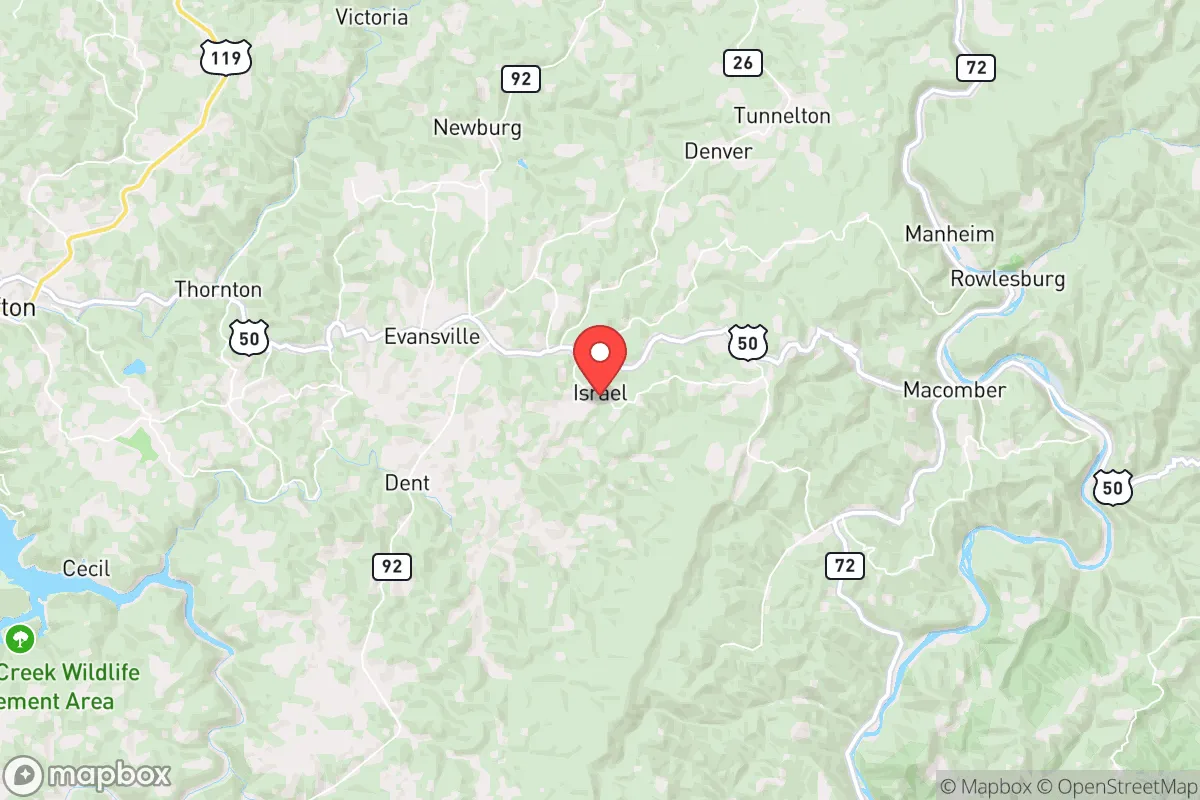
The people of Israel, West Virginia, today form a remarkably homogeneous community of 2,414 residents, where 97.4% identify as White and the foreign-born population stands at 0.0%. This small, tight-knit town in western Greenbrier County is characterized by its rural Appalachian identity, low population density, and a strong sense of local heritage rooted in coal mining and railroad work. With only 15.8% of adults holding a college degree, the population skews toward blue-collar employment and family-centric living, creating a community where multigenerational ties run deep and newcomers are often drawn by affordable land and a slower pace of life.
How the city was settled and grew
Israel, WV, was founded in the late 19th century as a railroad and coal mining settlement along the Greenbrier River. The town’s original population consisted almost entirely of Anglo-American families from the surrounding Appalachian region, many of whom moved from nearby counties like Monroe and Summers to work in the booming coal camps and on the Chesapeake & Ohio Railway. The earliest residents clustered in what is now known as Old Town Israel, a historic district along the river where company-built houses and the original general store still stand. By the 1910s, a second wave of settlers—primarily Scots-Irish and English-descended farmers—established homesteads in the Hillside Addition, a neighborhood that grew up along the ridge above the rail line. The town’s growth peaked in the 1920s when the local mines employed over 400 men, but the Great Depression and subsequent mechanization of mining caused a steady population decline that continued through the mid-20th century. No significant immigrant groups settled in Israel during this period; the population remained overwhelmingly native-born White, with a small number of Black families (0.5% today) arriving briefly during the coal boom but largely departing after the mines closed.
Modern era (post-1965)
After the 1965 Hart-Cellar Act, Israel saw no measurable increase in foreign-born or non-White populations—the foreign-born share remains 0.0% and the Hispanic share is 0.0%. Instead, the modern era has been defined by domestic out-migration as younger residents left for larger cities like Beckley and Charleston. The population dropped from roughly 3,200 in 1960 to 2,414 today. The few new residents who have arrived since the 1990s are overwhelmingly White retirees and remote workers seeking cheap land, settling in the newer Riverbend Estates subdivision, a small development of single-family homes built on former farmland east of town. The historic Depot District, once the commercial heart of Israel, has seen most of its storefronts converted to residences or left vacant, reflecting the town’s economic stagnation. The Black population, which never exceeded 2% even during the coal era, has remained at 0.5% since 2000, concentrated in a handful of families in the South End neighborhood near the old mining tipple. No East/Southeast Asian, Indian, or Arab communities have ever been recorded in the town’s census data.
The future
Israel’s population is projected to continue a slow decline over the next 10–20 years, mirroring broader trends in rural West Virginia. The town’s demographic profile is unlikely to become more diverse: the 0.0% foreign-born and 0.0% Hispanic shares are expected to remain unchanged, as there are no local industries or institutions attracting immigrant populations. The White share may actually increase slightly as the small Black population ages and younger Black residents leave for more urban areas. New residential development is limited to scattered infill lots in Meadowview Acres, a small subdivision of modular homes built in the 2010s, but no large-scale housing projects are planned. The cultural identity of Israel is becoming more insular, with local churches and family networks dominating social life. For someone moving in now, the town offers extreme homogeneity, low housing costs (median home value around $85,000), and a community where nearly everyone shares a similar background—but also limited economic opportunity and a shrinking tax base that strains public services.
Israel, West Virginia, is becoming a quieter, older, and more uniformly White community—a place where the population is slowly contracting rather than diversifying. For a conservative-leaning family or individual seeking affordable land, low crime, and a deeply rooted Appalachian culture, it offers a stable, predictable environment. But those looking for demographic variety, a growing job market, or a vibrant social scene will find little to draw them here.

* Values derived from national, state, county, city and local statistics and may differ in a specific area. Last updated: 2026-11-01T22:20:54.000Z
Narrative content on this page is AI-generated and may contain mistakes. Verify any details that matter before acting on them.
ReloMaps may earn a commission from affiliate links at no extra cost to you.

